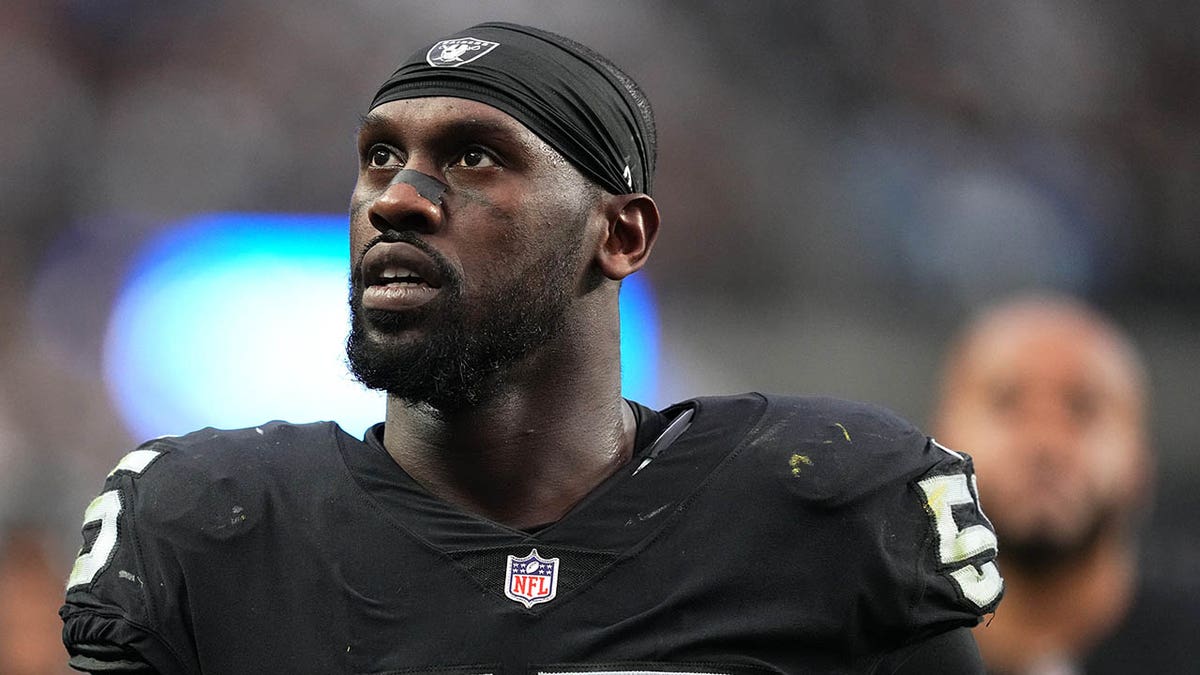
Former Las Vegas Raiders defensive end Chandler Jones was arrested on Tuesday for violating a domestic violence temporary protection order, per Clark County Detention Center records.
This marks the second time in one month that the embattled edge rusher has been taken into custody by police, both of which came in Las Vegas.
Jones, 33, was previously arrested on Sept. 28 on two charges of violating a domestic violence protective order.
Former Las Vegas Raiders defensive end Chandler Jones is accused of committing multiple violations of a protective order, according to police.(Las Vegas Metropolitan Police Department)
The protection order against Jones reportedly came from a Sept. 12 incident that occurred when he was allegedly “rambling incoherently” as he arrived at an unidentified woman’s home with a flashlight and without shoes on, per The Athletic.
The woman who has the protection order against Jones claims that she was a victim of domestic battery and Jones was the one who committed the wrongdoing. She was previously in a romantic relationship with him.
The Sept. 28 incident allegedly had Jones on the property of the woman, and later on in the day, she claims that he sent her videos of him burning items that appeared to have been taken from her home.
The Raiders released Jones shortly after his first arrest, which ended his time with the team just over one year after signing a three-year, $51 million contract. Jones had been at odds with the organization prior to his arrest, posting cryptic social media content that alleged the team was withholding his ability to access the facility.
Defensive end Chandler Jones of the Raiders walks off the field after the first half of a game against the Los Angeles Chargers at Allegiant Stadium on Dec. 4, 2022, in Las Vegas.(Chris Unger/Getty Images)
He also said prior to his Sept. 28 arrest that he had been taken to a hospital “against my will” by the Las Vegas Fire Department in September in a since-deleted post showing a handwritten journal entry.
Las Vegas released a statement one day after his arrest on Sept. 28.
“The Raiders are hopeful that Chandler Jones receives the care that he needs,” the statement read. “He, his family, and all those involved are in our thoughts. As this is now a legal matter, we will not be providing further comment.”
Head coach Josh McDaniels added: “We want the best for all of our players, former players, etc. So, that will never change. That part is going to be there now and forever for all the guys we’ve coached and got an opportunity to know and work with. So, just kind of take it as it comes here as we’re going through this, and we continue to try to do the best we can. Like I said, there’s not much we can do other than that.”
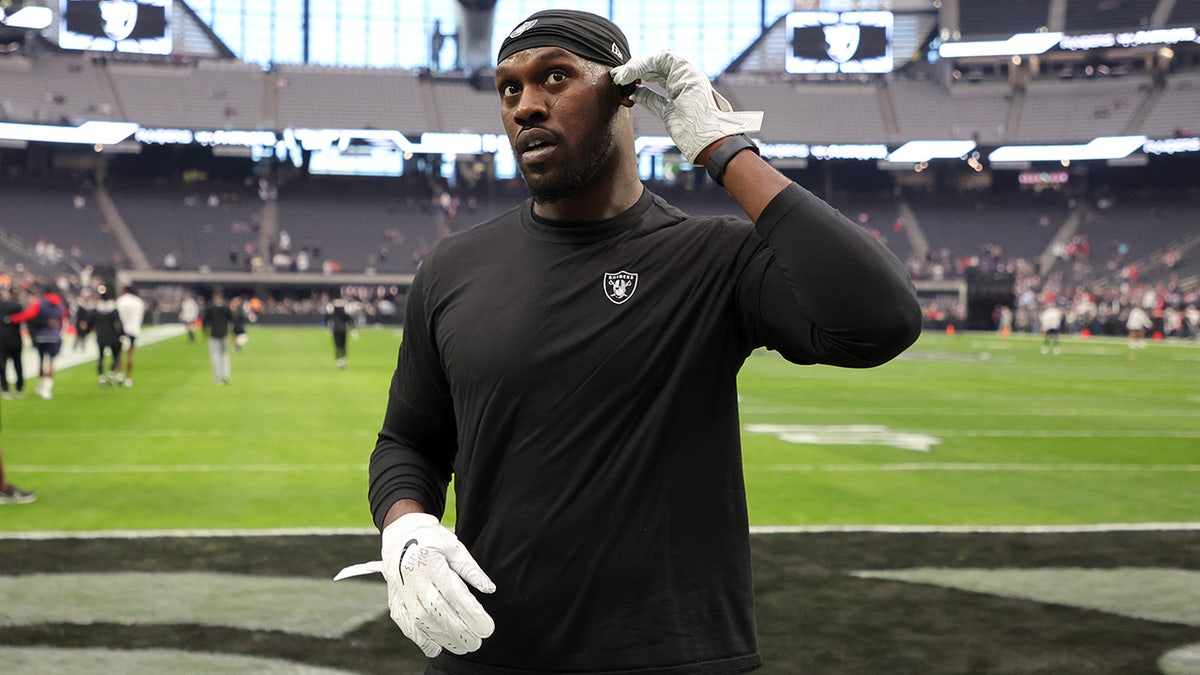
Chandler Jones of the Raiders talks to fans before a game against the New England Patriots at Allegiant Stadium on Dec. 18, 2022 in Las Vegas.(Ethan Miller/Getty Images)
Jones has not appeared in any Raiders games this season prior to his release. He finished last season with 4.5 sacks – second on the team – as well as 15 quarterback hits in 15 games.
Scott Thompson is a sports writer for Fox News Digital.
Voter fraud is, unfortunately, an all too real reality. It seems to be more rampant today than ever before, and maybe that is because of incidents like data breaches. It’s sort of an oxymoron – reverting to digital and paperless systems has made our lives much more convenient, yet, in turn, has also made us vulnerable to those who can hack their way through our digital fortresses.
How RansomedVC exploited DataNet to hit the DC Board of Elections
The District of Columbia Board of Elections (DCBOE) is the latest entity grappling with the fallout of compromised voter information. A cybercriminal group known as RansomedVC, which specializes in data extortion, targeted the DCBOE.
RansomedVC didn’t go straight for DCBOE’s own system, sidestepping what might be expected to be a heavily guarded front door in terms of cybersecurity. The group instead targeted DataNet, which is not the DCBOE itself, but a hosting provider responsible for managing the online platform and data of Washington, D.C.’s election authority.
Imagine DataNet as a kind of digital warehouse where DCBOE’s data is stored. The attackers didn’t break into DCBOE’s office, per se, but the warehouse where DCBOE’s information is stored.
While no internal DCBOE databases or servers were directly affected, this approach not only provided a path to the sensitive data but also brought to light the sometimes overlooked vulnerabilities that can exist when third-party vendors are involved in data management and storage.
RansomedVC claims 600,00 lines of U.S. voter data with proof of authenticity
RansomedVC claims to have its hands on 600,000 lines of U.S. voter data, specifically records from Washington, D.C., voters, as a result of the breach. They now claim they are selling this stolen information on the dark web, though the exact price remains a mystery.
As proof of authenticity, RansomedVC shared a single record containing the personal details of a Washington, D.C., voter. This dataset includes the individual’s name, registration ID, voter ID, partial Social Security number (SSN), driver’s license number, date of birth, phone number and email. While some voter registration data is public in Washington, D.C., confidential info like contact details and SSNs are off-limits according to election authorities.
Ransomware group gloats about their hacks and bold claims
RansomedVC seems to be enjoying its moment in the limelight following this cyber incident. This isn’t their first rodeo in the world of high-profile hacks, and their track record includes some bold, if not audacious, claims.
A notable instance from their past involves a claimed breach of Sony. RansomedVC asserted they had penetrated Sony’s defenses, walking away with over 260GB of files. A modest 2MB archive was released as supposed proof of their activities. The truth of this claim has remained somewhat enigmatic, with no third-party verifications able to completely affirm the authenticity of their statement. Sony has investigated the situation but has not confirmed or denied the breach publicly.
DCBOE and federal agencies effort to contain data breach
In the wake of the data breach, the DCBOE was quick to mobilize, launching an intensive investigation. They didn’t work alone on figuring out what happened; they got the FBI and the Department of Homeland Security to help out. Together, they started a big, thorough investigation to understand and manage the situation better.
When the DCBOE became aware of the cyber breach, they promptly took their website offline, displaying a maintenance page to the public. This wasn’t only about fixing issues; it was a strategic move to safeguard the ongoing investigation and shield any additional data from being compromised.
How to keep safe
Keeping safe online, especially when there are hackers around like RansomedVC, can be a bit tricky. The digital world can sometimes be like a big city where most people are friendly, but there are a few who might try to pick your pocket. Now, although hacks like this may be a bit out of our control, there are ways to keep your data safe and secure. Here how:
Have good antivirus software on all your devices: The best way to protect yourself from having your data breached is to have antivirus protection installed on all your devices. Having good antivirus software actively running on your devices will alert you of any malware in your system, warn you against clicking on any malicious links in phishing emails and ultimately protect you from being hacked. Get my picks for the best 2023 antivirus protection winners for your Windows, Mac, Android and iOS devices.
Use identity theft protection: Identity theft protection companies can monitor personal information like your home title, SSN, phone number and email address and alert you if it is being sold on the dark web, which RansomedVC claims to be doing. They can also assist you in freezing your bank and credit card accounts to prevent further unauthorized use by criminals. See my tips and best picks on how to protect yourself from identity theft.
Have strong passwords and use 2-factor authentication: Using the same password across multiple platforms will always make you more vulnerable because if one account gets hacked, they all get hacked. And 2-factor authentication is just an extra shield that will prevent a hacker from getting into your accounts. Make sure to use a password manager to keep track of all your passwords.
Free service to stay protected: If you’re concerned about your data on the dark web, head over to experian.com/darkweb. They offer a dark web scan to check if your information is on the dark web. It’s offered once for free, with no credit card information required. The scan looks back to 2006 and searches over 600,000 web pages for your SSN, email or phone number. If your information is compromised, Experian will let you know the next steps you should take.
The DCBOE’s experience with hackers like RansomedVC shows us how important it is to be safe online for our voting systems and individually as Americans. Hackers are getting smarter, targeting not just individuals but big organizations to get valuable data.
That’s concerning, especially when it’s stuff like our voting information. We need to make sure we’re doing everything possible to protect ourselves and be as resilient as possible against these threats, like using good antivirus software, being careful with our personal details and having very strong passwords.
How do you approach maintaining your digital safety, and are there particular strategies or experiences you’ve found valuable in safeguarding your online presence? Let us know by writing us at Cyberguy.com/Contact.
For more of my tech tips and security alerts, subscribe to my free CyberGuy Report Newsletter by heading toCyberguy.com/Newsletter.
Kurt “CyberGuy” Knutsson is an award-winning tech journalist who has a deep love of technology, gear and gadgets that make life better with his contributions for Fox News & FOX Business beginning mornings on “FOX & Friends.” Got a tech question? Get Kurt’s CyberGuy Newsletter, share your voice, a story idea or comment at CyberGuy.com.
Senator Elizabeth Warren was the lead author of a letter signed by 28 other senators and 76 members of the House of Representatives about the role of cryptocurrency in financing terrorism. Signers came from both parties and included one independent, although Democrats predominate.
The letter, dated Oct. 17, was addressed to Treasury Under Secretary for Terrorism and Financial Intelligence Brian Nelson and National Security Advisor Jake Sullivan. The authors cited a news article that claimed Hamas and the Palestinian Islamic Jihad raised over $130 million in crypto donations between August 2021 and June 2023, and very little of the donated money had been recovered. The letter said:
“That the deadly attack by Hamas on Israeli civilians comes as the group has become ‘one of the most sophisticated crypto users in the terror-finance domain’ clarifies the national security threat crypto poses to the U.S., and our allies.”
It continued: “As Congress considers legislative proposals designed to mitigate crypto money laundering and illicit finance risks, we urge you to swiftly and categorically act to meaningfully curtail illicit crypto activity.” It then posed nine questions to the addressees, asking about the information the administration of President Joe Biden has about the funders of terrorism, what is being done about the use of crypto to finance terrorism, and what other resources the administration needs.
Warren is one of the most prominent crypto opponents in the U.S. Congress. She introduced the Digital Asset Anti-Money Laundering Act in December and reintroduced it in the current Congress. The bill was picking up support before the beginning of the conflict between Israel and Hamas, but the current hostilities have clearly gained her allies.
“US Treasury sanctions Gaza-based crypto operator allegedly tied to Hamas. Find out how terrorist organizations used Buy Cash Money for fund transfers. Stay informed and read more on Cointelegraph: https://t.co/j1IhVDNU3o#DYOR @HRM69INU”
The letter has signatures from other active anti-crypto legislators, such as Roger Marshall and Sean Casten. Senate Banking Committee chair Sherrod Brown, who has called for crypto regulation but did not support Warren’s bill, also signed the letter. Crypto advocates, such as Cynthia Lummis, Kirsten Gillibrand and Patrick McHenry did not sign the letter, but many signers had no prior record on crypto. Signers Jake Auchincloss and Josh Gottheimer had previous pro-crypto voting records.
Nelson’s remarks on Hamas’ financing. Source: U.S. Treasury Department
The Treasury Department released Nelson’s remarks prepared for a Deloitte Anti-Money Laundering conference on Oct. 17. Nelson said Hamas was “uniquely resourced” and “possesses well-honed methods of surreptitiously accessing the formal financial system.” Nelson referred to secret financial portfolios, shell companies, fake philanthropies and racketeering. In addition:
“We are closely monitoring how Hamas and Palestinian Islamic Jihad (PIJ) use virtual assets to raise and move funds […] and Treasury will continue to establish transparency in the virtual asset ecosystem in order to combat illicit activity by criminals, rogue states, and terrorist financiers.”
In addition, the Treasury’s Office of Foreign Assets Control announced sanctions against a “Gaza-based virtual currency exchange and its operator,” along with a number of other Hamas collaborators on Oct. 18.
In what may be a first of its kind study, artificial intelligence (AI) firm Anthropic has developed a large language model (LLM) that’s been fine-tuned for value judgments by its user community.
What does it mean for AI development to be more democratic? To find out, we partnered with @collect_intel to use @usepolis to curate an AI constitution based on the opinions of ~1000 Americans. Then we trained a model against it using Constitutional AI. pic.twitter.com/ZKaXw5K9sU
Many public-facing LLMs have been developed with guardrails — encoded instructions dictating specific behavior — in place in an attempt to limit unwanted outputs. Anthropic’s Claude and OpenAI’s ChatGPT, for example, typically give users a canned safety response to output requests related to violent or controversial topics.
However, as innumerable pundits have pointed out, guardrails and other interventional techniques can serve to rob users of their agency. What’s considered acceptable isn’t always useful, and what’s considered useful isn’t always acceptable. And definitions for morality or value-based judgments can vary between cultures, populaces, and periods of time.
One possible remedy to this is to allow users to dictate value alignment for AI models. Anthropic’s “Collective Constitutional AI” experiment is a stab at this “messy challenge.”
Anthropic, in collaboration with Polis and Collective Intelligence Project, tapped 1,000 users across diverse demographics and asked them to answer a series of questions via polling.
The challenge centers around allowing users the agency to determine what’s appropriate without exposing them to inappropriate outputs. This involved soliciting user values and then implementing those ideas into a model that’s already been trained.
Anthropic uses a method called “Constitutional AI” to direct its efforts at tuning LLMs for safety and usefulness. Essentially, this involves giving the model a list of rules it must abide by and then training it to implement those rules throughout its process, much like a constitution serves as the core document for governance in many nations.
In the Collective Constitutional AI experiment, Anthropic attempted to integrate group-based feedback into the model’s constitution. The results, according to a blog post from Anthropic, appear to have been a scientific success in that it illuminated further challenges towards achieving the goal of allowing the users of an LLM product to determine their collective values.
One of the difficulties the team had to overcome was coming up with a novel method for the benchmarking process. As this experiment appears to be the first of its kind, and it relies on Anthropic’s Constitutional AI methodology, there isn’t an established test for comparing base models to those tuned with crowd-sourced values.
Ultimately, it appears as though the model that implemented data resulting from user polling feedback outperformed the base model “slightly” in the area of biased outputs.
Per the blog post:
“More than the resulting model, we’re excited about the process. We believe that this may be one of the first instances in which members of the public have, as a group, intentionally directed the behavior of a large language model. We hope that communities around the world will build on techniques like this to train culturally- and context-specific models that serve their needs.”
NFL Commissioner Roger Goodell’s contract was extended for three years, the league announced Wednesday.
“The Compensation Committee updated the full ownership today that an agreement has been reached to extend Commissioner Roger Goodell’s contract for three years, through March 2027,” the league said in a statement.
The exact compensation Goodell will receive is not known. Pro Football Talk speculated that he could earn around $60 million per year.
Commissioner Roger Goodell at the NFL Experience London at the Battersea Power Station on Oct. 7, 2023.(Kirby Lee-USA Today Sports)
The first inkling that Goodell was going to receive an extension came in March when the league’s compensation committee was expected to propose the extension to team owners for approval. Indianapolis Colts team owner Jim Irsay said in May the deal was “virtually done.”
With the NFL’s financial success, ESPN reported earlier this year that Goodell’s extension is expected to be incentive-laden but also the most lucrative deal a commissioner has gotten in any sport. It will also be his fourth extension since taking over as commissioner in 2006.
It was speculated that Goodell’s 2017 extension would be his final one, especially after the tumultuous process it went through. Dallas Cowboys owner Jerry Jones even threatened a lawsuit against the league, which eventually resulted in him being fined.
Commissioner Roger Goodell Tottenham attends the NFL international match at the Tottenham Hotspur Stadium, London, on Oct. 8, 2023.(Simon Marper/PA Images via Getty Images)
However, Goodell has kept the peace among owners and players after facilitating the league’s collective bargaining agreement, which was ratified in 2020 and goes through the 2023 season. That includes changes to the league’s revenue distribution, increases in player benefits and health, as well as safety improvements.
It also led the league to add an extra game to the regular season.
Goodell’s efforts also aided in the billions of dollars that were gained for media rights from FOX, CBS, NBC, ESPN, Amazon and now YouTube, which will have the league’s Sunday Ticket package for games.
Goodell’s tenure hasn’t all been smooth, though. Player safety remains a high concern for the league, particularly in the area of concussions. While the NFL was slow to acknowledge the effects of the game on current and former players, recent instances, including the situation with Miami Dolphins quarterback Tua Tagovailoa this past season, brought about more controversy within the sport regarding the proper steps taken when head injuries occur.
The lack of diversity among NFL head coaches, general managers and team presidents is something that Goodell has said is “unacceptable” but remains an issue.
ESPN added that this could be the final deal for the 64-year-old Goodell.
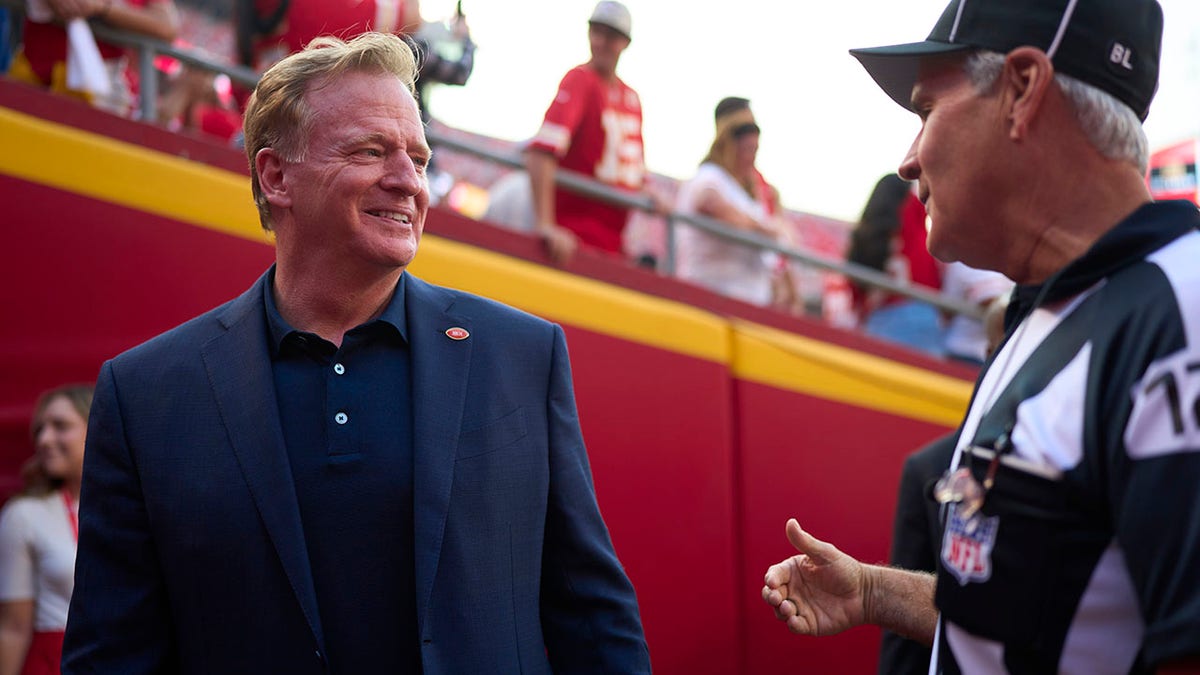
NFL commissioner Roger Goodell visits with referees before kickoff between the Kansas City Chiefs and the Detroit Lions at GEHA Field at Arrowhead Stadium on Sept. 7, 2023 in Kansas City, Missouri.(Cooper Neill/Getty Images)
The league could look into finding a potential replacement for Goodell, as his predecessor, Paul Tagliabue, was 65 when he passed the torch, and Pete Rozelle before him was 63 when he stepped down.
Fox News’ Scott Thompson contributed to this report.
Ryan Gaydos is a senior editor for Fox News Digital.
Travis and Jason Kelce talked about their father meeting Taylor Swift and the two being spotted during the Kansas City Chiefs and Denver Broncos game talking to each other in the suite.
Swift and Ed Kelce were at the game talking to each other. It appeared to be the first time the two were spotted on camera interacting in any way as Swift and Donna Kelce have been the two who have mostly been in the spotlight.
“Taylor talking to dad. You know dad, like I know dad,” Travis Kelce said on the latest episode of the “New Heights” podcast that dropped on Wednesday.
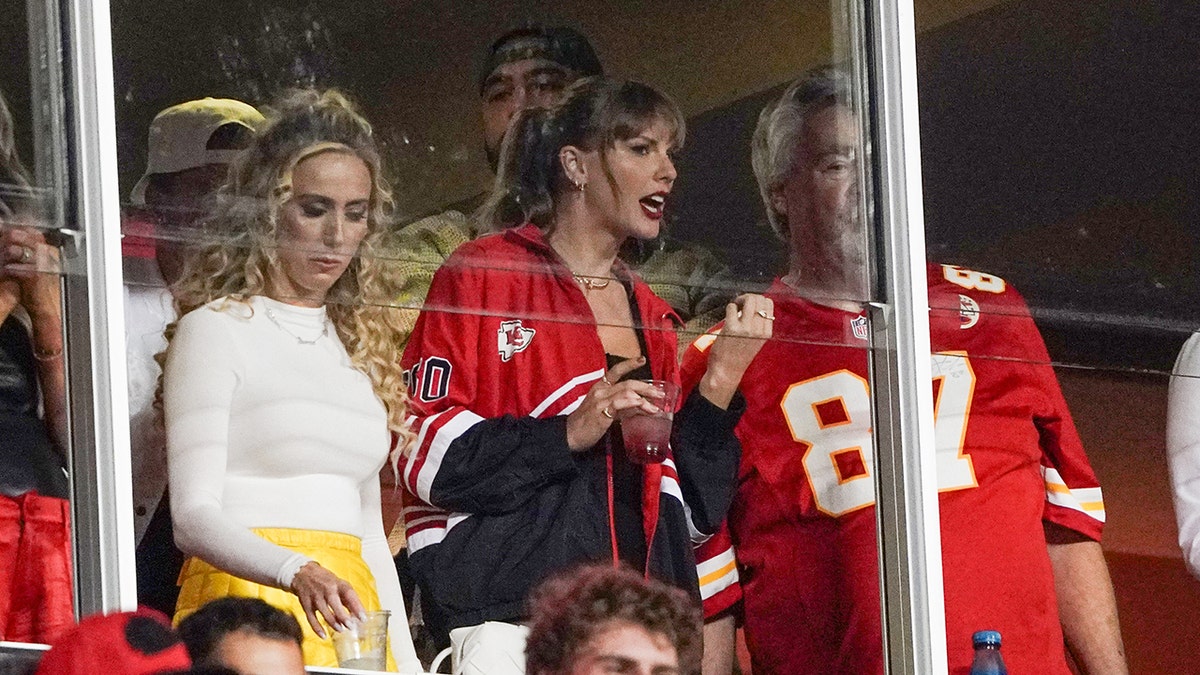
Taylor Swift laughs while talking to Ed Kelce during the Chiefs game at GEHA Field at Arrowhead Stadium in Kansas City, Missouri, on Oct. 12, 2023.(Denny Medley-USA Today Sports)
Jason Kelce responded that there was no way their dad should be talking to someone like Swift as they both laughed about the moment.
“This is a terrifying conversation. I felt terrible for Taylor for being in this,” Travis said.
Jason replied, “If you see dad talking to anybody and you can’t hear what’s happening, who knows where that conversation is going.”
Travis said he didn’t want to pick on their dad too much.
“We can’t keep kicking dad just because we enjoy doing it,” he said. “Our dad is the best f—ing dad in the world. He is a great converser or conversator (sic). However you wanna put it. It’s where Jason gets his storytelling, a lot of his charisma. We’re saying this because we like to rag on the big guy.”
Taylor Swift talks to Ed Kelce at GEHA Field at Arrowhead Stadium on Oct. 12, 2023.(Denny Medley-USA Today Sports)
Jason continued, “It was nice because mom has been getting quite a bit of the spotlight. It was cool to see dad up there on the TV for a little bit.”
Travis Kelce also responded to the notion he pushed one of Swift’s security guards out of the way. Swift fans appeared to love the idea that Kelce was taking charge to protect their queen, but the superstar tight end denied he was pushing anyone out of the way.
“Pushing them out of the way?… I didn’t push him. I placed my hand on the gentleman’s back to let him know I was behind him. If I pushed him, he probably would’ve turned to Taze me,” he said.
“’Good sir, could you excuse me, I need to get the door, sorry. Thank you. I’m right behind you. Don’t want to startle you. I know it’s your job to keep crazy people away and if you just get randomly pushed in the back while standing in front of a door, that could probably be a little alarming.’
“I didn’t one time get security to say anything about it. I’ll you what, they’re great. They’re good people.”
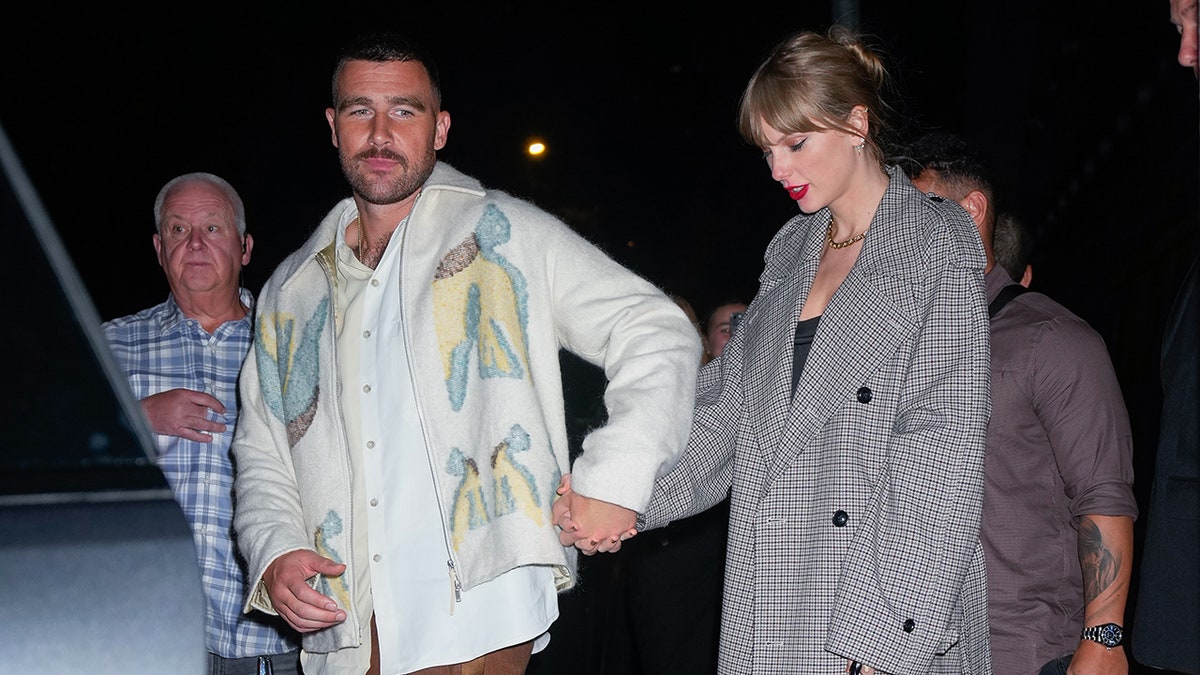
Taylor Swift is led by Travis Kelce to their waiting vehicle.(Gotham/Getty Images)
Kelce and Swift were spotted in New York City over the weekend. Kelce even appeared on “Saturday Night Live.” It’s unclear if they’ve put a label on their relationship, but they are certainly getting cozier.
Ryan Gaydos is a senior editor for Fox News Digital.
AI ARMS RACE: China, US duel to see who can produce the first killer military robots. Continue reading…
ET OR AI?: Experts split over if star gazers should seek aliens or new tech. Continue reading…
National Astronomy Observatory, Socorro, New Mexico.(Photo by: Joe Sohm/Visions of America/Universal Images)
HUMANS VS AI: Demand for human freelance writers grows amid rise of AI. Continue reading…
SMART WEAPONS: 5 ways AI is leveling the battlefield. Continue reading…
An MQ-9 Reaper remotely piloted aircraft (RPA) flies by during a training mission at Creech Air Force Base on Nov. 17, 2015, in Indian Springs, Nevada.(Isaac Brekken/Getty Images)
AUTOMATION ACCELERANT: AI coming for blue-collar jobs. Continue reading…
SUPERIOR GLOBAL FORCE: Experts say AI will be critical to US keeping the edge on tomorrow’s battlefields. Continue reading…
Stay up to date on the latest AI technology advancements and learn about the challenges and opportunities AI presents now and for the future with Fox News here.
The Bank for International Settlements’ (BIS) Project Atlas report offers yet another indication that the worlds of crypto and traditional finance may be converging.
On the surface, this proof-of-concept project backed by some of Europe’s biggest central banks — like German central bank Deutsche Bundesbank and Dutch central bank De Nederlandsche Bank — seems modest enough: securing more crypto-related data, like cross-border Bitcoin (BTC) flows.
But the mere fact that these giants of the incumbent financial order now want such information suggests that crypto assets and decentralized finance (DeFi) applications are becoming, in the report’s words, “part of an emerging financial ecosystem that spans the globe.”
BIS, a bank for central banks, and its partners still have some serious concerns about this new ecosystem, including its “lack of transparency.” For instance, it’s still hard to find seemingly simple things, like the countries where crypto exchanges are domiciled.
And then, there are the abiding potential risks to financial stability presented by these new financial assets. Indeed, in the introduction of the 40-page report, published in early October, BIS references how recent crypto failures — such as the recent theft of $61 million from Curve Finance’s pools — “exposed vulnerabilities across DeFi projects.” Moreover:
“The crash of the Terra (Luna) protocol’s algorithmic stablecoin in a downward spiral and the bankruptcy of centralised crypto exchange FTX also highlight the pitfalls of unregulated markets.”
Overall, this seemingly innocuous report raises some knotty questions. Does crypto have a macro data problem? Why are cross-border flows so difficult to discern? Is there an easy solution to this opaqueness?
Finally, assuming there is a problem, wouldn’t it behoove the industry to meet the central banks at least halfway in supplying some answers?
Is crypto data really lacking?
“It’s a valid concern,” Clemens Graf von Luckner, a former World Bank economist now conducting foreign portfolio investment research for the International Monetary Fund, told Cointelegraph.
Central banks generally want to know what assets their residents hold in other parts of the world. Large amounts of overseas assets can be a buffer in times of financial stress.
So, central banks want to know how much crypto is going out of their country and for what purpose. “Foreign assets can be handy,” said von Luckner. A large stock of crypto savings abroad could be seen as a positive by central banks worried about systemic safety and soundness. In times of crisis, a country may get by financially — at least for a period — if its citizens have high overseas holdings, von Luckner suggested.
Yet the decentralized nature of cryptocurrencies, the pseudonymity of its users, and the global distribution of transactions make it more difficult for central banks — or anyone else — to gather data, Stephan Meyer, co-founder and chief legal officer at Obligate, told Cointelegraph, adding:
“The tricky thing with crypto is that the market structure is significantly flatter — and sometimes fully peer-to-peer. The usual pyramid structure where information flows up from banks to central banks to BIS does not exist.”
But why now? Bitcoin has been around since 2009, after all. Why are European bankers suddenly interested in cross-border BTC flows at this moment in time?
The short answer is that crypto volumes weren’t large enough earlier to merit a central banker’s attention, said von Luckner. Today, crypto is a $1 trillion industry.
Moreover, the banks recognize the “tangible influence these [new assets] can exert on the monetary aspects of fiat currencies,” Jacob Joseph, research analyst at crypto analytics firm CCData, told Cointelegraph.
Meyer, on the other hand, assumed “rather that the emergence of stablecoins led to an increased demand for gathering payment data.”
Still, it’s complicated. Many transactions take place outside of regulated gateways, said Meyer. When regulated gateways do exist, they usually aren’t banks but “less-regulated exchanges, payment service providers, or other Anti-Money Laundering-regulated financial intermediaries.” He added:
“The usual central actors existing in the fiat world — e.g., the operators of the SWIFT network as well as the interbank settlement systems — do not exist in crypto.”
What is to be done?
Central banks are currently getting their crypto data from private analytic firms like Chainalysis, but even this isn’t entirely satisfactory, noted von Luckner. An analytics firm can follow Bitcoin flows from Vietnam to Australia, for example; but if the Australian-based exchange that receives a BTC transaction also has a New Zealand node, how does the central bank know if this BTC is ultimately staying in Australia or moving on to New Zealand?
There seems to be no simple answer at present. Meyer, for one, hopes that the central banks, the BIS and others will be able to gather data withoutintroducing new regulatory reporting requirements.
There’s some reason to believe this could happen, including proliferating numbers of chain tracking tools, the fact that some large crypto exchanges are already disclosing more data voluntarily, and the growing recognition that most crypto transitions are pseudonymous, not entirely anonymous, said Meyer.
Would it help if crypto exchanges were more proactive, trying harder to provide central banks with the data they require?
“It would help a lot,” answered von Luckner. If exchanges were to provide via an API some basic guidance — such as “people from this country bought and sold this much crypto, but the net was not so much” — that “would give central banks a lot more confidence.”
“Presenting regulators with clear, insightful data is beneficial for the development of reasonable regulatory frameworks,” agreed Joseph. He noted that analytics firms like Chainalysis and Elliptic already share “vital on-chain data” with regulatory entities. “This collaborative approach between crypto companies and regulators has been effective and will likely continue to be crucial in navigating the regulatory landscape.”
As part of a first proof-of-concept, Project Atlas derived crypto-asset flows across geographical locations. It looked at Bitcoin transactions from crypto exchanges “along with the location of those exchanges, as a proxy for cross-border capital flows.” Among the difficulties cited:
“The country location is not always discernible for crypto exchanges, and attribution data are naturally incomplete and possibly not perfectly accurate.”
So, for starters, perhaps crypto exchanges could reveal a home country address?
Deriving cross-border flows based on crypto exchange locations. Source: Project Atlas
“There are different factors that drive this opacity,” von Luckner told Cointelegraph. Part of it is the crypto ethos, the notion that it’s a universal, borderless, decentralized protocol — even as many of its largest exchanges and protocols are owned by a relatively small cohort of individuals. But even these centralized exchanges often prefer to present themselves as decentralized enterprises.
This opacity may also be driven by strictly business interests, such as minimizing taxes, added von Luckner. An exchange may make most of their profits in Germany but want to pay taxes in Ireland, where tax rates are lower, for example.
That said, “It’s not in the industry’s interests,” at least in the longer term, because “it risks crypto being banned altogether,” said von Luckner. It’s just human nature. What people — i.e., regulators — don’t understand, they want to go away, he argued.
Moreover, the average Bitcoin or crypto user doesn’t really require a system perfectly decentralized with total anonymity, von Luckner added. “Otherwise, everyone would use Monero” or some other privacy coin for their transactions. Most just want a faster, cheaper, safer way of conducting financial transactions.
Is Europe overregulated?
There is also the possibility that this focus on cross-border crypto flows and macro data is just a European fixation, not a global problem. Some believe that Europe is already over-regulated, especially at the startup level. Maybe this is just another example?
While there are concerns that the European regulations in the past have stifled innovations, acknowledged Joseph, recent advancements, such as MiCA, have been welcomed by large parts of the crypto industry:
“The introduction of clear regulatory frameworks, something the industry has long sought, represents a significant step forward by Europe.”
Indeed, there has been an uptick in the number of crypto companies moving to Europe as a result of the developments around MiCA, Joseph said.
Meyer, for his part, is based in Switzerland, which is part of Europe, though not the European Union. He told Cointelegraph that Europe does “an excellent job of creating regulatory clarity, which is the most decisive factor for business certainty. By far, the worst a jurisdiction can do is to have either no or unclear rules. Nothing hinders innovation more.”
Does crypto need to be integrated?
In sum, a few things seem clear. First, European central banks are clearly worried. “Regulators are becoming increasingly apprehensive about the scale of crypto markets and their integration with traditional finance,” notes the report.
Second, cryptocurrencies have achieved a threshold of sorts, becoming important enough that major regulators around the world want to learn more about them.
“The more dynamic an industry is – and the crypto industry is extremely dynamic — the bigger the knowledge gap between the market and the (central) banks,” noted Meyer. So, this initiative on the part of BIS “seems reasonable, even if it might be to a certain degree also an educational purpose project of BIS and the contributing central banks.”
Third, it’s probably too early to say whether European central banks are ready to accept Bitcoin and other cryptocurrencies without conditions. Still, it seems clear “that cryptocurrency has evolved and now demands attention, monitoring, and regulation, indicating its [crypto’s] presence in the wider financial ecosystem,” said Joseph.
Finally, the crypto industry might want to think seriously about supplying global regulators with the sort of macro data they require — in order to become fully integrated into the incumbent financial system. “The only way for it [crypto] to survive is to be integrated,” von Luckner noted. Otherwise, it may continue to exist, but only on the economic fringes.
Bitcoin’s ongoing market trend looks very similar to its price action during the 2017 to 2020 period. Therefore, it can repeat a key breakout moment (the greened area) for a decisive bull run, argues popular BTC analyst Stockmoney Lizards.
BTC/USD price performance comparison between 2020 and 2023. Source: TradingView/Stockmoney Lizards
The 2020 breakout preceded a Bitcoin bull run to its record high of $69,000 in November 2021. If a similar breakout occurs, the analyst sees BTC’s price climbing to the $45,000-$50,000 range by year’s end.
Unlike Bitcoin’s 2020 price rally, however, Bitcoin is currently facing headwinds from the United States Federal Reserve’s tightening, resulting in lower liquidity in the market.
Bitcoin’s price is down 40% since April 2022 when the Federal Reserve’s balance sheet reached its peak.
Standard Chartered also sees Bitcoin at $50K
Standard Chartered also predicts Bitcoin will reach $50,000 by the year’s end.
Geoff Kendrick, the global head of research and chief strategist at Standard Chartered, argues that increased miners’ profitability will reduce their need to sell BTC, leading to a lower supply against potential rising demand.
“Increased miner profitability per BTC (Bitcoin) mined means they can sell less while maintaining cash inflows, reducing net BTC supply and pushing BTC prices higher,” Kendrick stated in a report.
Bitcoin miner reserves in 2023. Source: CryptoQuant
Bitcoin price technical pattern hints at $32,000
Meanwhile, one Bitcoin technical setup puts its year-end target near $32,000, also a recent price peak.
Notably, BTC has entered the breakout stage of its prevailing bump-and-run reversal (BARR) Bottom pattern. The BARR Bottom pattern typically resolves after the price breaks above its descending trendline resistance and rises by as much as the pattern’s maximum height, as shown below.
BTC/USD daily price chart ft. BARR breakout setup. Source: TradingView
This article does not contain investment advice or recommendations. Every investment and trading move involves risk, and readers should conduct their own research when making a decision.
Former NCAA star swimmer Riley Gaines made clear in a statement on Wednesday that NCAA president Charlie Baker was made aware of her experience while at the 2022 championships and how she felt about having to compete against and change in front of Lia Thomas.
Baker was on Capitol Hill on Tuesday and appeared to shift the focus to former president Mark Emmert about how the NCAA dealt with the controversy surrounding Thomas.
Gaines, who is the director of the Riley Gaines Center at the Leadership Institute, said in a statement to Fox News Digital she was “excited to hear of Charlie Baker’s acceptance of the NCAA position because Mr. Baker has a reputation for fairness and for considering all viewpoints” given that he was a student-athlete at Harvard and has a daughter her age who played sports as she grew up.
University of Pennsylvania swimmer Lia Thomas, left, and Kentucky swimmer Riley Gaines react after finishing tied for 5th in the 200 Freestyle finals at the NCAA Swimming and Diving Championships on March 18, 2022 at the McAuley Aquatic Center in Atlanta.(Rich von Biberstein/Icon Sportswire via Getty Images)
“Because of all this, I imagined that he would be adamant about prioritizing fairness and the integrity of sports rather than creating guidelines that limit opportunities for females under the guise of promoting ‘inclusion.’ And let me be clear, the guidelines he mentioned in this week’s Senate Judiciary hearing are no less harmful to women, no less discriminatory to women than those in 2022. Without single sex competition, there can be no equal athletic opportunity,” Gaines said.
However, she took issue with the point he made about the policies in 2022 as she said she wrote a letter to him addressing her own thoughts and feelings when he took over as NCAA president at the beginning of the year.
“To be certain Mr. Baker understood the severity of what the female Division 1 swimmers dealt with at our NCAA Championships, I wrote a letter to him in January 2023 before he assumed his new NCAA role,” Gaines’ statement continued. “I explained the general consensus of how the female athletes felt disregarded and betrayed by the unfair competition and lack of privacy and vulnerability in our locker rooms where male genitalia was on full display. I explained how athletes, coaches, administrators, and parents were silenced amidst the controversy.
“I explained why it’s crucial to understand the scientific evidence that shows the impossibility of leveling the collegiate playing field through hormone therapy. I asked for an opportunity to meet face-to-face and sit down with him to better explain my (and so many other female athletes’) perspective and to work together to create a solution that would provide everyone a place where they can play fairly and safely.
Riley Gaines gives a speech at Penn State.(Riley Gaines)
During his testimony on Tuesday, Baker was asked about the debate surrounding transgender athletes’ participation in women’s sports, which became a contentious issue in 2021 with the emergence of Thomas.
“I’m not going to defend what happened in 2022,” Baker said in response to questions about the sports governing body’s current policy with regard to transgender athletes being allowed in women’s locker rooms.
“I wasn’t there. I was still governor of the commonwealth. What I will say is, we have very specific rules and standards around the safety and security of all our student athletes, and anyone who hosts one of our national championships has to accept that they know what they are and then abide by them accordingly.
“I don’t believe that policy would be the policy we would use today,” he continued.
Baker was pressed further about what measures the NCAA has taken to avoid a similar situation. He pointed to the new policies set by other sports governing bodies which the NCAA follows.
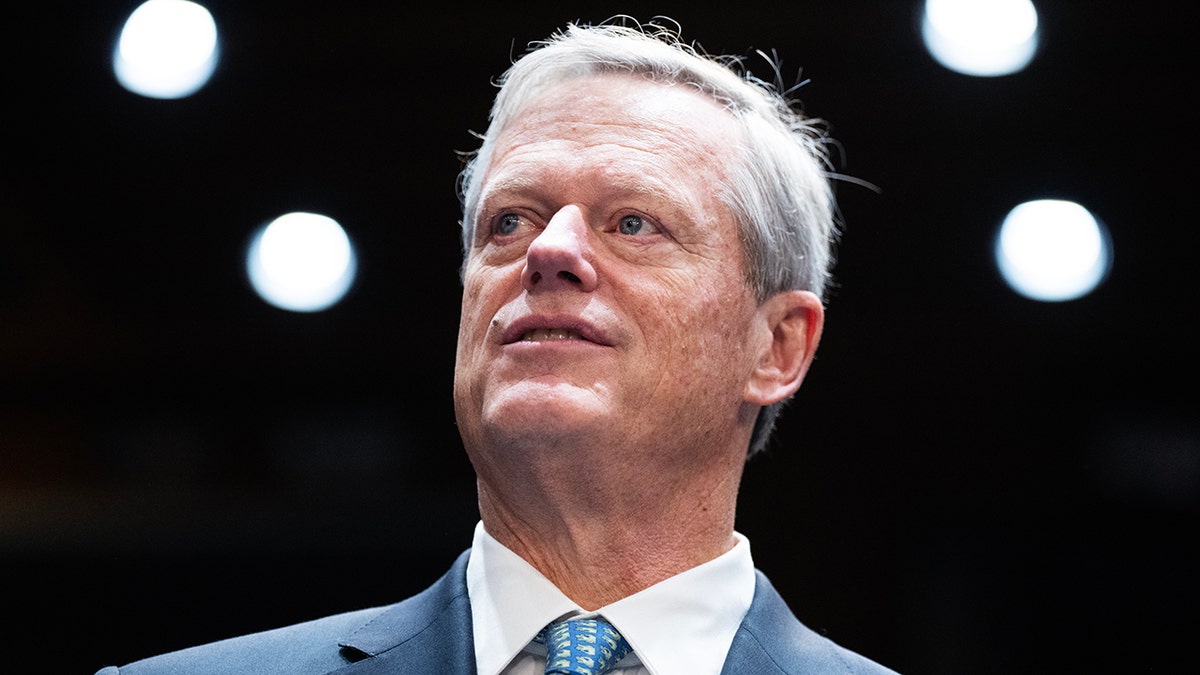
Charlie Baker, president of the NCAA, arrives for the Senate Judiciary Committee hearing titled “Name, Image, and Likeness, and the Future of College Sports,” in Hart Building on Tuesday, Oct. 17, 2023.(Tom Williams/CQ-Roll Call, Inc via Getty Images)
“As I said before, the rules around transgender athletes generally are more restrictive today than they were in ‘22. And I can state pretty clearly that no one’s going to get forced into any sort of situation that’s going to make them uncomfortable. We make that very clear in the guidance that we give to anybody who hosts one of our championships, period,” he explained.
“I can tell you that the standards with respect to participation for trans athletes in women’s sports have been adjusted since then and continue to be adjusted based on conversation with other governing bodies.”
Fox News’ Paulina Dedaj contributed to this report.
Ryan Gaydos is a senior editor for Fox News Digital.