3.7 C
New York
Monday, February 16, 2026
Home Blog Page 1032

Blockchain innovation or dangerous house of cards? – Cointelegraph Magazine

0


Ethereum restaking — proposed by middleware protocol EigenLayer — is a controversial innovation over the past year that has some of the brightest minds worried about the potential ramifications.

Restaking involves reusing staked or locked-up Ether tokens to earn fees and rewards. The restaked tokens can then help secure and validate other protocols. 

Proponents believe restaking can squeeze additional security and rewards from already staked ETH and grow the crypto ecosystem in a healthier way based on Ethereum’s existing trust mechanisms. Restaking could serve as a security primitive for exporting Ethereum’s trust generated by its validators to other projects.

Yet Ethereum co-founder Vitalik Buterin and a number of key devs worry that restaking is a house of cards that will inevitably tumble. Some of those Ethereum devs have even proposed a fork to head off restaking platform EigenLayer. 

Why the project’s founders promote “trust as a service” from Ethereum without the Ethereum founder and others’ willingness to participate is still to play out. Will the whole concept result in an Ethereum fork to protect the network from catastrophic failure? 

Staking and restaking

Staking is a crypto-native concept. On Ethereum, it means putting up a security bond in ETH so that the validator (validators of new transactions who maintain the security of the blockchain) will behave honestly in verifying transactions rather than lose their staked tokens. Stakers are then paid rewards for locking up this ETH. 

In essence, stakers lock up their tokens to commit to producing Ethereum blocks — an on-chain way of supporting development, regardless of fluctuations in highly volatile token prices. 

So what is restaking?

In short, restaking works in that already staked Ethereum tokens can be rehypothecated (when a lender re-uses collateral posted from one loan to take out a new loan) to secure a wider variety of applications and accrue additional rewards.

But restakers also get penalized or slashed for non-performance of their staking tasks. (More on that below).

So restaking is a crypto primitive for generating economic security from Ethereum’s nine years of concerted developer activity and project track record. 

“It’s an extension protocol to extend what Ethereum can do, scaling out Ethereum stakers beyond Ethereum to other bridges and oracles that need to be secured,” EigenLayer founder Sreeram Kannan tells Magazine.

He says EigenLayer is commoditizing ETH staking to make it more general purpose, as, in crypto parlance, “staking is the root of trust.” 

Kannan is an academic on leave from the University of Washington, and EigenLayer began as academic research into “exported trust” as a consensus protocol. Basically, he sought to piggyback the trust generated by Ethereum to other ecosystems. 

Kannan essentially seeks to export the “trust” generated by Ethereum for other projects across the ecosystem and other chains. “In crypto, mechanisms for trust mean that investors need skin in the game. The pseudonymous world needs carrots and sticks whereby validators are distributed.” He calls it “permissionless innovation.” 

The best each chain has to offer

The big idea for EigenLayer is to bridge blockchains and create super applications, taking the best each chain has to offer. Kannan says “every ecosystem is better in some dimension, but not all dimensions,” and EigenLayer enhancing decentralized tech stacks will actually benefit the industry. 

Kannan said that what can be built with EigenLayer fits roughly into two categories.

Firstly, EigenLayer allows for the construction of bridges from chain to chain, say Ethereum to Avalanche. EigenLayer acts as a marketplace for “decentralized trust,” connecting stakers seeking yields, projects built on EigenLayer offering risk-reward structures for yields, and operators acting as bridges between stakers and projects.


Secondly, a set of smart contracts on Ethereum’s chain lets ETH stakers opt to run other software. EigenLayer could, for example, improve Ethereum transaction finality speeds. ETH stakers can now take the layer-1 blockchain Fantom chain (for better transaction finality times) and fork it on EigenLayer, thereby running a layer as a super fast finalization layer with an EigenLayer trust layer.

But it’s all still theoretical.  

The idea of restaking makes sense theoretically, helping projects build off Ethereum’s security layer — but the problems worry many. 

In theory, “it’s like the NATO security alliance; each country is still a sovereign country, but their mutual defense pact is secured by the sum of their military power,” Sunny Aggarwal, co-founder of Osmosis Labs and creator of a similar restaking system — Mesh, on Cosmos’ chain — told Magazine. 

In practice, EigenLayer provides two ways to restake: whitelisted liquid staking derivatives can be restaked with EigenLayer or an EigenPod (a smart contract can be created to run a validator while restaking). But most restakers won’t run their own validator, so new networks can build projects without their own communities of validators. 

EigenLayer isn’t live yet, and it’s impact is still highly speculative, according to Anthony “0xSassal” Sassano, a full-time Ethereuem educator, founder of YouTube channel The Daily Gwei and an early investor in EigenLayer.

To date, there’s only a smart contract for staked ETH to bootstrap the EigenLayer network, and perhaps given EigenLayer’s hype, people are depositing their ETH into that network, expecting to farm an unconfirmed airdrop of native EigenLayer tokens. 

A force for good or evil?

To be successful, new consensus protocols need a balanced alignment of incentives. Trust is like a scale weighing competing interests. And trying to export Ethereum security layers to different blockchain ecosystems worries some. Many are still trying to understand if it’s a force for good or evil — or both.

“There are two camps: those excited by broadening the use case of ETH staking, and then there are those that worry about potential attack vectors on Ethereum and potential negative consequences for Ethereum if something goes wrong with EigenLayer. My view is in the middle; I understand the concerns and the excitement.” Sassano says.

“Inherently, all of this is complex; it depends which rabbit hole you want to go down. The simple answer is that Ethereum, as a network, currently has over 25 million ETH at stake — that’s tens of billions of dollars. So restaking is asking, what if we could harness that economic security for other purposes than just securing the Ethereum chain?”

Sassano continues: “That’s exactly what EigenLayer is trying to do, to generalize the security that Ethereum has with its stakers and expand that to other things like an oracle network or a data availability network. It’s inherently more technical and complex than that, but that’s the gist of it.” 

There are two types of danger that restaking could pose: first for “restakers” and then for Ethereum itself. 

Restaking creates too much leverage

Restaking is controversial as it is akin to leveraged investing through borrowing. Some argue that the danger here is that the hunger for “real yields” or actual revenue that emerged in crypto in 2022 leads to unsavory developments, like restaking. 

Jae Sik Choi, portfolio manager at Greythorn Asset Management, told Magazine that securing networks through restaking could work, but restaking is akin to leverage:

“Just like how Terra’s over-leveraged ‘safe’ collateralization of Luna was, there would always be a risk of participants over-leveraging into this new concept, and such a risk won’t be quantifiable until we see more data sets throughout the emergence of this new restaking narrative.”

Dan Bar, chief investment officer at Bitfwd Capital — a boutique crypto assets hedge fund — agreed that restaking amounts to leverage, telling Magazine: “While moderate schemes of restaking could be beneficial for capital efficiency purposes, any crypto assets manager and finance professional worth their salt knows too well how easily and quickly leverage can turn into a slew of synthetic toxic financial instruments that bring disasters into even the most healthy of ecosystems.”

And maybe that’s the first major problem. Investors will only see restaking as quick, easily leveraged financial products. EigenLayer building an open-source, decentralized network security may fail to convince doubters.

Risks to Ethereum itself

One fear is that slashing on EigenLayer will affect Ethereum itself.

Ethereum’s proof-of-stake trust system keeps everyone in check with slashing conditions — essentially non-performance penalties. Programmable slashing means restakers have additional computational responsibilities and face consequences for non-execution.

Ethereum co-founder Vitalik Buterin fears an overload of the chain’s consensus, basically, computational overloads, if the blockchain’s computational power is suddenly redirected elsewhere. 

Read also


Features

Australia’s world-leading crypto laws are at the crossroads: The inside story


Features

Why are crypto fans obsessed with micronations and seasteading?

Kannan admits that Vitalik’s concerns are valid. “We don’t want to shard Ethereum’s trust layer, and we don’t want contagion of nefarious actors leveraging Ethereum’s trust system.”

Sassano also notes that the functionality of Ethereum proof-of-stake was designed to make sure that there won’t be a sudden influx or outflux of validators, which would affect the core properties of Ethereum’s consensus mechanism. 

The issue is that EigenLayer will decide where to take ETH from, but they can’t slash a validator on Ethereum.

“In Ethereum, there’s also a queue for validators to enter or exit each day. So let’s say, in an extreme example, 30% of all staked ETH begins staking with EigenLayer and say that all 30% gets ‘slashed’ by EigenLayer. While it depends on what the slashing condition was, let’s say all this ETH was lost because they tried to do something really bad. Even if all 30% had to be exited, there’s a limit on how much can exit per day. It would take literally years to exit 30% of ETH stake. So I understand people’s concerns, but at the same time, other things built on top cannot dictate what happens on Ethereum.”

So, restakers should have to play by Ethereum’s rules. 

Yet Sassano’s biggest concern is around the calculus of ETH staking, which may one day become a question of whether stakers get more from staking on EigenLayer than Ethereum itself. This could erode the Ethereum staking model in time.

He is confident, though, that Ethereum’s tech offsets those systemic risks: “It’s not a critical risk to Ethereum if you are slashed on EigenLayer. You are not slashed on Ethereum. EigenLayer cannot cause you to be slashed on Ethereum because Ethereum has its own slashing conditions built into the protocol. And EigenLayer has its own separate slashing conditions built into its protocol as well.”

Anything built on top of Ethereum introduces additional complexity and risk. Juan David Mendieta Villegas, co-founder and chairman at crypto market maker Keyrock, tells Magazine:

“EigenLayer is an interesting development but creates additional attack vectors without providing explicit benefits to the Ethereum ecosystem itself. If we take a step back, it’s important to note that ETH staking has introduced a base benchmark yield for the industry, and that is a good development. You can almost think of it as a ‘risk-free’ rate. Any additional layers, such as liquid staking derivatives and re-staking mechanisms, of course, can carry more concerns such as concentration risk, security and smart contract.”

But Villegas wishes EigenLayer well. “Overall, we’re advocates of the innovations that are happening around staking and want to see multiple protocols win as this will assist in the decentralization and democratization of the network.”

In other words, he wishes for competitors to EigenLayer to create similar products. 

Restaking could make or break new projects

Cosmos’ Aggarwal believes restaking will only benefit those blockchains with existing network effects for those with existing economic alliances or overlapping communities.

He also sees restaking protocols akin to a venture capital arm for layer 1s that might discourage solo stakers and further centralize networks. 

In the end, competing layer-1 blockchains probably won’t engage in restaking across chains. For that reason, he feels that EigenLayer’s design could be improved. 

While EigenLayer is designed as a security system importing trust from Ethereum, builders will create their own tokens and revenue models. This has pluses and minuses. 

In some cases, dodgy new tokens may benefit from Ethereum’s trust layer. Choi thinks “this trust layer benefit could potentially be moot due to the tokenomics that these alt layer 1s would want to try and attain (i.e., the use of their own token — their own agendas) could be problematic and so any supposed trust exported from Ethereum is lost anyway.”

On the other hand, experimental, well-meaning projects may now have a chance at success thanks to EigenLayer. That’s why Choi thinks the ultimate potential benefit EigenLayer is proposing is that other blockchains that do not want to spin up their own validator and staker sets have a chance at scaling to success. 

Aggarwal also notes that with appropriate checks, restaking should be set within parameters to control risk. Restaking primitives need cleverly programmed governance, such as discounted voting power to restaked tokens on another chain. For example, one restaker can’t have more than 20% of the vote for another chain.  

So, is restaking a good thing for Ethereum?

“The purists would say Ethereum should only be securing the Ethereum Beacon Chain and nothing else. [They] shouldn’t be exporting Ethereum security to anything else. But I don’t think that is necessarily a bad thing to get node operators to do other work,” says Sassano. 

“If it can happen on the Ethereum network, it will happen. If the network can’t resist it and Ethreuem’s chain becomes insecure because of it, and there are adverse effects because of it, then Ethereum as a protocol was not designed correctly and needs to be improved.”  

We’ll find out soon enough.

Max Parasol

Max Parasol

Max Parasol is a RMIT Blockchain Innovation Hub researcher. He has worked as a lawyer, in private equity and was part of an early-stage crypto start up that was overly ambitious.






Source link

Tom Cruise shares stark Hollywood reality with actor Timothée Chalamet: ‘It’s up to you’

0

There is no one better than Tom Cruise to offer insight into the lengths it takes to be a successful action star in Hollywood.

Actor Timothée Chalamet, who stars in the upcoming sequel to his critically acclaimed 2021 film “Dune,” says he was on the receiving end of that gift, telling GQ, “After I met [him] right after finishing the first ‘Dune,’ he sent me the most wonderfully inspiring email.” 

The email included pertinent contacts for Chalamet, such as a motorcycle coach and stunt training expert.

‘TOP GUN: MAVERICK’ STAR GLEN POWELL EXPLAINS THE CUDE ADVICE TOM CRUISE GAVE HIM

Tom Cruise, left, had some sage advice for actor Timothée Chalamet after meeting the young star. (Han Myung-Gu/VALERIE MACON/Getty Images)

“He basically said, in Old Hollywood, you would be getting dance training and fight training, and nobody is going to hold you to that standard today. So it’s up to you,” Chalamet explained. “The email was really like a war cry.”

The email was not the only thing Chalamet took from Cruise, admitting that while filming “Dune: Part Two,” he saw “Top Gun: Maverick” a whopping eight times. While filming in Budapest, Hungary, he actually rented out a movie theater and took the entire cast and crew to watch the blockbuster.

Josh Brolin and Timothée Chalamet balance on a plane wing in a scene from "Dune."

Josh Brolin, left, and Timothée Chalamet in a scene from “Dune.” (Warner Bros.)

LIKE WHAT YOU’RE READING? CLICK HERE FOR MORE ENTERTAINMENT NEWS

“‘Top Gun’ was just hugely inspiring to me last summer when we were making ‘Dune,’” he admitted. “Some of the crew were kind of scoffing at going, but I just thought it was one of the greatest films I’ve ever seen.”

Representatives for Cruise and Chalamet did not immediately return Fox News Digital’s request for comment.

Tom cruise in a white top and blue jeans in "Top Gun: Maverick"

Tom Cruise in a scene from “Top Gun: Maverick.” (Skydance Media/Paramount Pictures)

CLICK HERE TO SIGN UP FOR THE ENTERTAINMENT NEWSLETTER

Cruise has frequently offered advice to the next generation of Hollywood. Actor Glen Powell, who starred with Cruise in “Maverick,” previously revealed that his co-star encouraged him to “lean into the d—–baggery” of his character.

In the movie, Powell plays Lt. Jake “Hangman” Seresin, a cocky pilot being trained by Cruise’s character, Capt. Pete “Maverick” Mitchell.

“Sometimes you can fall into the trap of wanting to be liked on camera,” Powell explained during a conversation with Kate Hudson for Variety. “And in a movie like this, where you know there’s going to be a lot of eyes on it, you don’t want to be Draco Malfoy,” he said, referencing the bad boy in the “Harry Potter” series.

Tom Cruise in a black tuxedo smiles alongside co-star Glen Powell in a white tuxedo on the red carpet in Cannes, France

Glen Powell says that Tom Cruise told him to “lean into” playing a d—–bag for his character to be believable in “Top Gun: Maverick.” (Marc Piasecki/FilmMagic)

CLICK HERE TO GET THE FOX NEWS APP

“Tom gave me this advice: ‘For the ending to work, you have to completely lean into that. Everybody else in the movie is questioning their own ability,'” Powell said, recalling what Cruise said about Powell’s character.

“You’re the only guy that’s not questioning it. So, if there’s any sort of apology in anything you say, the movie doesn’t work. Lean into the d—–baggery of it all.”

Tom Brady sounds off on controversial Giants-Bills ending

0

NFL officiating became a hot topic of conversation at the end of Week 6 because of how the Buffalo Bills were able to hold on against the New York Giants on Sunday night.

The Giants got a chance on an untimed down to win the game from the Bills’ 1-yard line. Tyrod Taylor fired a quick pass to tight end Darren Waller but the ball sailed over his head. It appeared Bills cornerback Taron Johnson was grabbing Waller’s jersey but no flag was thrown.

Buffalo won the game 14-9, but fans on social media were outraged over the missed ball.

CLICK HERE FOR MORE SPORTS COVERAGE ON FOXNEWS.COM

Buffalo Bills cornerback Taron Johnson defends New York Giants tight end Darren Waller on the last play of the game at Highmark Stadium in Orchard Park, New York, on Oct. 15, 2023. (Mark Konezny-USA Today Sports)

Tom Brady explained on a recent episode of the “Let’s Go!” podcast he understood why fans get “p—ed off” when watching games. He then talked about the controversial play.

“You wanna believe that they even themselves out over the period of the season. Some calls you get, some calls you don’t get. It’s also tough, when you see a call like that, to go, ‘God that’s, it’s really unfair,'” Brady said. “You know, it’s definitely a penalty. It was obviously a holding. They just didn’t call it.

“I don’t know why they call it sometimes when they don’t. I always had a problem when they threw a flag and it didn’t happen. Like, for example, they call a hold and there was no hold. I don’t know how you can throw a flag on something that you didn’t see. I always accepted the fact that if a ref, if there was a hold and they didn’t call it, OK, I didn’t see the call. So sometimes they let guys play.”

Brady said it was an “obvious” holding penalty on Johnson and everyone expects, in that moment, for the officials to get the call right.

Taron Johnson defends Darren Waller

Buffalo Bills cornerback Taron Johnson breaks up a pass intended for New York Giants tight end Darren Waller at Highmark Stadium on Oct. 15, 2023. (Mark Konezny-USA Today Sports)

JETS’ AND BROWNS’ UPSETS GIVE SPORTSBOOKS ‘BEST DAY SO FAR’ AFTER BETTORS SUFFER BAD BEAT IN WEEK 6

“They don’t always get it right. They mess up, too, just like we as players mess up. So I don’t think you always blame the refs. I don’t think you can always let the refs off. There’s always probably a middle ground in all of it that you’re hoping over the course of the season they balance themselves out and maybe you’re on the positive end of one of those calls.”

Officiating seems to be the topic of conversation each week. The difference this time is the play happened so fast that slowing down the moment on replay may have been the only way to see the holding at that moment.

“Sunday Night Football” referee analyst Terry McAulay explained the situation to Mike Tirico and Cris Collinsworth.

“Yeah, Mike, it certainly wouldn’t be holding. The ball’s in flight. And had the ball not been in flight, that jersey pull is an automatic foul. We understand that,” he said. “Once the ball’s in flight, now it changes what that pull means. It has to significantly hinder the receiver. And one can argue it did. Certainly one could argue that it maybe didn’t. Again, that’s the level you’re looking for, for a foul. Does that jersey grab significantly hinder the receiver’s ability to make the play?”

Tom Brady in Foxborough

Tom Brady speaks to fans during a “Thank You” celebration honoring the former New England quarterback during halftime of Patriots’ home opener on Sept. 10, 2023, in Foxborough, Massachusetts. (Joseph Prezioso/AFP via Getty Images)

CLICK HERE TO GET THE FOX NEWS APP

McAulay said he believed Waller was hindered but left it up to the officials on the field who “didn’t believe it significantly hindered him and didn’t make the call.”

Japanese Singer-Songwriter Nishioka Continues to Climb to the Top of the Charts

0

With his unique world view of POPS, his one-of-a-kind melodies and voice, and his music that goes straight to the heart, more and more people are now listening to Nishioka’s music in America.

Japan, October 17, 2023, ISHIKORO, one of the most popular songs of Nishioka, has attracted the most attention. Within him is a commonality in the music of singer-songwriters. That commonality is that their music is born from their upbringing and roots. He is one of them. Nishioka has already garnered critical acclaim in Japan, and is spreading his message in the USA.

He was recently interviewed by a celebrity interviewer; the following is in Nishioka’s words:

  • Why don’t you show your face?
    “Not showing my face is a sign of my upbringing and trauma. I am not an idol to begin with, so my face and appearance have no value. I don’t think there is any point in showing my face.”
  • What is the value you are talking about?
    “I’m just a singer-songwriter, so if there is any value, it’s the music I’ve created. Recently, with the support of people around me, I feel that more and more people are listening to my music on Spotify and YouTube. This makes me happy.”
  • What is it that you want to convey through your music?
    “It’s a difficult question… If I had to sum it up in one word, it would be “cherish your life.”
  • How did you come to this idea?
    “I grew up in a toxic household. I had a father, a mother, and an adopted brother, and I was the youngest child. My family was far from wealthy, and because of poverty, my parents fought daily in loud voices that echoed throughout the neighborhood.” From childhood to adulthood, my father yelled at me, telling me I was “stupid,” “useless,” and “die”, and every time I started something new, he said, “How can a fool like you do it?” Naturally, my brother was also treated unfairly by my parents, so he repeated unreasonable abuse and mistreatment every day to relieve stress. I spent my childhood without a life of my own volition and choice.”
  • You must have had a very difficult childhood:
    “Yes, but I grew up in such a difficult environment. But I don’t think of it so negatively because I think I am the person I am today because I grew up in such a difficult environment. Some of my songs were born because I was in such a difficult environment. I think there are many people in the world who grew up in a more unfavorable family environment than I did.”
  • What makes you not negative about such a sad past?
    “When I was in high school, my dream was to become president. I thought that if I became president and became successful and made money, I could escape poverty and parental control. I think I was able to have these thoughts at the time because I had an unhappy childhood.”
  • Did that dream come true?
    “Yes, I started my own company when I was 22 and became a business owner, and that business happened to do well. I stepped out of my parents’ control. But even now, as an adult, when I see my father, I don’t know why, but he calls me ‘you are not a good person,’ ‘you are narrow-minded,’ ‘you are crazy,’ and so on in various languages. But now I don’t care what they say. One cannot change others, but one can change oneself. So I will continue to change more and more. For the better, of course.”
  • Are you still a business manager?
    No, I stopped being a manager a long time ago.
  • Why music now?
    “I always wanted to be a musician, and many times when I was a child, listening to music or singing saved my heart when I was going through a difficult time, so next time I want to make music that people like me who are growing up in a poor environment or have some problems in life can find a little hope. That’s what I’ve been doing on my journey as a singer/songwriter.”
  • “I think Children can’t choose their parents and they can’t choose the environment in which they grow up, but they can choose to live their own lives. In other words, freedom or inconvenience is up to you. To live freely is to take responsibility for your own choices. And music is the thing that gives me the greatest sense of freedom, which is why I am doing it now.”
  • What is the end point of your journey?
    This journey will not end until I die.
  • What is your ideal image as a singer-songwriter?
    A cool singer-songwriter. My ideal image of a cool singer-songwriter is to always be a cool father to my wife and two daughters. Unfortunately, I did not receive love from my parents, but I will live my life with supreme love for my family, my children, and my fans. And my family and fans will continue to support my music.

Nishioka also commented: “I was born and raised in Nishinari, I curse Nishinari, and Nishinari gave birth to my music. I’m working on a new song right now, and I can’t wait for it to be finished. I can’t wait for everyone to hear it.”

Artist NISHIOKA:

For more information, visit: https://Nishioka.news/

YouTube:
https://www.youtube.com/watch?v=lYTQ0iU0fcE

Spotify:
https://open.spotify.com/intl-ja/track/4LMHg5C7a89BdmK6wh12Sv

Apple Music:
https://music.apple.com/us/album/ishikoro/1669153326

Instagram:
https://www.instagram.com/nishiokaofficial/

Media Contact:

Tune Factory Maeda
Osaka, Japan
+816-7710-0308
info@Nishioka.news

nish
Japanese Singer-Songwriter Nishioka Continues to Climb to the Top of the Charts 28

Iran shares chilling message for Israel after Gaza hospital explosion kills 500: ‘Time is OVER’

0

Iran’s foreign minister posted an ominous tweet on Wednesday that said time is “running out” for Israel. The post was made hours after an explosion at a Hamas-run hospital in Gaza suffered an explosion that left hundreds dead.

Hossein Amir-Abdollahian posted the tweet after Hamas blamed Israel for the blast at the Al-Ahli Arab Hospital, where more than 500 were killed. The Israeli Defense Forces (IDF) denied attacking the hospital and has since investigated the blast. The IDF has since claimed it was caused by a rocket misfire launched by the Palestinian Islamic Jihad.

“After the terrible crime of the Zionist regime in the bombing and massacre of more than 1,000 innocent women and children in the hospital, the time has come for the global unity of humanity against this fake regime more hated than ISIS and its killing machine,” Amir-Abdallohian tweeted.

He added: “Time is OVER!”

PRESIDENT BIDEN VISITS ISRAEL AS IDF BLAMES GAZA HOSPITAL BLAST ON HAMAS

Iran’s Foreign Minister Hossein Amir-Abdollahian looks on during a joint press conference with his Lebanese counterpart in Beirut on October 13, 2023.  (ANWAR AMRO/AFP via Getty Images)

The post follows similar remarks Amir-Abdallohian made during a televised interview.

“Time is running out very fast,” he said. “If the war crimes against the Palestinians are not immediately stopped, other multiple fronts will open and this is inevitable.”

BIDEN SAYS ISRAEL NOT TO BLAME FOR ROCKET ATTACK ON GAZA HOSPITAL THAT LEFT 500 DEAD: ‘DONE BY THE OTHER TEAM’

Protesters in Iran

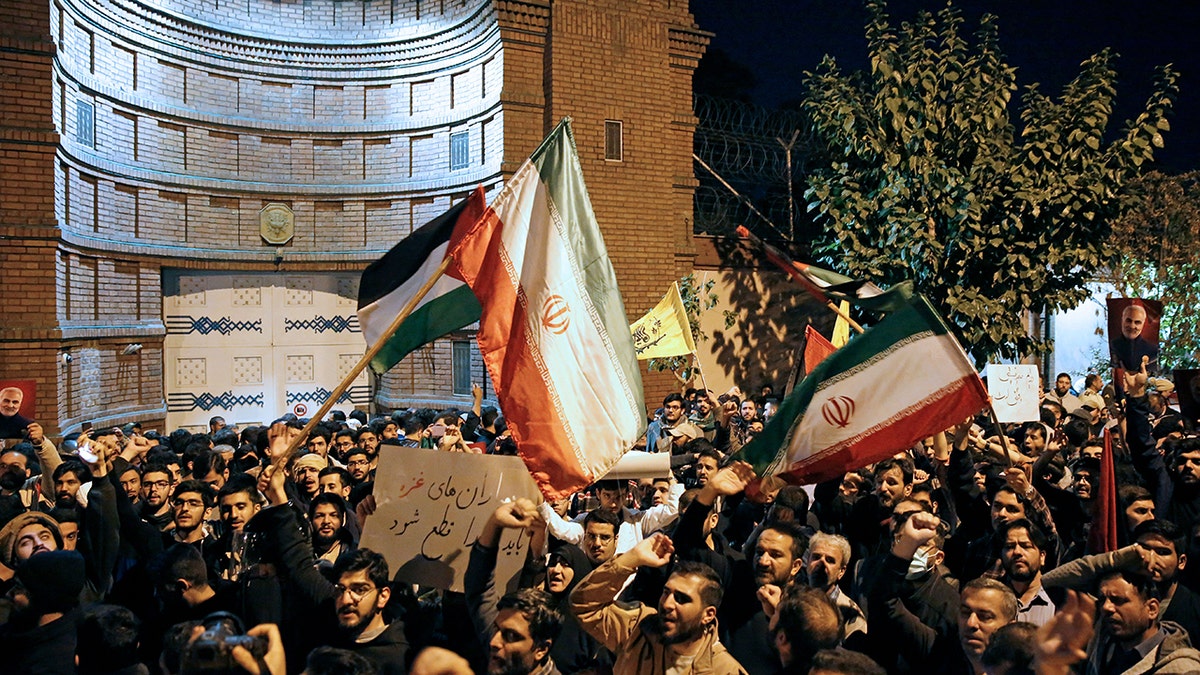
Iranian students and demonstrators protest in support of Palestinians in front of the French embassy in Tehran, early morning on October 18, 2023. Hundreds of protesters gathered outside the British and French embassies in Tehran in the early hours of October 18, 2023, an AFP correspondent said, as regional anger grew over a deadly strike on a Gaza hospital.  (ATTA KENARE/AFP via Getty Images)

Other regional leaders have expressed strong language in the fallout of the hospital explosion. 

CLICK HERE TO GET THE FOX NEWS APP

On Tuesday, Jordan’s King Abdullah II said: “This war, which has entered a dangerous phase, will plunge the region into an unspeakable disaster.”

The hospital explosion also caused an international summit that was initially set for Wednesday to be canceled. It was going to feature Biden, Jordan’s Abdullah, Egypt’s Abdel-Fattah el-Sissi, and Palestinian Authority President Mahmoud Abbas.

President Biden, who landed in Israel on Wednesday, denied Israel’s involvement in the hospital blast, strongly suggesting it was the result of a terror group.

Cryptonauts shares tips on growing a crypto YouTube channel

0


While the term “fake news” has been floating around for a while, the phrase was given new life and popularity when former United States President Donald Trump turned it into a viral campaign slogan. “Fake news” eventually became a generation-defining meme, and this is likely because there is a certain truth to the phrase that resonates with the public to this day.

Media does occasionally make mistakes in its reporting, and even Cointelegraph is not immune to this. At the same time, news anchors, journalists and media companies are also known to cast aside objectivity and inject their personal opinions — or those of their paid sponsors — into what is promoted as strictly fact-based news.

In 2023, this has become a crisis facing crypto content creators. The proverbial “jig” is up, and many investors are now well aware that much crypto-focused content has an ulterior motive of shilling a particular coin or, in some cases, an unannounced paid sponsor backing the content of the day. As a result of the broader fallout, several professional and hobbyist crypto content creators have told The Agenda that maintaining and growing their subscribers has been a challenge this year.

On Episode 22 of The Agenda, hosts Ray Salmond and Jonathan DeYoung spoke with Nathan Leung, co-founder and host of the Cryptonauts YouTube channel, about the nuts and bolts of educating and onboarding new users to crypto on YouTube — and how to remain ethical while doing so.

ada956ae a65a 4581 802d f48cf577f3d0

Humanizing is appetizing

Leung told The Agenda that when attempting to separate oneself from all the chaff, “humanizing” the content is a useful and effective tactic, given that “in times like this, everyone’s like, ‘NFTs are a scam, blah, blah, blah. Everything’s a scam.’” But as he points out, “There’s also good people trying to make digital ownership a real thing. There’s actually builders actually running hackathons, trying to find the best project, right? There’s actually real builders who want this technology to kind of help the world in a way.”

So, Cryptonauts talks to these builders and highlights that they are just regular people with a mission. “It’s kind of just humanizing. It’s like, yeah, you’re worth $250 million or $18 billion, right? But what do you do? Do you wake up in the morning? Do you have a family? Do you walk your dog?”

Related: The Agenda podcast predicts the future of crypto and talks adoption

Leung also emphasized the importance of respecting “the viewer’s time,” highlighting that the ultimate goal is to have viewers watch a whole video and not feel like their time was wasted.

“If they’re going to watch our video, we want them to at least watch it all, right? So, if we feel like it’s not absolutely necessary, we don’t want to waste their time either, because time is obviously the most valuable currency. So, we just try to make it short and sweet.”

He added, “I think a lot of people think that longer videos are better, but I think if you can just save people time and condense it and just make it engaging, it could be two minutes.”