2.4 C
New York
Friday, February 13, 2026
Home Blog Page 1080

Luis Rubiales, Spain’s Top Soccer Official, Resigns Over World Cup Kiss

0

The head of the Spanish soccer federation, Luis Rubiales, resigned on Sunday, weeks after kissing a member of Spain’s women’s team on the lips after the team won the World Cup last month, setting off a national scandal and drawing accusations of abusing his power and perpetuating sexism in the sport.

In a statement posted to X, formerly known as Twitter, on Sunday, Mr. Rubiales said he had submitted his resignation as the federation’s president and as vice president of UEFA, European soccer’s governing body.

“After the rapid suspension carried out by FIFA, plus the rest of proceedings open against me, it is evident that I will not be able to return to my position,” he wrote. “My daughters, my family and the people who love me have suffered the effects of persecution excessively, as well as many falsehoods, but it is also true that in the street, the truth is prevailing more every day.”

Mr. Rubiales, 46, was largely unrepentant about his actions, but pressure had grown on him and the group he leads, known formally as the Royal Spanish Football Federation, and it became clear that his position was untenable as the outrage against him showed no signs of abating.

Spanish prosecutors opened a sexual assault case on Friday after the player Jennifer Hermoso, who said she was made to feel “vulnerable” and a “victim of an attack” when he kissed her, filed a formal complaint, and there were signs of opposition to his continued presence at the top of Spanish soccer at every turn.

The soccer federation had called for him to resign “immediately,” female players had said they would not take the field for the national team as long as he was in charge, the men’s team had condemned his actions, and FIFA, soccer’s governing body, had suspended him for 90 days.

Some commentators have described the events as a watershed moment in Spain’s #MeToo movement, as they put a spotlight on a divide between traditions of machismo and more recent progressivism that placed Spain in the European vanguard on issues of feminism and equality.

The controversy centers on the conduct of Mr. Rubiales, who kissed Ms. Hermoso, one of the team’s star players, after Spain defeated England, 1-0, at the World Cup final in Sydney, Australia, on Aug. 20.

He offered a tepid apology the next day, but by the end of that week he had dug in his heels and reversed course, insisting that Ms. Hermoso had “moved me close to her body” during their encounter onstage, feet from the Spanish queen. He also accused his critics of targeting him in a “social assassination” and declared that he would not step down.

Ms. Hermoso has vigorously disputed his account and has received support far and wide, with players and others — including the United Nations’ human rights office — using the hashtag “se acabó,” or “it’s over.”

The Spanish government was limited in its ability to punish Mr. Rubiales, but Prime Minister Pedro Sánchez described the soccer chief’s actions as “unacceptable,” and the secretary of the opposition People’s Party, Cuca Gamarra, described them as “shameful.”

The scandal has taken some of the shine off the national team’s World Cup triumph, diverting attention from the rapid ascent to soccer glory by a squad that qualified for the tournament for the first time eight years ago after decades of mediocrity.

On Sunday evening, Mr. Rubiales gave an interview on “Piers Morgan Uncensored,” in which he said he came to the decision to resign after speaking to friends and family. “They say to me, ‘Luis, now you have to focus on your dignity and to continue your life, because if not, probably, you are going to damage people you love,’” he said.

Víctor Francos, the president of Spain’s National Sports Council, said on Onda Cero radio that Mr. Rubiales’s resignation was “good news for the government” and “what the citizens were asking for.” Minutes earlier on Cadena Ser radio, he said the government was considering “legislative changes that can improve, strengthen and enrich public control over the federations.”

“We must reflect so that certain things that have happened don’t happen again,” he said.

But Mr. Rubiales was not without his supporters.

When he spoke at a federation meeting in late August, his robust defense was met with loud applause by some in attendance, and his mother locked herself in a church and began a hunger strike to protest what she considered a witch hunt of her son.

Before Mr. Rubiales was punished, the controversy led to the ouster of another high-profile figure in the world of Spanish women’s soccer: Jorge Vilda, the coach of the World Cup winning squad but a polarizing figure, who was fired on Tuesday.

Mr. Vilda, who was hired in 2015 when his predecessor was ousted amid accusations of sexism, had been dogged by scandal in recent months. And last year, 15 star players refused to play on the national team, complaining about controlling behavior by Mr. Vilda and a general culture of sexism.

A Race to Rescue Survivors

0

Rescuers in Morocco are racing to dig survivors out of rubble after the country’s worst earthquake in a century flattened homes and buildings, killing at least 2,000 people.

The magnitude-6.8 quake struck in the mountains south of Marrakesh, an ancient city that is a popular tourist destination. Buildings crumbled and caked its cobblestone streets with mounds of red dust from the walled old city.

The quake particularly devastated communities in the Atlas Mountains, where the full extent of the damage is still unknown. Debris has blocked some of the region’s roads, making it difficult for rescue crews to reach remote communities. The quake also knocked out power and cell service in some areas. The death toll is expected to rise: Most homes there are made of mud bricks, a traditional construction method that is vulnerable to earthquakes and heavy rains.

In some remote areas, people sifted through debris with their bare hands to search for survivors. Others climbed through the canyons between collapsed homes to retrieve bodies. The U.N. said that more than 300,000 people in Marrakesh and its outskirts had been affected by the earthquake.

Emergency teams from around the world are arriving to help. One of the first countries to offer aid was Turkey, which experienced its own earthquake in February that killed tens of thousands of people there and in neighboring Syria. Spain’s foreign affairs minister said the country would send search and rescue teams to try to “find the greatest number of people alive.” The Moroccan Army said the air force was evacuating casualties from a hard-hit region to a military hospital in Marrakesh.

Still, some foreign crews complained that the government approvals process for rescue efforts had been slow. Some villages have not yet received any aid, according to reports on social media. One man who said he was volunteering as a rescuer in a province southwest of the epicenter begged for more assistance in an Instagram video. “We don’t have any food or water. There are still people underground. Some of them are still alive,” he said, adding, “There are some villages that we couldn’t reach.”

Here are the latest updates:

  • Aftershock: A 3.9-magnitude earthquake, almost certainly an aftershock, struck Morocco this morning, the U.S. Geological Survey said. Afraid of aftershocks, many people spent the weekend sleeping outside on grassy medians and roundabouts near one road heading into Marrakesh.

  • Housing: The office of Morocco’s leader, King Mohammed VI, said he had ordered the government to rapidly provide shelter and rebuild houses for those in distress, “particularly orphans and the vulnerable.”

  • See maps of where the quake struck and photos of the destruction.

  • The authorities announced three days of national mourning to honor victims. Here’s how you can help.

  • “My husband and four children died,” one woman told Moroccan state television. “Mustapha, Hassan, Ilhem, Ghizlaine, Ilyes. Everything I had is gone. I am all alone.”

  • Moroccan news media reported that no deaths had been recorded in hotels in Marrakesh and that there had not been any major damage to the airport there.

  • Some Biden allies say that he is too deferential to his son Hunter Biden and that their closeness has created political peril for the president.

  • A former Secret Service agent present at John F. Kennedy’s assassination contradicted the official conclusion about the “magic bullet” thought to have both hit Kennedy and wounded Gov. John Connally of Texas.

  • California’s governor, Gavin Newsom, a Democrat, said he was not running for president and urged his party to line up behind Biden.

  • Gun owners denounced a gun safe manufacturer after it acknowledged that it gave the F.B.I. the access code to one of its safes to help an investigation.

  • After acquiring Twitter, Elon Musk looked for signs of disloyalty in employees’ internal communications. Read more takeaways from a new biography of Musk.

  • Facebook and Google built tools years ago that could recognize any face but declined to release them, deciding it was too dangerous to make widely available.

  • The 19-year-old American Coco Gauff beat Aryna Sabalenka in three sets to win her first Grand Slam tennis title.

  • Just over a decade ago, Gauff was a young tennis fan dancing in the U.S. Open stands. See the video.

  • Novak Djokovic will play Daniil Medvedev in the men’s singles final today.

The Chinese Communist Party’s only plan to deal with its disillusioned youth is repression, Ho-Fung Hung writes.

Even though we don’t understand why obesity drugs work, people who need them should take them anyway, Aaron E. Carroll argues.

Here’s a column by Farhad Manjoo on Vivek Ramaswamy.


The Sunday question: Can India lead developing nations in addressing climate change?

India has already taken the lead as the holder of this year’s Group of 20 presidency, and officials have met with other countries’ energy ministers to stress the importance of an “equitable transition” away from fossil fuels, Syed Munir Khasru writes for The South China Morning Post. But combating global warming is extremely difficult, and India’s own ambitious energy goals are “looking even less achievable,” David Fickling of Bloomberg writes.

Vows: The popular guy meets the academic girl.

Lives Lived: Mangosuthu Buthelezi was a Zulu chief who was a strong voice for tribal rights as apartheid ended in South Africa. He died at 95.

I spoke with the great cartoonist Roz Chast, who grew up in New York and whose work is deeply associated with the city, about the irritation of moving to the suburbs.

You’ve written about feeling as if you didn’t fit in as a kid. Do you remember when you first thought, I do fit in?

When I got my first apartment in the city. When I got out of art school [at the Rhode Island School of Design], I thought: “My cartoons, they’re weird. They make me laugh, but this doesn’t look like anything that I see.” Then I decided to start taking my cartoons around, and that was when things started to change. That has a lot to do with why I love New York. It was the first time in my life that I didn’t feel like I was in the wrong place, in the wrong clothes, at the wrong time.

How did moving to the suburbs change that?

I did not feel like I fit in. I remember going to a P.T.A. meeting and thinking, I hate this so much. I can’t stand any of these people. There was a field day — you know field day?

Oh yes.

I had decided to be one of the parents who helped out, and somebody gave me a bag of ice to break up and I didn’t know how. I was hitting it with a branch! This woman, she took it from me with this “tsk!” and she drops the bag of ice on the floor. She acted like, “You’re an idiot” — and I sort of knew I was.

Will my own lingering sense that somehow moving to the suburbs represents a personal failing ever go away?

You have to repress it. (Laughs.) Deeply repress it.

Read more of the interview here.

Dishy: Read a tell-all about the beauty brand Glossier.

Our editors’ picks: “Play to Win,” a book about winning the lottery, and eight other books.

Times best sellers: Hannah Nicole Maehrer’s TikTok series has been turned into the novel “Assistant to the Villain,” which is a No. 1 debut on the paperback trade fiction list.

Pick the right leaf blower for fall.

Wear these cheap but durable leggings.

Maximize credit card points.

Take a long walk on Prince Edward Island, in Canada’s smallest province.

A US Navy veteran got unexpected help while jailed in Iran. Once released, he repaid the favor

0

WASHINGTON (AP) — Michael White had only recently arrived in a grim Iranian jail when a curious fellow prisoner, an English-speaking Iranian, approached him in the courtyard for a conversation.

The American did not reveal much at first, but it was the beginning of an unlikely friendship between White, a Navy veteran imprisoned on spying charges he says were unfounded, and Mahdi Vatankhah, a young Iranian political activist whose positions on social issues had drawn his government’s ire.

As the men connected behind bars over a shared interest in politics and human rights, they developed a bond that proved vital for both.

Vatankhah, while in custody and after his release, helped White by providing White’s mother with crucial, firsthand accounts about her son’s status in prison and by passing along letters White had written while he was locked up. Once freed, White did not forget. He pushed successfully this year for Vatankhah’s admission to the United States, allowing the men to be reunited last spring inside a Los Angeles airport, something neither could have envisioned when they first met in prison years earlier.

“He risked his life to get the information out for me when I was in the prison in Iran. He really, really did,” White said in an interview alongside Vatankhah. “I told him I would do everything I could in my power to get him here because I felt, one, that would be for his safety in his own life. And I also felt he could get a great contributing member of society here.”

This year, White received permission for Vatankhah to live temporarily in the U.S. under a government program known as humanitarian parole, which allows people in for urgent humanitarian reasons or if there is a significant public benefit.

Vatankhah told AP he had dreamed about coming to the U.S. ever since he could remember. When he landed, “It was like the best moment of my life. My whole life changed.”

White, 50, a Southern California native who spent 13 years in the Navy, was arrested in Iran in 2018 after traveling to the country to pursue a romantic relationship with a woman he met online. He was jailed on various charges, including espionage accusations that he calls bogus, as well as allegations of insulting Iran’s supreme leader.

He endured what he says was torture and sexual abuse, an ordeal he documented in a handwritten diary that he secretly maintained behind bars, and was sentenced to 10 years in prison in what the U.S. government has said was a wrongful detention.

Vatankhah, now 24, said he had been in and out of prison since he was a teenager because of his involvement in left-leaning causes and vocal criticism of the Iranian government, including through protests, social media posts and university newspaper pieces. He met White in 2018 after one such arrest when Vatankhah faced accusations of spreading propaganda against Tehran’s government.

Though Vatankhah was later released, he was arrested again, this time winding up in the same cell as White in Iran’s Mashhad prison.

During the course of their friendship, Vatankhah helped White navigate his imprisonment and better understand the judicial system, functioning as an interpreter to help him communicate with guards and inmates. In early 2020, while Vatankhah was out on furlough, he also became a vital conduit to the outside world for White.

Using contact information White had given him, Vatankhah got in touch with Jonathan Franks, a consultant in the U.S. for families of American hostages and detainees who was working on White’s case and later helped spearhead the humanitarian parole process for Vatankhah. He also spoke with White’s mother and smuggled out White’s letters.

The detailed information about White, his status and his health — he suffered from cancer and COVID-19 in prison — came at a crucial time, providing a proof-of-life of sorts at a time of heightened tensions between the U.S. and Iran due to a U.S. drone strike that killed Iranian Gen. Qassem Soleimani, who led the expeditionary Quds Force of the paramilitary Revolutionary Guard.

White was released in a June 2020 prisoner swap, exchanged for an American-Iranian physician imprisoned in the U.S. for violating American sanctions laws. Vatankhah, released the same year, made his way to Turkey.

White argued in his March application on Vatankhah’s behalf that his friend met the criteria for humanitarian parole because, despite having relocated to Turkey, he was continuing to face harassment on account of his political viewpoints. Vatankhah wrote in his own petition that the situation was unsafe for him in Turkey. He noted that Turkish police had raided his home and that he remained at risk of deportation to Iran.

Paris Etemadi Scott, a California lawyer who has worked with White and Vatankhah and filed the humanitarian parole application on the Iranian’s behalf, said Vatankhah’s assistance to an American — a veteran, no less — enhanced the legitimacy and urgency of his petition because it added to the potential that Vatankhah could face imminent harm.

While many applicants do not have significant supporting documentation, “Mahdi had this amazing amount of evidence to show that he was in fact incarcerated over and over again,” she said.

U.S. Citizenship and Immigration Services said it does not discuss individual humanitarian parole cases. A State Department spokesman said in a statement that the office of the department’s special presidential envoy for hostage affairs had worked hard to secure White’s release in 2020, and after learning of Vatankhah’s case, “worked hand-in-hand with multiple partners in the U.S. government” to secure the parole.

Vatankhah is now living in San Diego, where White is from. Vatankhah said his humanitarian parole is good for one year, but he already has applied for asylum, which would allow him to remain in the U.S. He’s obtained a work permit and has found work as a caregiver.

He’s also enjoying freedom to share his political views freely without fear of retribution.

“I like to express my ideas here where I can. I can continue to use my freedom to talk against the Iranian regime,:”

_____

Follow Eric Tucker on Twitter at http://www.twitter.com/etuckerAP

Statin May Lower Heart Disease Risk for H.I.V. Patients

0

Americans with H.I.V. are achieving the once unthinkable: a steady march into older age. But beginning around age 50, many people living with the virus face a host of health problems, from heart disease and diabetes to social isolation and cognitive decline.

And so the medical research community, which some three decades ago developed lifesaving drugs to keep the virus at bay, is now hunting for new ways to keep people with H.I.V. healthier in their later years.

A recent study, for example, showed that a statin drug significantly lowered the risk of heart attacks and strokes among middle-aged and older adults with H.I.V., and may reveal biological insights into why this group tends to age faster than others. And a crop of academic hospitals have established specialized clinics for older people with the virus, offering medical experts as well as social workers, substance abuse counselors, psychologists and nutritionists.

“I have been unbelievably impressed at how care for the older H.I.V. population has really exploded,” said Dr. Nathan Goldstein, who heads one such clinic at Mount Sinai in New York City. “I get emails every day about new models, new grant funding. People are paying so much attention to this.” More than two dozen H.I.V. and aging experts also expressed optimism, in contrast to the more grim perspective many held a decade ago.

Researchers have often referred to a looming “silver tsunami” of older people with H.I.V. needing better care. In 2021, there were 572,000 Americans aged 50 and older diagnosed with H.I.V., up 73 percent from 2011.

Today, two-thirds of deaths in the H.I.V. population are from causes other than the virus. This aging group faces an increased risk of diabetes, liver and kidney disease, osteoporosis, cognitive decline and various cancers.

But perhaps their most pressing health concern is a doubled risk of cardiovascular disease compared with people who do not carry the virus. Researchers in the Netherlands estimated that by 2030, more than three-quarters of that country’s H.I.V. population will have cardiovascular disease, including high blood pressure, high cholesterol, heart attacks or strokes.

Seeking a bulwark against this mounting threat, the National Institutes of Health invested $100 million in a randomized controlled trial, called Reprieve, that tested a statin medication against a placebo among 7,769 people with H.I.V. 40 to 75 years old. The volunteers were relatively healthy and on stable antiretroviral treatment, so they typically would not have been recommended a statin. But the results of that trial, published in The New England Journal of Medicine, showed that the drug lowered the volunteers’ risk of major cardiovascular events by more than one-third.

“This is really an important study,” said Dr. Anthony S. Fauci, who as the former director of the National Institute of Allergy and Infectious Diseases — he retired in December — was among the N.I.H.’s leaders who approved Reprieve’s mammoth budget. “The results, in some respects — they’re even better than I would have expected.”

Donté Smith, a health consultant from Kansas City, Mo., is 37 but began taking a statin earlier this year. Mx. Smith, who is genderqueer and uses gender-neutral pronouns, said they were motivated to take the medication because, in addition to H.I.V., they had a family history of cardiovascular disease and diabetes and had smoked on and off.

Mx. Smith also noted that the virus took an extra toll on Black and L.G.B.T.Q. people. Of the nearly 1.1 million Americans diagnosed with H.I.V., 63 percent are gay and bisexual men, and 40 percent are Black.

“A lot of us don’t make it,” Mx. Smith said. “It’s important to buck that trend. The best revenge for me is being an elder and being able to share and exist and to still be here.”

Heart disease and other conditions occur disproportionately among H.I.V.-positive people in part because of environmental risk factors that are more common among this group.

“People aging with H.I.V. are more likely to continue to smoke cigarettes, consume unhealthy amounts of alcohol and use cocaine than people aging without H.I.V.,” said Dr. Amy Justice, a clinical epidemiologist at Yale School of Medicine who studies this population. “Each of these behaviors adds to the excess risk of cardiovascular disease.”

Even without those risk factors, aging is accelerated in people with H.I.V. Researchers have long believed the reason to be chronic inflammation and immune dysregulation spawned by the virus, even when it is controlled by antiretroviral drugs.

Dr. Steven Grinspoon, Reprieve’s lead author and a professor at Harvard Medical School, said that the clinical trial also measured many chemical markers of inflammation in the volunteers’ blood and scanned their coronary arteries. The researchers are now looking at whether these data can help explain why the statin lowered cardiovascular events. The researchers will present their findings at a meeting in November.

Dr. Fauci suspected that this analysis will likely reveal that the statin tamped down the volunteers’ chronic inflammation, and in turn prevented the plaque buildup in the arteries that can precipitate a heart attack or stroke.

But experts said that the long-term care of people with H.I.V. will depend on much more than prescription drugs. An array of social problems are especially prevalent among older people with H.I.V. and can exacerbate the perils of aging, including poverty, loneliness, addiction, mental illness, stigma and housing insecurity.

Paul Aguilar, 60, was given five years to live when he was diagnosed with H.I.V. in 1988. He has survived, but not without struggle. The fat has drained from his face, a side effect of the toxic early generation of antiretroviral drugs. And he has weathered waves of lost peers in San Francisco: first from AIDS and more recently from other illnesses.

Last year, he began going to the “Golden Compass” program for aging H.I.V. patients at the University of California, San Francisco, which provides a panoply of services, including cardiology, exercise classes and dental, vision and mental health care. He said that the psychological counseling and support he received there helped him cope with his closest friend’s death by suicide and his own subsequent mental health crisis.

The university’s program is “really a godsend,” Mr. Aguilar said, noting that he has no out-of-pocket costs, thanks to his coverage from Medicare and Medicaid.

But the vast majority of older people with the virus still lack the type of high-quality care that has helped Mr. Aguilar thrive, experts said. Such programs are often prohibitively expensive and pose staffing and space demands that many clinics, especially in resource-poor areas, cannot hope to meet.

“Patients are falling through the cracks,” said Jules Levin, 73, a leading activist holding the bullhorn on behalf of H.I.V.-positive seniors such as himself.

After learning about the Reprieve study’s findings, Mr. Aguilar asked his doctor about starting a statin.

“I’m going to be crotchety and telling kids to get off my lawn,” he quipped.

Mangosuthu Buthelezi, Zulu Nationalist and a Mandela Rival, Dies at 98

0

Controlling the police, the legislature, the courts and other levers of power, he repressed anti-apartheid groups with policies critics said were remarkably like those of Pretoria: ordering arrests, disrupting protests, dispensing patronage and denying jobs to dissenters. Many Black intellectuals and activists fled KwaZulu, the collection of 40 tribal homelands scattered across the former Natal Province on South Africa’s southeast salient. (After apartheid, KwaZulu became KwaZulu-Natal Province.)

Moreover, historians said, Mr. Buthelezi controlled Inkatha paramilitary fighters whose internecine clashes with African National Congress militants claimed up to 20,000 lives in the late 1980s and ’90s. Besides financing the KwaZulu government, Pretoria admitted in 1991 that it had covertly subsidized Inkatha in its war with the A.N.C., reinforcing allegations that Mr. Buthelezi had collaborated with the white government.

“Depending on whom you talk to in South Africa, he is a tool of apartheid, a courageous opponent of white domination, a tribal warlord or a visionary proponent of democratic capitalism,” Michael Clough said in a New York Times review of Mr. Buthelezi’s book, “South Africa: My Vision of the Future” (1990), adding, “While he speaks eloquently of the need for nonviolence, his followers have been accused of murdering hundreds of their opponents in Natal Province.”

In 1990, when South Africa signaled its willingness to disband apartheid by freeing Mr. Mandela and lifting a 30-year ban on the A.N.C., Mr. de Klerk and Mr. Mandela became the principal negotiators for a new constitution. But Mr. Buthelezi quickly inserted himself into the bargaining as a voice for capitalism, education, tribal and ethnic rights, and powers for regional governments.

Over the next few years, as debates at the table flared and factional fighting worsened, Mr. Buthelezi often boycotted the talks. But apartheid ended in hospitals, theaters, swimming pools, parks, libraries and public transportation. And a new constitution emerged, creating a parliamentary democracy with executive, legislative and judicial branches, a Bill of Rights, a universal franchise and 10 regional governments.

Japan says swarms of tourists defiling sacred Mt Fuji

0

By Mariko Katsumura

FUJIYOSHIDA, Japan (Reuters) – On a grey, rainy Saturday a steady stream of tour buses arrive at a base station of Japan’s Mount Fuji depositing dozens of lightly dressed foreign tourists in front of souvenir shops and restaurants.

The scene evokes a theme park image, not the veneration most Japanese would expect below the 3,776-metre (12,388 ft) mountain worshipped as sacred by the Japanese, and a source of pride for its perfectly symmetrical form.

“Hey, no smoking here!” a souvenir store attendant barked, addressing a man dressed in shorts and holding a can of beer in front of the red ‘torii’ gate symbolising the entrance to the Shinto shrine up ahead.

Mt Fuji, which straddles Yamanashi and Shizuoka prefectures in eastern Japan, has always been popular with local and overseas tourists.

But a recent surge in inbound tourists to Japan has led to extreme levels of pollution and other strains, authorities say, adding they may be forced to take drastic measures such as restricting the number of visitors by making the mountain only accessible by a yet-to-be-built tram system.

“Fuji faces a real crisis,” Masatake Izumi, a Yamanashi prefecture official told reporters during a tour for foreign media on Saturday, the last weekend before the trails close for the year.

“It’s uncontrollable and we fear that Mt Fuji will soon become so unattractive, nobody would want to climb it,” he said.

Mt Fuji was listed as a UNESCO World Heritage site 10 years ago, further boosting its popularity. But the distinction came with conditions that Japan reduce overcrowding, environmental harm from visitors and fix the artificial landscape, such as the large parking lots constructed to accommodate tourists.

However, overcrowding has worsened. “Subaru”, the fifth and largest base station, had about 4 million visitors this summer, a 50% jump from 2013.

Despite the frenetic pace of cleaning by janitors, businesses, and volunteers, social media is rife with posts about soiled bathrooms and mounds of litter along the climbing path.

Izumi worries that the International Council on Monuments and Sites (ICOMOS), which advises the World Heritage Committee, could come knocking any day to ask for an update.

“Bullet climbing”, where climbers attempt to scale Japan’s tallest peak for sunrise and descend on the same day, is also a growing headache, authorities say.

Rescue requests totalled 61 this year, up 50% from last year, with non-Japanese tourists accounting for a quarter, according to Shizuoka prefecture police. An official said most were poorly equipped, suffering hypothermia or altitude sickness. Yamanashi police had no comparable data.

One local visitor said restrictions may be inevitable.

“Any Japanese person would want to climb Mt Fuji at least once in their life,” said 62-year-old Jun Shibazaki, who arrived on a tour. “But it’s so crowded. Limited entry might be something we have to live with.”

(Reporting by Mariko Katsumura, Writing by Chang-Ran Kim; Editing by Michael Perry)

Lynn Lynn’s Journey From Rocker to Dissecting Myanmar’s Coup in Film

0

Long before he became an award-winning filmmaker, Lynn Lynn was already a star.

His voice was ubiquitous on the radio, belting out rock songs, and he played sold-out shows in stadiums across the country. Everywhere he went, fans hounded him for selfies and autographs.

But all that fame was confined to Myanmar, a country he had to flee after a February 2021 military coup.

It wasn’t only his lyrics about the suffering of people under military rule that had made him a target of the country’s generals. He was also close to the country’s now-imprisoned civilian leader, Daw Aung San Suu Kyi, having once served as her bodyguard.

Now living in the Thai city of Mae Sot, bordering Myanmar, the 39-year-old rocker has taken on a new identity: refugee.

Despite the drastic changes in his circumstances, he has not given up on art, but he has changed his focus: to film.

His first short movie, “The Beginning,” whose main characters are a fictional group of people from Myanmar, focuses on the importance of good will in building a democratic nation. Five months later, he followed with “The Way,” which captures the trauma and despair of a family suffering from a nation’s conflict; despite the dark themes, the movie is a musical — the first by a director from Myanmar.

Both films have won multiple honors at international film festivals, with “The Way” also earning multiple accolades for its soundtrack.

“I want to give the message that the military junta can oppress an artist physically, but the spirit and art cannot be oppressed,” Mr. Lynn Lynn said, speaking from his spartan music studio, a bedroom in a rented house in Mae Sot.

Mr. Lynn Lynn’s life story has been shaped by his country’s convulsive recent history, shifting from dictatorship to democracy to the present-day resistance.

The youngest of four boys, he was born in the city of Mandalay to a railway worker father and a mother who stayed at home.

When he was 5, he saw close at hand the brutality of the army whose leaders ruled the nation: soldiers pulling passengers from a boat and commanding everyone — regardless of age — to kneel. That scene of dominance and humiliation, he says, has stayed with him throughout his adult life.

As a 9-year-old, he taught himself how to play guitar. After high school, he moved to Yangon, the capital at the time, where he cycled through a series of jobs, including bus conductor and security guard, while trying to start a musical career.

His big break came in 2001, after he walked into a recording studio to drop off his demo tape and was soon hired to compose songs for some of Myanmar’s most famous singers. He established a reputation for composing original songs, a rarity in a country where nearly all the songs were copied from abroad.

In 2007, he marched daily with the country’s monks during the Saffron Revolution protests. He read over and over again “Freedom From Fear,” a book of essays by Ms. Aung San Suu Kyi, at the time the leader of the country’s opposition, who was under house arrest.

He learned how to navigate the country’s censors. Out of every five songs submitted, he was instructed to change the lyrics of three. Sometimes, he submitted different lyrics and then later swapped back in the original words, without anyone seeming to notice.

“He is a rebel,” said his wife, Chit Thu Wai, a well-known actress and singer.

In 2008, Mr. Lynn Lynn released “Think,” an album with love songs that he had written initially for other singers. It was an instant hit and catapulted him to stardom.

In 2011, the military initiated a range of sweeping political changes, including releasing Ms. Aung San Suu Kyi, who convened a gathering of the country’s artists at her house.

There, Mr. Lynn Lynn told the Nobel Peace Prize winner he would be willing to do anything for her. He became one of her bodyguards during the 2012 by-election and the 2015 general election.

After she won in 2015, becoming the country’s civilian leader, Mr. Lynn Lynn returned to music. Able to sing openly about the generals, he released an album called “The Fourth Revolution.”

Then, in February 2021, two months after Ms. Aung San Suu Kyi won the 2020 election in a landslide, the military detained her and announced it had taken power in a coup.

The junta charged dozens of actors and musicians, including Mr. Lynn Lynn and his wife, with “incitement.” After months in hiding, the family decided reluctantly to leave Myanmar.

Mr. Lynn Lynn went first in August 2021, trekking across a jungle and then swimming to Mae Sot. Ms. Chit Thu Wai and their twin daughters, now 6, followed a week later.

Mr. Lynn Lynn had never wanted to make movies in Myanmar. While he dabbled in script writing and supported independent filmmakers through a production company he owned with his wife, he considered most of the movies made in Myanmar to be too lowbrow to much interest him.

He says he turned to film in part to “challenge” his artistic peers back home, many of whom allow the generals to use them for propaganda.

Myanmar’s Directorate of Public Relations and Psychological Warfare has always exploited actors and actresses, using them in films to portray soldiers as honorable heroes. In return for staying silent, these celebrities enjoy perks, like being paid to attend galas such as the Myanmar Academy Awards.

Mr. Lynn Lynn says he has noticed that the timing of these celebrity events often coincides with reports about more military atrocities. Nearly every week brings horrific news: 100 dead in an airstrike. Bombs dropped at an outdoor concert. Eleven children killed at a school.

Midway through an interview in Mae Sot, Mr. Lynn Lynn lifted up his T-shirt to reveal his back. In neat, cursive script, there were 700 tattooed names and ages of some of those killed in the coup’s aftermath.

Aung Myint, 32. Tun Win Han, 25. Khin Myo Chit, 7.

“There are so many more to come,” Ms. Chit Thu Wai said.

Mr. Lynn Lynn says he looks at the names in the mirror to “compel a sense of urgency upon my consciousness.” The Assistance Association for Political Prisoners, a rights group, said more than 4,000 people had been killed in Myanmar since the coup.

Mr. Lynn Lynn knew that shooting movies in Mae Sot, so close to Myanmar, was dangerous. Seventeen of 20 cast members of “The Way” stood accused of “incitement,” and they feared Myanmar military’s spies were everywhere, raising concerns they could be abducted or killed.

In the movie, members of the central family sing about their suffering from conflict and their quest for peace and justice. Myanmar is never explicitly mentioned because, Mr. Lynn Lynn says, he wants the story to be universal.

Two weeks before the shoot, he was still not sure how he would pull it off without the sophisticated equipment typically needed to make a film. He decided to borrow a friend’s iPhone 13 Pro to use as the camera. For the music, he gave himself a crash course in sound mixing.

Mr. Lynn Lynn’s cast members had never acted before, but some had backgrounds similar to the stories that he wanted to depict. His directorial advice was to read the script and “feel it in your heart,” recalled Aung Lun, one of the actors, who had left his 5-year-old son and wife behind in Myanmar when he fled in 2021.

Mr. Aung Lun’s character in “The Way” leaves his baby daughter at a school as soldiers set fire to their village. Years later, his character confesses that secret to his family.

During that scene, Mr. Aung Lun cried so hard the crew had to pause the shoot for an hour.

As Mr. Lynn Lynn waits to hear whether he and his family can be resettled in the United States, he has more film projects in the works, including a satire set in Myanmar before the coup.

Wherever he finds himself, he intends to keep making films.

“I want to use a language understood by the entire universe,” he said. “I want to show that even while we are on the run, our art will continue to live powerfully.”

The Orphans of Flight 723

0

At the age of 58, stuck in her house through the long nights of the coronavirus pandemic, Michelle Brennen started to spend more and more of her time thinking about the worst thing that had ever happened to her.

She was 10, on summer vacation. She had been playing in the yard in Essex, Vt., and when she came inside, she found her mother standing in the archway between the kitchen and the living room, crying.

“Daddy’s plane crashed,” said one of her five siblings — she has never known which one. The information did not register; she thought they meant one of her father’s model airplanes. No big deal, she thought. Just glue it back together.

It was 1973, a time when adults didn’t talk to children about death. That afternoon, a neighbor took the children to the beach so they wouldn’t see news coverage of the crash, among the deadliest in New England’s history.

The following week, when their father was buried, they weren’t allowed to attend the funeral. When school started, a guidance counselor called her in and asked her how she was doing. Michelle said, “Fine,” and that was that.

Maybe that’s why, all these years later, something kept steering Michelle’s mind back to the plane crash.

Clearing out her mother’s basement after she died in 2021, Michelle found a cardboard box where her mother had stored everything related to the flight, Delta 723 — newspaper clippings, correspondence with lawyers, journal entries.

Once she began reading, Michelle found that she could not stop. She was especially drawn by the dog-eared passenger manifest, 89 names on a battered sheet of paper. How many of them had left children like her behind? Where were those children now? How had their lives turned out?

And so, planting herself in front of an iPad at the dining room table, she tracked them down one by one. She popped up in their DMs. She called their landlines. She invited them to exchange stories on a Facebook page. She hoped she didn’t sound like a kook.

In her own way, she was exploring questions that have preoccupied the field of mental health. How does traumatic loss alter the course of a person’s life? Does grief subside more fully when left in a box, or when it is shared? Does it subside at all?

These questions hung in the air on a Sunday morning in July, when Michelle, now 60, awaited the arrival of around 200 people, nearly all of them strangers. Over two years, she had managed to track down survivors for all but four of the 89 people who had been aboard the plane, and persuade them to gather in person on the 50th anniversary of the crash.

She had chosen for the location of their one and only meeting an obvious and terrible place — Logan Airport, not far from the runway where Flight 723 had burst into flames.

The plane was descending through dense clouds surrounding Boston when something seemed to go wrong in the cockpit. “Going like a son of a bitch,” said the pilot, John Streil, to his co-pilot, Sidney Burrill, who was trying to line up the jet to approach the runway properly.

Thick fog in Boston had caused many flights to be diverted, so Flight 723, from Burlington, Vt., had made an unscheduled stop in Manchester, N.H., to pick up stranded passengers. Most of them were probably looking at their watches, worried about making connecting flights.

On the instructions of air traffic control, the crew had made a series of turns intended to align the aircraft with a localizer beam, which demarcates the centerline of the runway and acts as a guide for pilots in low visibility.

But they were moving too fast — 237 miles per hour — and they were too high. They overshot the localizer, and then scrambled to correct course, descending too quickly.

The crew had been told that the cloud cover was at 400 feet, and peered into the whiteness, expecting to break through at any moment. But a thick bank of sea fog was moving across the airport. They saw nothing.

“OK, just fly the airplane,” the pilot said, according to cockpit voice recordings. Two seconds later, Mr. Streil understood that the plane’s flight director was malfunctioning, and he said: “You better go to raw data. I don’t trust that thing.”

For the first time, his voice betrayed strain. “Let’s get back on course if you can,” he barked at his co-pilot. The plane was traveling at around 150 m.p.h. when it hit the concrete sea wall that separates the airport from Boston Harbor.

The impact shattered the plane, and pieces of the cabin rocketed forward onto the runway. A construction worker nearby described a “large, long flame” appearing on the runway, rising “as if it were a curtain.”

When rescue workers arrived, they found fragments of the plane and its passengers scattered down the runway, covering an area the size of three football fields. There were blue and red seats, some with passengers still strapped in.

The remainder of the aircraft had broken with such force that, a spokesman with the National Transportation Safety Board later said, “you could pick up almost any of the pieces in your hands.”

Many things went wrong simultaneously during the landing, Paul Houle, a former U.S. Army accident investigator, concluded in his 2021 book on the disaster. The plane’s flight director was faulty; the air traffic controller was distracted; the crew had been misinformed about the weather. Each of these factors, he said, carried equal weight.

But at the time, the public was offered only one explanation: pilot error. Aviation officials “would only say that the pilot, Captain John N. Streil Jr., was flying the jetliner 230 feet too low and 3,500 feet short of the usual touchdown point,” The Associated Press reported.

Fishermen told The Boston Globe that the fog had been so thick that they hadn’t been able to see their hooks hit the water. “The goddamn fools, flying in this weather,” one of them said.

On the day of her father’s funeral, Michelle watched the adults leave in their church clothes.

She had shouted at her mother — she thought she was old enough to go — but now the fight had drained out of her, and she sat on a cement floor in an unfinished part of the house, behind a piece of lumber, where they couldn’t see her cry.

To comfort her, an aunt promised to bring her a gift: a bottle of Shower to Shower baby powder. But nothing could comfort her.

She came to understand her role in the family tragedy. “You knew something big was going down, and you didn’t make any waves,” she said. Her mother was “constantly trying to get us to go outside and play — go outside and play.”

In all that silence, terrible thoughts snagged in her mind. The night before the crash, she had gotten into an argument with her father, and, “in my 10-year-old, very stubborn and bossy way,” muttered to herself: “I wish you would die.” This ate at her, this unforgivable thing, but she never told. Whom would she tell?

And somehow it transpired that she did not quite take in her father’s death. Years later, she still sometimes thought she spotted him in crowds. She would look for him in Barre, Vt., where he had grown up. Her sister Denise, who was 8 when their father died, felt the same way. “I kept thinking for years that he was coming back,” she said.

Her father, Michael Longchamp, was 39 that summer, working as a draftsman at an architectural firm. He was an outdoorsman and a former Air Force tail gunner. By temperament, he was preternaturally even-keeled. At home, he would lie back in an armchair and let his six children crawl over him like puppies.

That summer was a perforated line, separating life with their father from life without him: Tear here.

The extended family closed ranks; their aunt moved her family back to Vermont so she could be near. Michelle remembers her mother, Patricia, as always busy in the years that followed. Chris was 9; Denise was 8; Anthony was 6; Renee was 5; and Joseph was 2. “It wasn’t like she could sit and cry over it with nobody around,” she said. “She had stuff to do.”

In that sense, they coped well. They moved on. “My family did a fabulous job of making sure that we didn’t feel any repercussions over it,” she said. “You know, we didn’t dwell on it.” But something was off-kilter, like a bone that had not been set properly. Even today, she wonders: Who would they have been if their father had not died?

After graduating from high school, she got a job at a flower shop and married her high school boyfriend, more or less to get out of the house.

She is sure that would not have happened if her father had been alive. He would have insisted that she go to college. Maybe she would have followed her father into the military. At the least, she would have left Vermont. “I think about that every day,” she said.

It was worse for her brothers, though. “You’re the man of the house now,” one of the grown-ups told Chris.

“I think my mother, to her deathbed, would say that just crushed him,” Michelle said.

When Michelle found the box in her mother’s basement, she realized how much her mother had carried alone. There were her father’s death certificate — “two broken legs and generalized thermal burns” — and her mother’s handwritten journals.

“Anthony asked tonight to see a picture of his daddy, because he had forgotten what he looked like,” read one of the entries. “I showed everyone a picture and Joseph laughed right out loud and said, ‘That my daddy.’ It hurts so much sometimes I don’t think I can make it.”

“In 48 years, we never knew that side of her, the pain she was going through,” Michelle said. She wondered if the box was a form of communication, whether she was meant to look inside.

“My mother had saved that whole box of stuff,” she said. “And I’m thinking that maybe, I did it for her, too. Like, maybe in the back of her mind, she thought this was important.”

Tracking down the other families felt satisfying. When she finally did get her bachelor’s degree, racking up one or two credits each semester while working two jobs, she had majored in psychology. Now she rolled up her sleeves and began collecting data.

There were, as a social scientist might put it, correlations. Many of the passengers’ children recalled feeling completely alone in their grief, excluded from the rituals of mourning. Douglas Watts, an IT manager in Portland, Maine, was 8 when his mother, Sandy, died in the crash. “It was basically: She died, we had a service, it was done,” he said. His job, he understood, was “to never do anything that brought pain or emotion to anybody.” So he did not cry, not once.

Many shared the feeling that the crash had radically changed the circumstances of their lives, setting them on a new path. Albert Holzscheiter, a building contractor in Fredericksburg, Texas, was 3 when his father died in the crash. His mother moved the family to Key West, Fla., as far as she could get from the extended family in Vermont.

“It has totally changed and rewired who I probably would be,” he said. “I do not know if I would recognize the person that I would have been.”

Even their memories of the day itself lined up with hers. Cornelia Prevost, who was 12 when her father, Count Laszlo Hadik, died in the crash, had written a poem that made Michelle cry when she read it, it was so close to her own recollection.

“A glorious, simple / summer day tripped / into slow motion,” it read in part. “Expectant, heavy calm / an approaching thunderhead / and sibilant grownups roboted. / We knew not to be boisterous.”

But not everyone understood what she was trying to do. “I’m barely getting people to tell me who they are,” she complained a year into the effort. It was too painful, some of them told her. “You know, my family was ripped apart, and I can’t even talk about it,” she recalled some saying.

Cindy Provost Long, 66, a nurse in Bennington, Vt., felt that way. She was 16 when the plane crashed; her grandmother, two cousins and her 14-year-old brother, Michael, were on board. She remembers a doctor coming “and giving my mother some kind of injection to calm her down.” After that, her mother “had, essentially, a nervous breakdown.”

She never really got better. Ms. Long used to wait for the mail so she could throw out her brother’s Mad magazine, to spare her mother the pang of seeing it. When dementia clouded her mother’s memories, she said, it was a blessing.

For Ms. Long, discussing the loss on Facebook was not therapeutic. The scab that had formed in her mind, slowly, over decades, was prized off, and she started having bad dreams again, lying awake at night, “asking what-ifs.” Michelle’s whole outreach project, she said, was “an intrusive act.”

“It’s too late, and it’s still too personal,” she said. And as for getting together at Logan Airport? No, thank you. “I don’t understand how this could be, like, a celebration,” she said. “Is it the airport asking forgiveness? Is it Delta that is doing this? I don’t even know what it is.”

Michelle didn’t argue when she got that kind of response. But there were a few families she kept going back to, because their story troubled her so deeply: the families of the men in the cockpit. Early in her research, she learned something she found wrenching. As New Englanders mourned the dead of Flight 723, some had turned their anger on the pilots’ families.

“They got death threats over the phone. They got death threats in the mail,” said Hollie Streil, who married the pilot’s son, John Randolph Streil. The experience, she said, “turned his mother into an alcoholic.”

Mr. Streil, who was 12 at the time of the crash, began drinking heavily in his teens, and struggled with addiction throughout his life. “He, his family, bore the brunt of everyone’s anger,” Ms. Streil said. “I just remember my husband just sitting and crying and saying they blamed him.”

She and Mr. Streil divorced in 2013 but lived together until he died of a heart attack in 2015. Her feelings about the crash and its aftermath were complicated and dark. But Michelle kept reaching out to her, and Ms. Streil became convinced that her intentions were good.

So she arranged to attend, with three children and two grandchildren.

She was dreading it, she confessed. “This has been buried under the rug for so long. All of a sudden people are going to rip up the pieces,” she said.

“I will be glad when it is over,” she said. “I don’t think I will ever go back into Boston.”

On the night before the big gathering, Michelle was frazzled and anxious. She had developed a sinus infection, and was so hoarse she could barely speak. Also, she was acutely aware of the things that might go wrong.

Culpability was litigated, slowly and painfully, for nine years after the crash. Passengers’ families sued Delta; Delta argued that the air traffic controllers were responsible; the pilots’ families sued the manufacturer of the faulty flight director.

But none of it, not the settlements or the court decisions, fully put to rest the question of blame. Two years of research had given Michelle a sense of the anger that some families still harbored, burning as steadily as a pilot light.

Now, at her request, they would all be in the same room, with an open microphone. This was a minefield. Delta had donated money for the buffet lunch. Then there were the Streils, whom she had coaxed into attending. What was she thinking?

It was true, she had shaken things loose. Mr. Holzscheiter, who had driven 30 hours from Texas, felt a wave of sickening panic after he checked into his hotel; he wasn’t sure he could go through with it. His wife, Ginger, compared the gathering to the story of Pandora’s box from Greek mythology, releasing all manner of phantoms.

On her way to the ballroom, Liz Axness, who lost her mother in the crash, found herself in an elevator with a group that appeared to be headed to the event. When she asked, “Who was your loved one?” one of them replied — meekly, she thought — that they were from Delta.

“I’m like, What do you think I’m going to do, kick you in the tummy or something?” she said. “You weren’t even born.”

The night before, Jim Fuller, a sportswriter who lost his mother and father in the crash, had met the Streils. It had been a pleasant interaction; they had participated in a memorial blood drive he had set up.

He had nothing but compassion for the Streils; their family, he said, “had been through more than any of us.” He would never assign blame. But a question had gnawed at him since he was 8, and he could not help asking it aloud now.

“Why,” he said, “would you try to land a plane if you can’t see the runway?”

One thing that has changed in this country since 1973 is the way we respond to traumatic losses.

When a child dies in a car accident, grief counselors are on hand at schools, to help students process their feelings. Police officers attend debriefings. Bereaved people send out flares of raw grief on social media. This is viewed as healthy. With luck, it gives us closure.

But researchers trying to pin down this phenomenon have been left with doubts. Two years after the terrorist attacks of Sept. 11, Roxane Cohen Silver, a social psychologist at the University of California, Irvine, and a team of researchers looked at a group of people who had been asked to describe their emotions on the day of the attacks.

What they discovered, she said, was that “those who emoted most, wrote the most words, actually did the worst over time.” It wasn’t that emoting was bad, Dr. Silver said. More likely, those who emoted more were simply in more distress.

Her research has also called into question a much larger assumption: that people who suffer terrible losses eventually come to peace with them. In a 1989 study, she and Rosemary Tait interviewed 45 older men and women — the mean age was 76 — about the worst thing that had ever happened to them. For most, it was the death of a spouse or a close family member.

These were old losses; the average elapsed time was almost 23 years. What the researchers found was that the pain had not gone away. Seventy-one percent said they still experienced mental images or memories of the loss, and 96 percent said they sometimes ruminated about it. Thirty-seven percent said they were still searching for meaning in it.

“There are some for whom resolution never happens,” Dr. Silver said. “And there is some acknowledgment that, for some people, they will never resolve their sudden tragic loss, and they will probably function well. It’s not that they will not be able to get out of bed. But they will not, quote, get over it.”

Still, something seemed to be happening that morning in the lobby of the airport Hilton, as those who had come recognized one another. They embraced each other, squeezed each other’s hands. They ran their fingers over a memorial plaque of Vermont granite that had been mounted in the airport’s chapel.

It was a comfort. There were so many of them. “My mother was on the plane,” a woman in dreadlocks told a man in Bermuda shorts. “My father was on the plane,” he responded.

Finally, they took their seats in a ballroom, where photographs of the dead were projected onto a screen. Michelle’s sister sang with her barbershop quartet. Someone read a poem by Robert Frost. Michelle said she hoped they could set aside whatever anger and bitterness remained, to honor the dead.

Then Jillian Streil, the pilot’s granddaughter, made her way to the microphone. She was 37, a waitress in Manchester, N.H., with blond bangs and cat’s-eye glasses.

She never met her grandfather, but when she searched online for information about the crash, the phrase that came up was “pilot error.” She had read through the passenger manifest many, many times. “I almost feel like it’s my responsibility,” she said.

Standing before the passengers’ siblings and spouses, their children and grandchildren, she held up a piece of paper on which she had written down what she wanted to say.

“He deserved to be remembered for more than this awful tragedy,” she said. So she said a few words about him. That he had been a devoted son. That he had loved to fly. That when he died, he had a son who was about to turn 13. That as his wife and son mourned, they absorbed the hatred of those who blamed him.

“They are no longer with us, and that’s why I am here today, to speak for them,” she said.

Standing up there, she set aside passages of the speech — things she had been thinking about for 20 years — because she couldn’t get through them.

“From the Streil family, thank you all,” she said.

She returned to her seat, looking pale.

And then a row of people were lined up to put their arms around the young woman.

The son of Bette Vincent, who died in the crash, hugged her.

The son of Sandy Watts, who died in the crash, hugged her.

The son of Al Holzscheiter, who died in the crash, hugged her.

The sister-in-law of Michael Longchamp, who died in the crash, hugged her.

The sister-in-law of Maria Abrams, who died in the crash, hugged her.

Michelle hugged her. And, for the first time that day, she wept.

Then it was done. The families dispersed quickly, stopping by a desk outside to validate their parking tickets, vanishing into the hubbub of the airport.

On the long drive back to Texas, Mr. Holzscheiter had time to consider something that had been proposed at the gathering: that this group reconvene every 10 years. “I think the word ‘generations’ was used,” he said.

He disagreed; his children didn’t have strong feelings about the crash, and he thought that was as it should be. “Daddy’s memory will die when I die,” he said. “My generation, and my mother’s generation, remembers them, and I think it should probably pass on.”

Michelle returned to Vermont the same day, loading up her S.U.V. with tote bags and centerpieces. All morning, people had been praising her, thanking her for bringing them together, and this made her uncomfortable; she shook it off reflexively, the way a dog shakes off water.

She was now finished with the memorial, a moment her friends and family had long pondered. What would she do without her project? The next day, she spent some time with her chickens. She went to see “Barbie” with her girlfriends.

But it didn’t take long before she started thinking about the crash again. Strangers were reaching out through the Facebook page. She still had questions; she had never known what meetings her father had been headed to in Boston that day, and it bothered her.

So her mother’s box of documents stayed in its spot at the dinner table, and before long, she was back at her iPad, looking for those four families she had never been able to reach.

Audio produced by Tally Abecassis.

Some People Think UPS Workers Are Being Overpaid, So This 33-Year-Old Driver Broke Down The Numbers

0

2022 was the year of quiet quitting (which, let’s be real, was just people taking back work/life balance and not really “quitting” in any meaningful sense of the word). But in 2023, labor unions are on the rise. Between the writers and actors strikes in Hollywood, a potential United Auto Workers union strike on the horizon, and other strikes around the US, some have dubbed these last few months “Hot Labor Summer.”

writers and actors on the picket line in hollywood
David Mcnew / Getty Images

It’s not hard to see why organized labor is having such a moment. Prices on basically everything have been going up, but for the average person, wages haven’t risen accordingly. Plus, low unemployment rates mean that workers have more leverage in this moment to demand better conditions and better pay. And for many workers, this has been a long time coming.

One of this year’s biggest labor stories was the historic contract the Teamsters negotiated for workers at UPS, averting a strike. UPS reportedly said that this five-year contract will result in the average driver making about $170k a year, a figure that’s led to some online chatter from people claiming UPS drivers are being overpaid.

ups driver making deliveries
Rivernorthphotography / Getty Images

But that’s not the whole picture, and recently, 33-year-old UPS driver Skyler Stutzman went viral on TikTok for the way he explained what this deal actually means for drivers. In a video that’s been viewed over 18 million times, Skyler says, “$170,000 a year is a bit of an exaggeration here, but let me break it down for you. Now, I don’t know about you, but I love factual information. So I’m going to do my best to just be transparent about the wages that we make.”

Skyler wearing his UPS uniform and sitting in the truck

Speaking before the new contract was voted on, Skyler explained, “Under current contract, our wage is $41.51 an hour. Now this contract that has been seen over social media, once that contract ratified, which is in the voting process right now, we’ll be making $44.26 an hour. Now, if you do some quick math here, if you were to take $44.26 an hour times 2,080 hours, which is 40 hours a week, that comes out to about $92,000 a year, but that’s not including overtime, and it’s also not the important part that we’re missing here.”

Skyler standing over a picnic table

Skyler continued by explaining how the medical insurance and pension he receives as a driver add up to this total. “Now our pension, don’t quote me, but it’s roughly somewhere between $11 and $13 per hour that’s paid into our pension at the 2080 hours, which comes out roughly about $25,000 a year. Now, you can figure the medical insurance at whatever you want, but you can quickly see that it would actually take about $170,000 a year job to replace this one for me. Now, while the media is making it a little more profound than it really is, they’re really not that far off of how amazing it is to work for this company.”

Skyler in the UPS truck

Basically, the $170k number represents total compensation, which is an important thing to take into consideration when you’re looking at your pay or comparing salaries. Without a strong benefits package, you could end up in a situation where you make more on paper than you actually end up holding on to after shelling out for necessities like health insurance.

woman using a calculator
Teera Konakan / Getty Images

Watch the whole video here:

@skylerleestutzman / Via tiktok.com

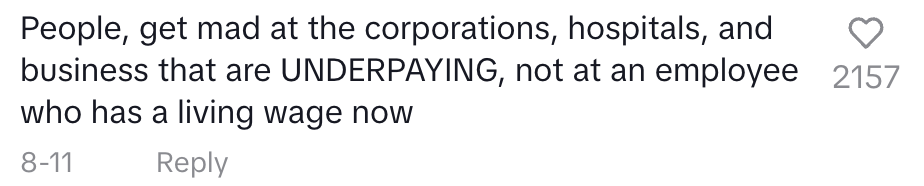
Most of the top commenters were supportive of Skyler’s message and really appreciated the transparency. One commenter wrote, “People, get mad at the corporations, hospitals, and businesses that are UNDERPAYING, not at an employee who has a living wage now.”

  @skylerleestutzman / Via tiktok.com

Another commenter chimed in, “If you’re making less in another field and upset, don’t bring these workers down, find out why your field isn’t willing to offer you a livable wage!”

  @skylerleestutzman / Via tiktok.com

Other commenters referenced the less-publicized fact that the new UPS deal will also make air conditioning in UPS trucks a requirement for the first time after more than 100 UPS workers have been hospitalized for heat-related illness in the last few years. (I genuinely can’t believe UPS workers have been driving around in the heat without AC in the year 2023).

If they don't have A/C in their trucks they deserve $270k a year

Some gently roasted UPS drivers, like this person who wrote, “$90k I would expect my package to be on time and delivered to my door and not the neighbors.”

  @skylerleestutzman / Via tiktok.com

Some fellow UPS workers also pointed out that the $170k figure doesn’t apply to everyone. One person wrote, “I’m a loader at UPS. I make $19.20 per hour and only get 4.5 hours a day. There is a HUGE disparity between drivers and everyone else.”

  @skylerleestutzman / Via tiktok.com

And others praised the power of unions and half-jokingly requested a little bit of help. One commenter wrote, “Can the UPS union come help out teacher unions?”

  @skylerleestutzman / Via tiktok.com

Another commenter added, “The only reason why it’s amazing to work for UPS is the union. Which fights against corporate executives and against the shareholders.”

  @skylerleestutzman / Via tiktok.com

While others rightfully pointed out that delivering packages is so much harder than it looks (Most jobs are, TBH). As someone who regularly lost my temper while doing much lighter food delivery shifts, yes, this absolutely checks out. Driving all day is tiring and can be dangerous at times, not to mention the heavy lifting involved in some UPS deliveries. And to do all that without air conditioning in this heat? I wouldn’t last an hour.

people complaining about ups drivers making too much wouldn't dare work a day as one it's hard work

There were also quite a few commenters who liked seeing that Skyler showed himself clocking out to make the video, then clocking back in when he was done. If you’re gonna post about work on social media, this is a great way to do it.

bro clocked out to make the vid played it safe

But some commenters were not so happy to learn about how much UPS drivers make. One commenter wrote, “I’m sorry, this is ridiculous. Most RNs [registered nurses] don’t make that much.” In a video made in response, Skyler said, “I never said that I should make more than anybody in the medical industry. Now, this might be a little bit of an unpopular opinion, but I don’t think I should make less. I think they should make more.”

@skylerleestutzman / Via tiktok.com

Skyler told BuzzFeed that he’s been working for UPS since 2008, and in another video he said, “I’ve actually been with the company for 15 years now. And to be able to say that at such a young age, I feel very blessed.”

In a statement, Teamsters General President Sean M. O’Brien said of the deal, “Teamsters have set a new standard and raised the bar for pay, benefits, and working conditions in the package delivery industry. This is the template for how workers should be paid and protected nationwide, and nonunion companies like Amazon better pay attention.”

At Yale, a Surge of Activism Forced Changes in Mental Health Policies

0

In the weeks after Rachael Shaw-Rosenbaum, a first-year student at Yale, died by suicide in 2021, a group of strangers began convening on Zoom.

Some of them knew Ms. Shaw-Rosenbaum. But many only knew what she had been going through, as she struggled with suicidal thoughts and weighed the consequences of checking herself into the hospital.

One, a physician in her early 40s, had been told years ago to withdraw from Yale while she was hospitalized after a suicide attempt, an experience she recalls as chillingly impersonal, “like you’re being processed through this big machine.”

Another, a classical pianist in his 20s, withdrew from Yale amid episodes of hypomania and depression, feeling, as he put it, “not just excluded but rejected and cut off and forgotten about.”

Members of the group, which took the name Elis for Rachael, shared a complaint that Yale’s strict policies on mental health leaves — requiring students to withdraw without a guarantee of readmission, stripping them of health insurance and excluding them from campus — had penalized students at their most vulnerable moments.

“We discovered that there were just generations of Yalies who had had similar issues, who had kept quiet about it for decades and decades,” said Dr. Alicia Floyd, the physician, one of the group’s founders. “And we all felt like something needed to change.”

The organizing that began that day culminated last month in a legal settlement that considerably eases the process of taking a medical leave of absence at Yale.

Under the new policy, students will have the option to extend their insurance coverage for a year. They will no longer be banned from campus spaces or lose their campus jobs. Returning from leave will be simpler, with weight given to the opinion of the student’s health care provider.

Most strikingly, Yale has agreed to offer part-time study as an accommodation for students in some medical emergencies, a step it had resisted.

“My hope is that the changes that have emerged from these discussions will make it easier for students to ask for support, focus on their health and well-being and take time off if they wish, knowing that they can resume their studies when they are ready,” said Pericles Lewis, the dean of Yale College, in a message to students.

Yale declined to comment beyond the statement from Dean Lewis.

Yale’s withdrawal policies were the subject of a Washington Post investigation in November 2022. The same month, Elis for Rachael filed a class-action lawsuit accusing the university of discriminating against students with disabilities.

Yale is not the only elite university to face legal challenges over its mental health policies. The Department of Justice has investigated Brown and Princeton over their handling of withdrawals, and Stanford faced a similar class-action lawsuit in 2019.

By offering part-time study as an accommodation, Yale has provided relief beyond what Stanford did, said Monica Porter Gilbert, an attorney at the Bazelon Center for Mental Health Law who represented plaintiffs in both cases.

“It’s the students and the plaintiffs in this case making their voices heard and bringing Yale to the table to have difficult conversations,” she said. The pandemic years, she added, have brought new urgency to their arguments. “As a nation, we talk about mental health differently now.”

Alicia Abramson, a Yale senior who is one of the two student plaintiffs in the class-action lawsuit, said Yale’s response was swifter and more comprehensive than she had expected. “It’s hopeful, in the sense that maybe they are finally taking this thing seriously,” she said.

She has no plans to abandon her advocacy work anytime soon, though. “I’m certainly hesitant to give Yale infinite praise,” she said. “You know, we had to sue them, right?”

As she struggled with suicidal thoughts in the second half of her first year at Yale, Ms. Shaw-Rosenbaum worried she would be forced to withdraw, jeopardizing the scholarships she needed to stay at Yale, said Zack Dugue, her boyfriend.

She had already been hospitalized once, her first semester. “Basically, if I go to the hospital again, I will not be able to resume college and will lose the opportunity I had to learn at an extremely competitive university,” she wrote in a post on Reddit a few days before she died.

Growing up in Anchorage, Alaska, Ms. Shaw-Rosenbaum had been a debate champion. She dreamed of following her idol, Ruth Bader Ginsburg, to the Supreme Court.

Mr. Dugue, who met her at a scholarship event the spring of their senior year of high school, described her as “a tiny firebrand” and “super-duper kind.” She was still very young: Mr. Dugue was the first boy she ever kissed, her mother said.

She was not from a wealthy family; at home, she had at one time received health care through Medicaid. Withdrawing would mean losing not just her sense of belonging, but her Yale health insurance, a prospect Mr. Dugue said she found “apocalyptic.”

“She also would have lost access to the very care she needed,” he said. “That was like a terrible tightrope to walk.”

For decades, students had criticized Yale’s withdrawal and readmission policies, which were deemed among the least supportive in the Ivy League in a 2018 white paper by the Ruderman Family Foundation.

In 2015, a sophomore math major named Luchang Wang died by suicide after posting a desperate message on Facebook, saying she “couldn’t bear the thought of having to leave for a full year, or of leaving and never being readmitted.”

“Yale was a case where they were being very strict, and people would have to apply multiple times,” said Marcus Hotaling, president of the Association for University and College Counseling Center Directors and director of counseling at Union College in Schenectady, N.Y.

Colleges must weigh the risks of allowing struggling students to remain on campus, he said, since they may be found liable for allowing a student’s condition to deteriorate.

Dr. Hotaling cited the case of Elizabeth Shin, a student at the Massachusetts Institute of Technology who died by suicide in 2000. Her parents, who had not been told of her decline, filed a $27 million wrongful death lawsuit against M.I.T.; the case was settled for an undisclosed amount.

Suicide contagion may be a concern for the university; so is the effect a suicide on campus may have on the larger community. “That’s going to have a drastic impact on the roommate, on the residents who live around them, their friends, their peers, their classmates,” he said.

After Ms. Shaw-Rosenbaum’s death, Yale officials took the unusual step of releasing a statement denying an allegation, circulating on social media, that Yale had refused her request to take a leave.

Undergraduate activists began demanding changes to the leave policy, as they had after previous suicides, but there was little response from Yale. “At the end of the day, we recognized we were at the mercy of the institution,” said Miriam Kopyto, who was then a leader in the Yale Student Mental Health Association.

A shift came with the involvement of alumni, who convened their first Zoom meeting just a few days after Ms. Shaw-Rosenbaum’s death. About two dozen people attended, including Mr. Dugue, and all felt some personal connection to the cause, said Lily Colby, a community organizer.

They held a moment of silence, shared pictures of Ms. Shaw-Rosenbaum and told their own stories. “We have been impacted in some way,” Ms. Colby said later, describing the core group. “We’ve had a loss or a tragedy.”

Students had tended to ask the university for accommodations on the grounds that it was the right thing to do, Ms. Colby said. The alumni began educating them on what they could demand under law — like a change to the leave policies.

For student activists, this was a fundamental shift. “Some of it is a favor,” Ms. Kopyto said. “And some of it is not.”

In January, Yale introduced major changes to its policy, reclassifying mental health breaks as leaves of absence rather than withdrawals, extending health insurance benefits and simplifying the reinstatement policy.

The settlement expands those protections by offering part-time study and creating a “Time Away Resource” for undergraduates. The court will oversee Yale’s compliance with the agreement for three years.

Lucy Kim, 22, who was among the last undergraduates to take a medical withdrawal under the old system, recalls crying when she read the news, because the accommodations were the ones that she had needed.

“I just kept thinking, if only I had gotten sick a year later,” she said.

She was a second-semester sophomore, juggling coursework in molecular biology and biochemistry and global affairs, when she stopped sleeping for 40-hour stretches. Her hands shook so violently that she dropped things. She began hallucinating.

Diagnosed with a sleep disorder, she initiated a medical withdrawal in December 2021. She had studied the policies, but was still jolted by the reality: She was given 72 hours to vacate her dormitory and surrender her key card.

“It really is like losing your house, your job and your family, all at the same time,” she said. She drained her savings, she said, spending $15,000 on rent, food and tuition for summer school classes before applying for reinstatement by submitting an essay, grades and letters of recommendation.

Ms. Kim, who will graduate next May, hopes mental health leaves will be seen differently now. This weekend, she began recruiting undergraduates to serve as “time away mentors” who help others navigate the process of taking leaves and returning to campus. She hopes that the university will provide funding.

“I think that Yale does want to move in the right direction,” she said. “It’s a matter of accumulating those voices for change until it reaches the threshold point where Yale says this is probably for the benefit of the greater student body.”

In interviews, students said the new policy opens avenues they had viewed as shut.

“What they’ve done has created an opening where I feel like I could actually go back if I wanted to,” said one former student, Jen Frantz, referring to the option of part-time study. She withdrew from Yale twice because of mental health crises, and finally let go of the idea of finishing her degree.

Ms. Frantz, 26, went on to get an M.F.A. in poetry at the Iowa Writers’ Workshop and now tutors students working on college essays. She said she felt “a little light touch of mourning of what could have been if they had been more prompt.”

As for Ms. Shaw-Rosenbaum, she was a stickler for detail. Had she lived, Mr. Dugue said, she might have sued Yale herself at some point.

“She read the withdrawal policies, she explained them to me, she was thinking about them, she knew they were wrong,” he said.

Rachael’s mother, Pamela Shaw, singled out two provisions of the settlement that she thought would have helped her daughter: part-time study and an administrator dedicated to advising on time away.

“I just wish she’d been here for the fight,” Ms. Shaw said.

Kitty Bennett, Susan Beachy and Alain Delaquérière contributed research.

Audio produced by Sarah Diamond.