The cryptocurrency trader whose ultra-leveraged Ether (ETH) trade tested Hyperliquid’s limits on March 12 has entered another multimillion-dollar position, this time in Chainlink (LINK), onchain data shows.
On March 14, the anonymous whale, referred to on X as “ETH 50x Big Guy,” took out long positions in LINK worth approximately $31 million with 10 times leverage, according to Lookonchain, a Web3 analytics service.
He placed the bets on Hyplerliquid and GMX, two popular perpetuals exchanges, Lookonchain said in a March 14 X post. Additionally, the whale accumulated roughly $12 million in spot LINK.
In the ensuing hours, the whale gradually reduced his LINK holdings through small swaps back into stablecoins, as per onchain data.
On March 12, the unidentified trader intentionally liquidated a roughly $200 million ETH long position, causing Hyperliquid’s liquidity pool, HLP, to lose $4 million. The trader’s profits topped roughly $1.8 million.
According to Lookonchain, the trader has earned nearly $17 million in the past month on Hyperliquid.
The incident highlighted the challenges facing perpetual trading platforms such as Hyperliquid, which enable traders to take long or short positions many times larger than their deposited capital.
Hyperliquid said the trader’s actions did not qualify as an exploit and were instead a predictable consequence of the mechanics of its trading platform under extreme conditions.
In response to the losses, Hyperliquid announced on March 13 revised collateral rules for traders with open positions to guard against similar edge cases in the future.
Launched in 2024, Hyperliquid’s flagship perpetuals exchange has captured 70% of the market share, surpassing rivals such as GMX and dYdX, according to a January report by asset manager VanEck.
Chainlink, the most popular decentralized oracle service, saw the price of its native LINK token increase by more than 150% in the weeks after President Donald Trump prevailed in the US election.
It has since given up much of those gains, declining from highs of nearly $30 per token in December to less than $14 as of March 14, according to data from CoinGecko.
Chainlink’s market capitalization is currently around $8.7 billion.
The cryptocurrency trader whose ultra-leveraged Ether (ETH) trade tested Hyperliquid’s limits on March 12 has entered another multimillion-dollar position, this time in Chainlink (LINK), onchain data shows.
On March 14, the anonymous whale, referred to on X as “ETH 50x Big Guy,” took out long positions in LINK worth approximately $31 million with 10 times leverage, according to Lookonchain, a Web3 analytics service.
He placed the bets on Hyplerliquid and GMX, two popular perpetuals exchanges, Lookonchain said in a March 14 X post. Additionally, the whale accumulated roughly $12 million in spot LINK.
In the ensuing hours, the whale gradually reduced his LINK holdings through small swaps back into stablecoins, as per onchain data.
On March 12, the unidentified trader intentionally liquidated a roughly $200 million ETH long position, causing Hyperliquid’s liquidity pool, HLP, to lose $4 million. The trader’s profits topped roughly $1.8 million.
According to Lookonchain, the trader has earned nearly $17 million in the past month on Hyperliquid.
The incident highlighted the challenges facing perpetual trading platforms such as Hyperliquid, which enable traders to take long or short positions many times larger than their deposited capital.
Hyperliquid said the trader’s actions did not qualify as an exploit and were instead a predictable consequence of the mechanics of its trading platform under extreme conditions.
In response to the losses, Hyperliquid announced on March 13 revised collateral rules for traders with open positions to guard against similar edge cases in the future.
Launched in 2024, Hyperliquid’s flagship perpetuals exchange has captured 70% of the market share, surpassing rivals such as GMX and dYdX, according to a January report by asset manager VanEck.
Chainlink, the most popular decentralized oracle service, saw the price of its native LINK token increase by more than 150% in the weeks after President Donald Trump prevailed in the US election.
It has since given up much of those gains, declining from highs of nearly $30 per token in December to less than $14 as of March 14, according to data from CoinGecko.
Chainlink’s market capitalization is currently around $8.7 billion.
House Minority Leader Hakeem Jeffries, D-N.Y., sidestepped questions on whether he had confidence in Senate Majority Leader Chuck Schumer, D-N.Y., on Friday.
The top House Democrat was directly asked about Schumer twice during a hastily-announced press conference to emphasize their opposition to Republicans’ government funding bill.
Early during the press conference, Jeffries was asked if it was time for new leadership in the Senate, to which he replied, “Next question.”
Jeffries gave the same exact answer when asked later if he had “lost confidence” in Schumer.
House Minority Leader Hakeem Jeffries, D-N.Y., right, is joined by Senate Minority Leader Chuck Schumer, D-N.Y., for a press conference in Statuary Hall at the Capitol in Washington, D.C., on Feb. 12.(AP/Rod Lamkey, Jr./File)
Many say it’s a major public rift between the top two Democrats in Congress. Jeffries’ silence on his fellow New York liberal comes as other Democratic lawmakers aim their fury at Schumer for announcing he will vote with Republicans to avert a partial government shutdown.
Jeffries later emphatically pushed back when Fox News questioned whether he was “afraid to say anything about Schumer.”
“Do not characterize my remarks. I’m not afraid about anything,” Jeffries said.
When pressed again, he said, “Do you think that this is what the American people care about right now? Or do they want us to do everything that we can to stop this partisan and harmful Republican bill from actually becoming law? Because that’s what we as House Democrats are focused on right now.”
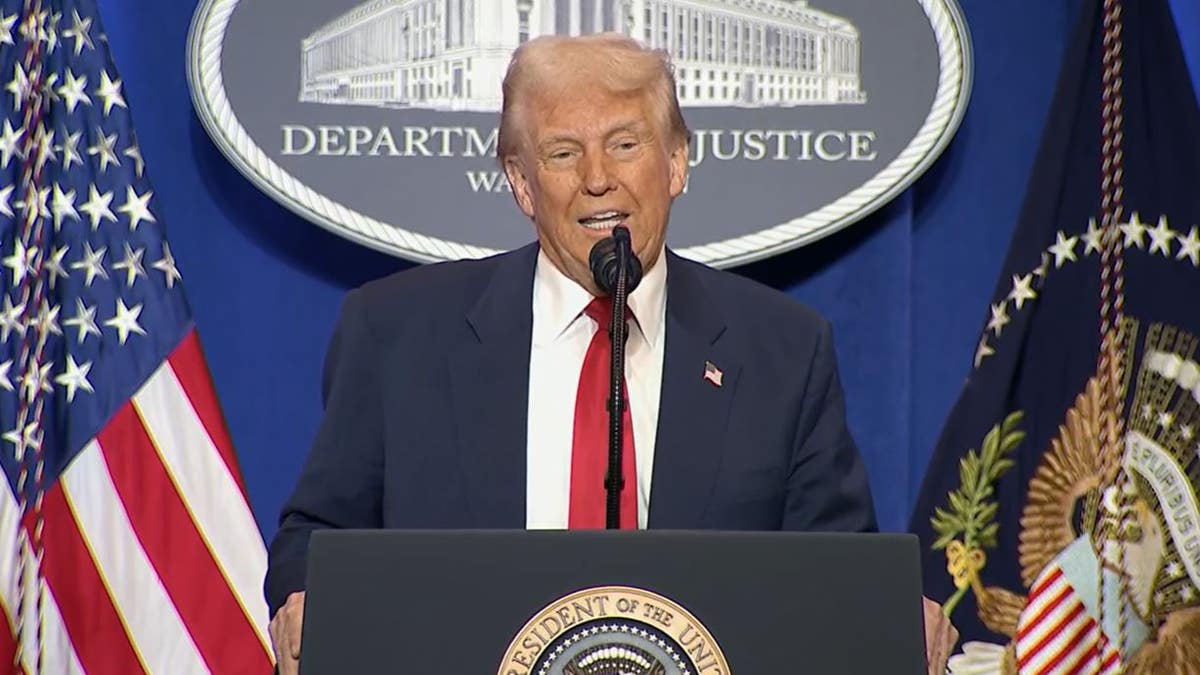
President Donald Trump speaks at the Department of Justice in Washington, D.C., on Friday.(Fox News/Pool)
Jeffries avoided mentioning Schumer during his press conference, but reporters pressed him with questions about the growing rift between him and the senior Democrat.
He did not directly answer when asked if Schumer “acquiesced” to President Donald Trump, only pointing out the vote had not yet taken place.
“That’s a question that is best addressed by the Senate. The vote hasn’t taken place yet, and the House Democratic position is very clear. We strongly oppose any efforts to cut the healthcare of the American people, veterans benefits and nutritional assistance, all of which are in the partisan Republican bill,” Jeffries said.
Democrats are in historic levels of disarray over a Republican bill to avert a government shutdown that’s been backed by Trump.
Progressives have been attacking Schumer for announcing he would not block the bill, but whether Republicans can find enough Democratic support to reach the necessary 60-vote threshold is still unclear.
The bill passed the House last week with support from just one House Democrat — Rep. Jared Golden, D-Maine.
The House and the Senate must send a bill to Trump’s desk by midnight Friday to avert a partial government shutdown.
Elizabeth Elkind is a politics reporter for Fox News Digital leading coverage of the House of Representatives. Previous digital bylines seen at Daily Mail and CBS News.
Follow on Twitter at @liz_elkind and send tips to elizabeth.elkind@fox.com
The agency responsible for conducting criminal prosecutions in England and Wales announced that a National Crime Agency (NCA) officer was due to be charged with the alleged theft of Bitcoin worth roughly $75,000 in 2017.
In a March 14 notice, the Crown Prosecution Service said it had authorized the Merseyside Police to charge NCA officer Paul Chowles with 15 offenses related to the alleged Bitcoin (BTC) theft “during an investigation into online organized crime.” Authorities said Chowles could face one count of theft, 11 charges for concealing, disguising, or converting criminal property and three counts for acquiring, using or possessing criminal property.
The 50 Bitcoin, worth roughly $75,000 before the December 2017 bull run, was valued at more than $4.2 million at the time of publication at a BTC price of $84,541. The NCA officer is expected to appear at the Liverpool Magistrates’ Court on April 25.
In April 2024, amendments to the UK’s Economic Crime and Corporate Transparency Act authorized NCA officers and local police to seize crypto from suspected criminals without arresting them. The Crown Prosecution Service did not mention how Chowles allegedly stole the Bitcoin or whether the funds were connected to illicit activities.
Crypto policies across the pond
The NCA said in December 2024 that it had seized roughly $26 million in cash and crypto and arrested 84 people as part of a global campaign to fight money laundering and organized crime. Some of the crypto addresses targeted by UK authorities at the time “showed regular exposure to Garantex.” The founder of the Russian crypto exchange was arrested in India in March and is expected to be extradited to the US to face criminal charges.
The UK government is expected to move forward on creating a comprehensive regulatory framework for digital assets in 2025 following the Labour government’s election victory. The country remains a significant market for crypto users, with Coinbase securing approval to operate from the financial regulatory body in February.
Several types of skincare products used to treat acne have been recalled due to a cancer risk.
The products, which contain benzoyl peroxide, a common treatment for acne, were tested for elevated levels of benzene, the U.S. Food and Drug Administration (FDA) said in a notice this week.
Several types of skincare products used to treat acne have been recalled over a cancer risk. (iStock)
The manufacturer of Zapzyt Acne Treatment Gel also agreed to voluntarily recall the product because of an elevated level of benzene found in its own testing, the FDA said.
The FDA explained that 90% of the 95 products with benzoyl peroxide that were tested had “undetectable or extremely low levels of benzene.”
Benzene is a “chemical used in the production of a wide range of industrial products, including chemicals, dyes, detergents, and some plastics,” according to the agency.
It is released into the air through “cigarette smoke, emissions from automobiles, and burning coal and oil.”
La Roche-Posay Effaclar Duo Dual Action Acne Treatment with lot number MYX46W is one of the recalled products.(La Roche-Posay)
While it is safe to use benzoyl peroxide in acne products, benzene contamination in small amounts over a long period of time “can decrease the formation of blood cells. Long-term exposure to benzene through inhalation, oral intake, and skin absorption may result in cancers such as leukemia and other blood disorders.”
The FDA said it started independent testing of benzoyl peroxide products after third-party test results “raised concerns about elevated levels of benzene in certain acne products.”
“FDA testing results indicate fewer products with benzene contamination than the third-party findings,” the agency added.
The FDA said the companies had voluntarily recalled the products, noting it was at the retail and not the consumer level.(AP Photo/Andrew Harnik, File)
The FDA said the companies had voluntarily recalled the products, noting it was at the retail and not the consumer level.
“This means retailers are instructed to remove products from store shelves and online marketplaces but does not specifically instruct consumers to take actions regarding products currently in their possession,” the FDA said. “Even with daily use of these products for decades, the risk of a person developing cancer because of exposure to benzene found in these products is very low.”
XRP’s fully diluted valuation (FDV) has surpassed Ether (ETH), according to March 14 data from CoinGecko.
The FDV flip signifies a reversal of fortune for both layer-1 (L1) blockchain networks behind the tokens, as XRP Ledger’s decentralized finance (DeFi) ecosystem gains traction and Ethereum grapples with competition from rival L1s, such as Solana.
As of March 14, XRP’s FDV stood at nearly $235 billion, more than $1 billion higher than Ether’s, according to CoinGecko. Ether’s market capitalization still leads at $233 billion versus XRP’s $136 billion, the data shows.
FDV measures the cumulative value of all existing tokens, whereas market capitalization only counts tokens already in circulation.
XRP’s developer, Ripple Labs, holds a multibillion-dollar allocation of its chain’s native token.
XRP’s price has risen by more than 300%, to around $2.3 per token, since President Donald Trump prevailed in the US elections on Nov. 5.
Trump said he wants America to become the “world’s crypto capital” and has appointed industry-friendly leadership to key regulators.
The thawing US regulatory environment is especially beneficial for XRP, which prioritizes enterprise users and unveiled an institutional DeFi roadmap in February.
The XRP token saw further support when Trump said he planned to include XRP in a proposed US Digital Asset Stockpile alongside other cryptocurrencies, such as Solana (SOL) and Cardano (ADA).
The US Securities and Exchange Commission is reportedly “in the process of wrapping up” an enforcement action against Ripple that has beleaguered the XRP developer since 2020.
The regulator has already dropped actions against crypto firms such as Coinbase, Kraken and Uniswap.
Meanwhile, Ether’s spot price has struggled since March 2024, when the network’s Dencun upgrade cut transaction fees by approximately 95%.
As of March, trading volume on Solana, which prioritizes fast transaction execution and was central to 2024’s memecoin frenzy, rivals that of Ethereum and all of its layer-2 scaling chains combined.
The US dollar has long reigned as the world’s primary reserve currency and the default choice for global trade and international transactions. But its dominance is now facing growing scrutiny as shifting geopolitical and economic forces—and concerns over the potential weaponization of the greenback—push more countries to accelerate efforts to loosen their dependence on the dollar.
By almost every measure, the US dollar’s command of the global economy is staggering. Although the country accounts for roughly 25% of global GDP, its currency reigns over nearly 60% of global foreign exchange reserves—far outpacing its nearest rival, the euro.
But this dominance is increasingly under pressure, with the strategic use of economic sanctions in the past leading some countries to seek alternatives, even as US President Donald Trump regularly threatens 100% tariffs on countries that actively seek to substitute the greenback.
In Russia, whose access to the SWIFT payment platform is crippled by sanctions, companies have been using cryptocurrencies as a means to skirt restrictions, turning to Bitcoin and other digital assets to conduct cross-border business. While crypto was barred as illegal by the country´s central bank years ago, recent changes to the regulation have paved the way for corporations to embrace cryptocurrencies since late last year.
The country permitted the use of cryptocurrencies in foreign trade and has taken steps to make it legal to mine cryptocurrencies, including Bitcoin.
Bitcoin, sanctions and the push for dedollarization
Since Bitcoin’s inception, crypto advocates have been fixated on “dedollarization,” often described as the push to reduce the US dollar’s dominance as the global reserve currency. The term broadly refers to moving away from the dollar in key financial and trade activities, including oil and commodity transactions (the petrodollar system), foreign exchange reserves, bilateral trade agreements, and investments in dollar-denominated assets.
A 2024 paper by Morgan Stanley’s head of Digital Asset Markets, Andrew Peel, suggested that the rise of digital currencies presents “opportunities to both erode and reinforce” the US dollar’s dominance, with the potential to significantly alter the global currency landscape.
Still, while digital assets—most notably stablecoins— are increasingly gaining traction, the crypto market’s dedollarization expectations look premature.
While Bitcoin is increasingly seen as a strategic reserve asset, experts caution that it’s still too soon to call it a true alternative to the US dollar. Countries like El Salvador have embraced Bitcoin aggressively, with the asset now making up about 15% to 20% of the nation’s total reserves. The US has reportedly considered similar moves, but widespread adoption remains limited, and questions persist about whether such steps would undermine the dollar rather than support it.
According to Bitcoin Depot CEO Brandon Mintz,
“For Bitcoin to become a true alternative to the USD, it would require broader mainstream adoption, clearer regulatory frameworks, and more scalable infrastructure.”
Currently, Bitcoin acts more like a hedge and a store of value than a dollar replacement, but its role could shift as global financial dynamics evolve. Factors like inflation and geopolitical tensions, Mintz said, could drive more interest.
While institutional adoption and cross-border use are on the rise, Mintz said that it remains to be seen “whether Bitcoin can genuinely challenge the dominance of the dollar as this will depend on how these trends develop over time.”
Despite its growing appeal, Bitcoin’s volatility remains a significant challenge. According to the World Gold Council, Bitcoin exhibits considerably higher volatility than gold and shows a greater correlation with Nasdaq tech stocks than with traditional safe-haven assets.
Gold and major asset 5-year average daily volatility – annualized. Source: World Gold Council.
Eswar Prasad, a trade professor at Cornell University, told Cointelegraph,
“Decentralized cryptocurrencies such as Bitcoin still have highly volatile values, rendering them unsuitable as mediums of exchange or as reserve currencies.”
US dollar global foreign reserves decline
Since the end of World War II, the US dollar has reigned as the world’s dominant currency, powering around 88% of global trade transactions in 2024.
The dollar’s status as the leading international currency is well-established. According to the International Monetary Fund, as of the third quarter of 2024, central banks held about 58 percent of their allocated reserves in US dollars—much of it in cash and US bonds. This is significantly higher than the euro, second in the race, which accounts for as much as 20%
Allocated foreign exchange reserves by central banks. Source: International Monetary Fund
While the US dollar remains the dominant global currency due to its stability, widespread acceptance in international trade and finance, and status as a key reserve asset for central banks, there are signs that its reign may be waning. The percentage of global foreign reserves held in dollars has diminished from over 70% in the early 2000s to below 60%.
Percentage of global FX reserves held in US dollars. Source: International Monetary Fund
The turning point came after February 2022 when the US froze $300 billion of Russia’s liquid foreign exchange reserves held in the US and NATO countries. While many US allies backed the move, it also sent shockwaves through global markets, highlighting the risk that Washington could weaponize the dollar against not just adversaries but potentially allies whose policies clash with American interests.
Citing the use of sanctions and how sanctioned countries react, an International Monetary Fund blog post in 2024 said,
“We have found that financial sanctions when imposed in the past, induced central banks to shift their reserve portfolios modestly away from currencies, which are at risk of being frozen and redeployed, in favor of gold, which can be warehoused in the country and thus is free of sanctions risk.”
Do stablecoins actually reinforce dollarization?
Despite efforts by BRICS+ nations to counteract US dollar dominance, the dollar’s value has remained strong in recent years. The US Dollar Index is up roughly 8% over the past five years.
In the crypto sector, stablecoins have emerged as some of the fastest-growing digital assets, often cited as a potential solution for cross-border transactions. However, most stablecoins are still pegged to the US dollar.
Currently, the stablecoin market cap stands at $233 billion, with US-pegged stablecoins such as Tether’s USDT dominating 97% of the sector, according to CoinGecko data.
This overwhelming reliance on USD-backed stablecoins suggests that rather than undermining dollar dominance, digital assets may actually reinforce it. “With USD-linked stablecoins at the core of this digital ecosystem, we have a unique chance to extend US financial influence globally—if policymakers act now,” Cody Carbone, president of Digital Chamber, a US-based blockchain advocacy association, said on X.
The emergence and widespread adoption of central bank digital currencies (CBDCs) could disrupt some cryptocurrencies, particularly stablecoins, by providing efficient and low-cost digital payment alternatives.
“A widely accessible digital dollar would undercut the case for privately issued stablecoins, though stablecoins issued by major corporations could still have traction,” said Prasad.
Still, Prasad emphasized that no viable alternative is poised to displace the US dollar as the dominant global reserve currency.
“The dollar’s strengths lie not just in the depth and liquidity of US financial markets but also in the institutional framework that underpins its status as a safe haven.”
This article is for general information purposes and is not intended to be and should not be taken as legal or investment advice. The views, thoughts, and opinions expressed here are the author’s alone and do not necessarily reflect or represent the views and opinions of Cointelegraph.
In the first three months of his presidency, Donald Trump has ignited trade tensions by announcing tariffs on Canada, Mexico, and China and the result has been unexpected turmoil in US and global markets.
The fallout from the tariffs has been relatively swift, and the impact has been felt across the crypto market. As of March 8, the US president had backed away from some plans to impose tariffs on certain Mexican and Canadian goods—another twist in the rollercoaster of US trade policy that continues to shake markets.
Singapore crypto trading firm QCP Capital said in a note. “This week’s crypto markets have been nothing short of a roller coaster. With macro conditions in flux, crypto remains tightly linked to equities, with price action reflecting broader economic shifts.”
The wild swings underscore the volatility ahead for cryptocurrencies—often seen as high-risk assets—as the Trump administration tests the limits of economic and foreign policy and serves as a cautionary tale as uncertainty pervades markets.
In a post on X, former US Treasury Secretary Lawrence Summers said that […] tariff policy has already taken $2 trillion off the value of the US stock market,” and Summers suggested that these measures were “ill-conceived” and that they would undermine US competitiveness.
“No wonder Wall Street’s fear gauge is up by one-third.”
Volatility index (VIX) price action. Source: Yahoo! Finance.
While tariffs and Trump’s market-moving policy announcements may create a sense of impending doom, their impact on the future of the crypto sector remains in question. If a trade war weakens the US dollar through inflation, Bitcoin could actually benefit, says Eugene Epstein, head of trading and structured products at Moneycorp. Investors fleeing depreciating fiat currencies may turn to crypto, and if tariff-hit nations devalue their currencies in response, Bitcoin could serve as a vehicle for capital flight.
Unlike traditional markets, Bitcoin trades 24/7 and reacts instantly to macroeconomic shifts, making it highly vulnerable to risk-off sentiment. “Sentiment-wise, the primary drivers of crypto will continue to be the status of a federal crypto reserve as well as overall risk sentiment. If US equities continue falling it is hard to envision a strong crypto market, at least in the near term,” Epstein said.
Many in the crypto community expected Trump’s return to the White House to send Bitcoin soaring, and initially, it did—rising from $69,374 on Election Day to a record $108,786 by Inauguration Day. But since then, BTC has tumbled, dropping below $80,000 by late February and again in March. The price weakness comes despite the administration’s pro-crypto stance, including plans for a strategic crypto reserve and market-structure reforms.
Cumulative flows into Bitcoin Spot ETFs reached record highs following Trump’s victory, with investors pouring over $10 billion into these instruments in the aftermath of the election, according to data by Farside Investors. However, growing concerns over a potential tariff war seem to have taken a toll on market sentiment and, by extension, on cryptocurrencies.
Since early February, Bitcoin ETFs have seen significant outflows as uncertainty looms over the broader economic landscape. At the same time, safe haven assets like gold, have actually responded positively amid the tariff war.
This isn’t the first time President Trump has wielded tariff threats as a bargaining chip and some traders believe the market will adjust to focus on fundamentals over the blunt use of tariffs as a way to force policy changes among US allies.
That’s why some traders in the industry choose to not base their strategies solely on tariffs. For Bob Walden, head of Trading at Abra, tariffs are “just a headline” that influences short-term investor sentiment but doesn’t alter the market’s fundamental conditions.
“To me, tariffs are a red herring. It is something Trump uses as a bargaining chip, and I do not think they mean anything to crypto. They initially caused a drawdown—tariffs caught a market that was long at the top and over-leveraged looking for an exciting move—but that was a correlation, not the causation.”
Walden points to Trump’s fiscal austerity program as the real driver of crypto markets.
“That is what everyone’s looking at in the TradFi space. Tariffs are just another piece in the fiscal austerity trade that’s happening across global markets—that is actually what’s influencing crypto a lot more, as fiscal austerity means less cash out there to deploy.”
This article is for general information purposes and is not intended to be and should not be taken as legal or investment advice. The views, thoughts, and opinions expressed here are the author’s alone and do not necessarily reflect or represent the views and opinions of Cointelegraph.
Bolivia’s state-owned energy firm YPFB is planning to use cryptocurrency to pay for energy imports, according to a March 13 report from Reuters. The move comes as the South American nation faces a shortage of foreign currency reserves and a dwindling supply of domestic gas production.
A spokesperson for YPFB said that a system had been put in place to use cryptocurrency to purchase energy imports after the government approved the use of digital assets to meet the country’s demand. While YPFB has not used the system yet, it plans to do so.
The report does not reveal what cryptocurrency will be used for the payments. Stablecoins, which are digital assets pegged to fiat currency, are often used to make cross-border transactions, though it is unclear if that will be the case in Bolivia.
The fuel shortage in Bolivia has led to protests and the threat of strikes among some of the nation’s workers, including farmers, who say the lack of fuel threatens their summer harvest. Only 35%–50% of the country’s public transport system is functional. Alejandro Gallardo, the energy and hydrocarbons minister, said there are challenges due to foreign currency shortages.
The spokesperson for YPFB noted that the new purchasing system was designed to support national fuel subsidies in the country amid the shortage of foreign currency. “From now on, these (cryptocurrency) transactions will be carried out,” they said.
In June 2024, Bolivia’s central bank, Banco Central de Bolivia, lifted its ban on Bitcoin (BTC) and crypto payments, allowing financial institutions to transact with digital assets. The ban had been in place since 2014.
In September 2024, Bolivia reported a 100% rise in virtual asset trading, with roughly $15.6 million worth of assets traded on a monthly basis between July and September. The $48.6 million traded was largely made up of stablecoins. Stablecoins are often used in developing countries whose local currency has experienced a high degree of devaluation or where there’s a shortage of foreign currency.
Stablecoin use gained further momentum in Bolivia in October 2024 when local bank Banco Bisa introduced a stablecoin custody service. That service, which was supported by the country’s financial regulator, allows the nation’s residents to buy, sell and trade Tether’s USDt (USDT), a US dollar-pegged stablecoin.
A characteristic lack of momentum at the start of the US trading session persisted, with risk assets still wary of macroeconomic and geopolitical surprises, notably in the form of US trade tariffs.
Assessing the current status quo on the daily BTC/USD chart, popular trader and analyst Rekt Capital reported increasing odds of a bullish divergence playing out on the relative strength index (RSI) metric.
Here, RSI should make higher lows as the price forms lower lows to indicate waning seller dominance.
“Promising early-stage signs of a Bullish Divergence developing,” he wrote in one of the day’s posts on X.
“Reclaiming the previous lows of $84k could set price up to further build out this Bull Div.”
BTC/USD 1-day chart with RSI data. Source: Rekt Capital/X
Another post flagged a key horizontal resistance line currently under attack from bulls.
“Bitcoin continues to Daily Close below the blue resistance. However, each rejection from this resistance appears to be weakening in terms of follow-through to the downside,” Rekt Capital commented.
“If this weakening in the resistance persists… This should open up the opportunity for BTC to finally Daily Close above this $84k resistance, reclaim it as support, and finally trend continue to the upside.”
BTC/USD 1-day chart with RSI data. Source: Rekt Capital/X
Keith Alan, co-founder of trading resource Material Indicators, meanwhile focused on the 21-day and 200-day simple moving averages (SMAs). At the time of writing, these stood at $83,740 and $86,800, respectively.
“BTC is poised to make another run at reclaiming the 200-Day MA, but it will only count if we get a sustained close above it, AND it is closely followed by an R/S Flip at the 21-Day MA,” an X post on the topic read.
BTC/USD 1-day chart with 21, 200SMA. Source: Cointelegraph/TradingView
Alan referenced one of Material Indicators’ proprietary trading tools, calling for an increase in “bullish momentum.”
“Notice how Trend Precognition’s A1 Slope line is showing a developing momentum shift,” he commented alongside a corresponding chart.
“Reverting from downward momentum is step 1. We need to see an increase in bullish momentum from here, with bids moving higher to stage a sustainable rally.”
BTC/USD 1-day chart. Source: Keith Alan/X
Gold leaves Bitcoin in the dust
Elsewhere, the S&P 500 saw some welcome relief at the open after dropping 10% from its latest all-time highs to officially begin a technical correction.
This article does not contain investment advice or recommendations. Every investment and trading move involves risk, and readers should conduct their own research when making a decision.