States are likely to adopt Bitcoin (BTC) reserves before the US federal government does, Senator Cynthia Lummis reportedly said on Feb. 28 during the Bitcoin Investor Week conference in New York.
“My bets are that you’ll see a state have a Bitcoin strategic reserve before the federal government,” Lummis said, according to a Bloomberg report.
In July 2024, Lummis, a Wyoming Republican, proposed legislation that would require the US federal government to create a national Bitcoin stockpile.
Her bill, dubbed the BITCOIN Act, calls for the US Treasury Department to gradually accumulate 1 million BTC, ultimately acquiring “a total stake of approximately 5% of total Bitcoin supply, mirroring the size and scope of gold reserves held by the United States,” according to Lummis’ website.
Lummis proposed the Bitcoin Act in July 2024. Source: Cynthia Lummis
In January, US President Donald Trump signed an executive order requiring federal officials to study the feasibility of a national Bitcoin stockpile. It was one of the first actions of Trump’s second presidential term, which started on Jan. 20.
In February, Trump signed another order instructing the US government to create a sovereign wealth fund, which could potentially serve as a vehicle for buying BTC.
“We’re seeing the United Arab Emirates purchase Bitcoin. You’re going to look at some of the sovereign wealth funds around the world who are not as tied up in a democratic republic like we are, be able to just make it so,” Lummis reportedly said.
There are currently 18 US states that have crypto reserve bills pending Senate votes, while two — Arizona and Utah — are in the final stages of the approval process.
State crypto investment bills have been rejected in Montana, Wyoming, North Dakota, South Dakota and Pennsylvania.
Although some states run by Democrats might resist Trump’s crypto-friendly stance, others are expected to embrace crypto as a bipartisan issue.
“[T]here are so many states out there that are pro-crypto, and they don’t necessarily follow blue or red policies,” Ashley Gunn, Coinbase’s senior manager for US policy, said during a Feb. 28 ETHDenver panel attended by Cointelegraph.
Establishing a strategic Bitcoin reserve in the United States would accelerate Bitcoin’s adoption even more than 2024’s exchange-traded fund (ETF) launches, cryptocurrency researcher CoinShares said in January.
“We believe that the enactment of the Bitcoin Act in the United States would have a more profound long-term impact on Bitcoin than the launch of ETFs,” CoinShares said.
Launched in January 2024, US-based Bitcoin ETFs hold upward of $100 billion worth of BTC.
Trump-owned company DTTM Operations filed for trademarks on Feb. 24 for the word ‘TRUMP’ in connection with a metaverse and NFT marketplace built around the US President’s brand.
In this Trump-themed virtual world, users would be able to shop for physical and virtual goods, dine in a Trump restaurant, enjoy simulated transport by limousine, aircraft, train, and automobile, and watch public service programs about social issues, current events, and fundraising.
Notably, the Trump metaverse would also feature virtual training services, personal coaching services, and guided tours of hotels and public and government buildings. There is also an NFT marketplace planned, although there is a caveat that only content permitted by the President would be allowed. The filing states:
“Hosting software platforms for virtual reality-based virtual worlds in which users can exchange digital goods and crypto currencies using only those images, texts, videos and sound files authorized by the 45th and 47th President of the United States of America and authenticated by non-fungible tokens (NFTs).”
According to Trademark Attorney Josh Gerben, the filing was submitted on an “intent to use” basis, which signals future commercial activity under the brand.
The hype surrounding the metaverse has been waning since 2021, the year that Mark Zuckerberg changed the parent company of Facebook to Meta. A look at Google Trends, which analyzes interest based on how many times a term has been searched, shows that the term “metaverse” saw a peak between Oct. 24-30, 2021 and has tailed off since.
Interest in the search term “metaverse” between 2020 and 2025. Source: Google Trends
NFTs, too, have not reclaimed the highs they saw since the bull run of 2021-2022, with many floor prices and even top collections continuing to see depressed prices.
Other members of the Trump family have gotten involved in crypto as well. Eric Trump and Donald Trump Jr., pledging to “make finance great again,” were part of a group that formed World Liberty Financial, an upstart decentralized finance platform.
While Donald Trump is still seen as the US’s first “Crypto President,” he has come under some criticism as of late, first for pivoting from a strategic Bitcoin reserve to a “digital asset stockpile” and then for the general market upheaval due to looming trade wars and economic uncertainty.
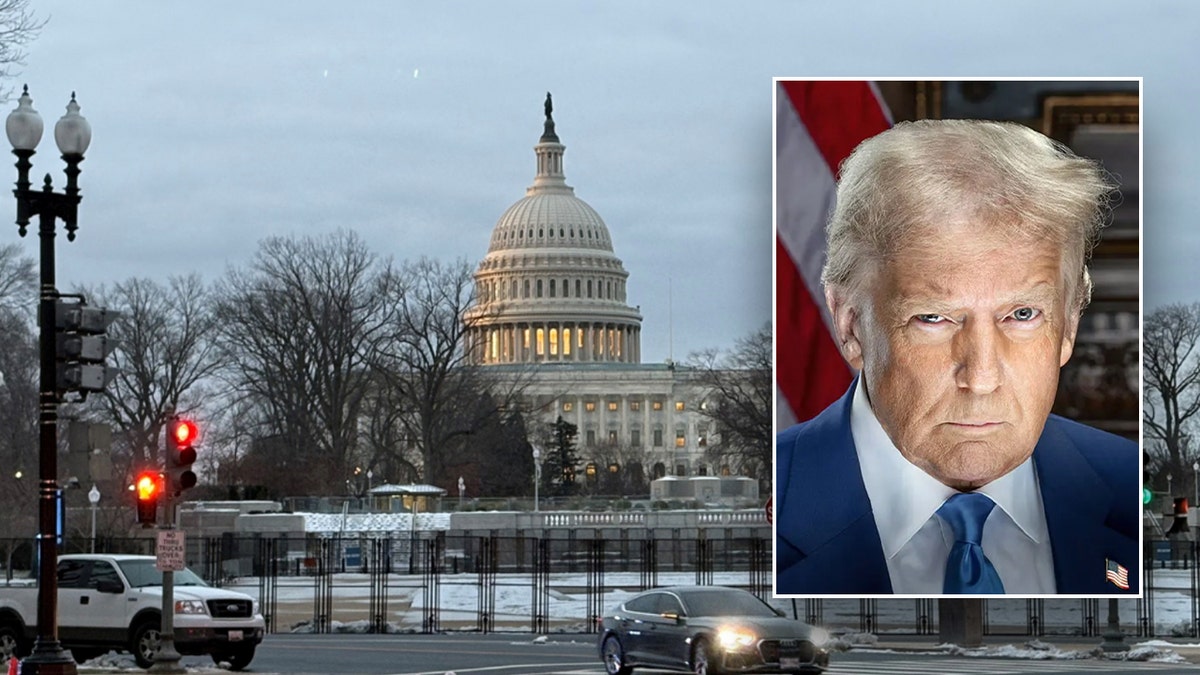
FIRST ON FOX: A group of top Republican lawmakers, MAGA world personalities and key allies of President Donald Trump are descending on Washington D.C., to gather and chart even more accomplishments under his leadership in his first 100 days.
Republican Sens. Rick Scott of Florida, Mike Lee of Utah, Ron Johnson of Wisconsin, Dan Sullivan of Alaska and Bill Hagerty of Tennessee will be guests at an event next week, hosted by Rescuing the American Dream (RAD), a group run by Scott allies.
“The First 100 Days: How Conservatives Can Help President Trump Accomplish His Agenda” will also feature Ohio gubernatorial candidate Vivek Ramaswamy and businessman and star of Shark Tank Kevin O’Leary, among others.
A Rick Scott-tied group is hosting an event with an all-star line-up of MAGA world figures to discuss how they can further assist President Trump to score more wins before his 100th day in office.(Reuters)
“Rescuing the American Dream is looking forward to hosting this event next week to highlight the accomplishments of the Trump Administration and Republicans in Washington and plan for more successes to come. We’re looking forward to hearing from leaders from across Washington and the conservative movement for in depth and insightful conversations,” RAD spokesperson Chris Hartline said in a statement.
The guests will come together in the U.S. capital over March 5 and 6 to discuss how they can best work with the Trump administration to deliver more wins in the president’s first 100 days, which he will hit on April 30.
The event will specifically explore how allies can best assist Trump in the crucial budget reconciliation process on Capitol Hill, in American business and manufacturing and through shutting down lawfare in and out of the Department of Justice (DOJ), Fox News Digital has learned.
Trump and Republicans are working out a budget reconciliation package.(Fox News Digital/Trump-Vance Transition Team)
Other speakers include Trump-world familiar faces regulars such as Alex Bruesewitz, campaign advisor to the president and CEO of X Strategies LLC and Senate Leadership Fund (SLF) Executive Director Alex Latcham, as well as Tiffany Smiley, Founder of Endeavor Pac and Political Commentator, Founder and CEO of American Majority Ned Ryun and Sentinel Action Fund President and Founder Jessica Anderson.
Trump will mark 100 days in office in April.(AP/Ben Curtis)
After an action-packed first month of his second administration, Trump shows no signs of slowing down. He will mark 50 days in office on March 11, followed by 100 on April 30.
With Republican control of both houses of Congress, the president has more ability to usher through his policies than ever before, and many GOP lawmakers are working to do their part and help rack up swift wins for Trump.
Julia Johnson is a politics writer for Fox News Digital and Fox Business, leading coverage of the U.S. Senate. She was previously a politics reporter at the Washington Examiner.
Tether’s competitors are exerting increasingly more pressure to push the world’s largest stablecoin issuer out of the crypto market, including political pressure aimed at reducing the firm’s leading market share.
In the wider crypto markets, analysts are suggesting that most cryptocurrencies won’t see a widespread “altcoin season” rally in 2025, and only select tokens with sustainable investor interest and revenue-generating models will be able to outperform the rest of the tokens.
Paolo Ardoino: Competitors and politicians intend to “kill Tether”
Tether’s competitors are working to push the world’s largest stablecoin issuer out of the crypto market, according to the company’s CEO, Paolo Ardoino.
Tether, the issuer of the world’s largest stablecoin, USDt (USDT), has a market capitalization of more than $142 billion — over twice as large as Circle’s USD Coin’s (USDC) $56 billion, according to Cointelegraph data.
However, the stablecoin issuer faces mounting pressure from competing firms and politicians, Ardoino said in a Feb. 25 X post.
“While our competitors’ business model should be to build a better product and even bigger distribution network, their real intent is ‘Kill Tether.’ Every single business or political meeting that they have culminates with this intent.”
“I’ll leave it to you to define a competitor trying to use lawfare to kill an opponent, instead of focusing on better products,” Ardoino added.
Tether will continue focusing on its mission to promote global financial inclusion, particularly in underdeveloped economies, Ardoino said, noting that USDT is used by more than 400 million people and gains 35 million new wallets each quarter.
Ardoino’s comments followed Tether’s exclusion from the list of 10 firms approved to issue stablecoins under the European Union’s Markets in Crypto-Assets (MiCA) regulatory framework.
Altseason 2025: “Most altcoins won’t make it,” CryptoQuant CEO says
Most cryptocurrencies beyond Bitcoin and Ether may not experience a widespread “altcoin season” rally in 2025, but projects with strong fundamentals and revenue-generating models could outperform the broader market, according to Ki Young Ju, the founder and CEO of CryptoQuant.
“Most altcoins won’t make it” during the 2025 market cycle, Ju wrote in a Feb. 25 X post.
Cryptocurrencies with potential exchange-traded fund (ETF) approvals, robust revenue-generating models and sustained investor attention may outperform the rest of the market, Ju said. Still, “The era of everything pumping is over,” he added.
The current downturn may signal an incoming market capitulation, according to Juan Pellicer, senior research analyst at crypto intelligence platform IntoTheBlock.
“The recent market correction, with significant liquidations (especially in assets like Solana) and a drop in total crypto market cap to $3.13 trillion, points toward possible capitulation as overleveraged positions are flushed out,” Pellicer told Cointelegraph.
Bybit hacker launders $335M as funds continue to move
The hacker behind the $1.4 billion Bybit exploit has laundered more than $335 million in digital assets, with investigators continuing to track the movement of stolen funds.
Onchain data shows that the hacker has moved 45,900 Ether (ETH) — worth about $113 million — in the past 24 hours, bringing the total amount laundered to more than 135,000 ETH, valued at $335 million.
That left the hacker with about 363,900 ETH, worth around $900 million, according to pseudonymous blockchain analyst EmberCN.
US lawmakers advance resolution to repeal “unfair” crypto tax rule
US lawmakers in the House of Representatives have advanced a resolution to repeal the “DeFi broker rule,” which requires brokers to report digital asset transactions to the Internal Revenue Service.
Set to take effect in 2027, the IRS broker regulation was approved on Dec. 5 and would expand existing reporting requirements to include decentralized exchanges. It would require brokers to disclose gross proceeds from sales of cryptocurrencies, including information regarding the taxpayers involved in the transactions.
During its Feb. 26 committee markup, the House Ways and Means Committee, a key group within the House that deals with financial issues, voted 26 to 16 to advance the resolution.
In a statement, Miller Whitehouse-Levine, the CEO of DeFi advocacy group the DeFi Education Fund, said the rule is an “unlawful and unconstitutional overreach” and needed to be overturned to “protect Americans’ freedom of choice in how they transact.”
MetaMask adds fiat off-ramp for 10 blockchains to improve crypto accessibility
Ethereum-based cryptocurrency wallet MetaMask is expanding its fiat off-ramp services to support 10 additional blockchain networks. The move, in partnership with payments provider Transak, is aimed at simplifying the process of converting digital assets into traditional currency.
MetaMask users were previously forced to swap assets into Ether (ETH) tokens before being able to convert them into fiat money, adding extra steps and transaction fees.
However, as part of MetaMask’s ongoing partnership with Transak, the wallet will add support to 10 new networks: the Arbitrum mainnet, Avalanche C-Chain mainnet, Base, BNB Chain, Celo, Fantom, Moonbeam, Moonriver, Optimism and Polygon.
The first four tokens to receive immediate off-ramping support include ETH on Ethereum, ETH on Optimisim, BNB (BNB) and the Polygon (POL) token. Support for the additional six networks will be gradually rolled out.
“By expanding off-ramping capabilities with Transak, MetaMask is removing barriers between crypto and traditional currency, allowing users to convert a broader range of tokens directly to cash,” said Lorenzo Santos, senior product manager at Consensys.
According to data from Cointelegraph Markets Pro and TradingView, most of the 100 largest cryptocurrencies by market capitalization ended the week in the red.
The Solana-based decentralized exchange Raydium’s (RAY) token fell over 55% as the week’s biggest loser, followed by the Lido DAO (LDO) token, down over 34% on the weekly chart.
Total value locked in DeFi. Source: DefiLlama
Thanks for reading our summary of this week’s most impactful DeFi developments. Join us next Friday for more stories, insights and education regarding this dynamically advancing space.
That year, a group of bold children walked up to the White House gate hoping to be allowed to play their egg-rolling games there.
President Donald Trump, accompanied by First Lady Melania Trump and a person dressed as the Easter Bunny, welcomes guests with opening remarks during the 141st Easter Egg Roll on the South Lawn of the White House on April 22, 2019.(Win McNamee/Getty Images)
President Rutherford B. Hayes told the guards to let the children enter, which began the annual tradition of Easter Monday on the White House grounds.
This year, the event will be held on the South Lawn of the White House on April 21.
“The president and first lady look forward to continuing this entertaining tradition and making it a truly memorable experience for all,” the White House said in a statement.
President Donald Trump and first lady Melania Trump watch children participating in the 141st Easter Egg Roll on the South Lawn of the White House on April 22, 2019 in Washington, DC.(Alex Wong/Getty Images)
Planning of the egg roll typically falls to first ladies, with each woman incorporating her own tastes and interests into the event.
Some past additions to the festivities included roping off part of the lawn for dancing and introducing the traditional egg roll races, according to the White House website.
First Lady Melania Trump watches children participating in the 141st Easter Egg Roll on the South Lawn of the White House on April 22, 2019.(Alex Wong/Getty Images)
Each year, attending children receive souvenir wooden eggs as a commemorative piece to take home.
The event is open to families with children aged 13 and younger.
Khloe Quill is a lifestyle production assistant with Fox News Digital. She and the lifestyle team cover a range of story topics including food and drink, travel, and health.
A stunning cosmic getaway is in store for residents of the United States on Friday evening as seven planets will align in a spectacular display — dubbed a planet parade — that can be seen without traveling far from home. Such a sight won’t be visible again until 2040.
“Seven planets will be visible in the evening sky,” Bill Cooke, NASA astronomer based at the Marshall Space Flight Center in Alabama, told Fox News Digital.
“And three of them are going to be easily visible.”
Planet hunters hoping to catch a glimpse of the spectacular display need just a few simple items for the optimal experience: clear weather, a dark sky and a pair of binoculars or a telescope to see the more elusive ones.
The action begins right at sunset — after which there will only be a 30-minute window in which all seven planets can be seen in alignment above the horizon.
Step outside and look into the night’s sky to see all seven planets in the solar system on full display.(Education Images/Universal Images Group via Getty Images)
“If you look out west after sunset, very close to the sun will be the planet Saturn,” Cooke said.
“But it’ll be so close, it’ll be sort of lost in the twilight glare — so you’ll need a pair of binoculars.”
Saturn will be about nine degrees above the horizon.
“You’ll have about 20 minutes to see Saturn, which will set very soon after sunset,” Cooke said.
Bill Cooke, NASA astronomer based at the Marshall Space Flight Center in Huntsville, Alabama, spoke with Fox News Digital about the out-of-this-world display that will be visible on Friday evening.(NASA)
“So if you want to catch all seven, you’ve got this narrow window starting with Saturn.”
But then there will be three planets very easily visible.
You will be able to see the planet Mercury through a pair of binoculars, said an expert.(iStock)
“Next will be the brightest thing in the sky outside of the moon,” he said. “The planet Venus. It’ll be that bright starlike thing people see in the west after sunset. Easy-peasy to see.”
After Venus, there will be a dim planet that’s hard to see.
“Those are the three easy targets for your eyes. Saturn, Mercury and Uranus you can see with a pair of binoculars — but Neptune would require a telescope.”
— Bill Cooke
“If you go farther east, you’ll need a pair of binoculars to see the planet Uranus,” Cooke said.
After Uranus will be another bright-looking star, which is the planet Jupiter.
“And after Jupiter, the farthest east of all of them will be the planet Mars,” Cooke said, “which will look like this pale, reddish-looking star. Those are your planets.”
If you’ve got a clear night and a relatively dark sky, seeing at least three planets is nearly a sure thing.
Not all planets will require the assistance of binoculars or a telescope to be seen; some will be visible to the naked eye.(iStock)
“Venus will knock your eyes out, so you can’t miss it,” Cooke said.
“Jupiter, which is also very bright, and Mars — those are the three easy targets for your eyes. Saturn, Mercury and Uranus you can see with a pair of binoculars, but Neptune would require a telescope.”
Cooke noted that a planetarium phone app can help the untrained eye identify the planets — and several of them are free and good for beginners.
You don’t have to travel to West Texas or Utah to see the planet parade.
Just getting outside the city limits can significantly improve the effects of light pollution, which fades the contrast between stars and planets and the night sky.
It is best to travel outside the city limits to avoid any potential physical obstructions and find an open sky.(iStock)
“Seeing the moon turn blood-red is always fun,” Cooke said. “A total lunar eclipse creates a blood moon, and it’s one of those events worth staying up for.”
Cooke said the phenomenon occurs when the Earth passes directly between the sun and moon.
Last year there was a smaller planet parade with only some planets visible and five out of the major seven will be seen in 2028.(iStock)
“When the moon passes into earth’s shadow, you would think it would turn black,” Cooke said, “but because the atmosphere bends light, especially the red part of the spectrum, the moon looks like it’s red.”
He added that the Blood Moon is a good opportunity for even amateur photographers to capture a celestial event.
“Now even with phones, like the modern Androids or iPhones, you can set that sucker up to take a sequence of images and catch the entire eclipse,” he said.
“So not only can you see it, but you can create a record of it, simply with your phone camera.”
A full planet parade showing all seven planets will not be seen again until 2040.(Apollo 17; Apollo 8; Apollo 12; Pioneer Venus; Voyager I; Mariner 10; Pioneer 11.)
Several meteor showers — Lyrid, Perseids and Geminids — also will grace the skies throughout the year, but Cooke has his favorites.
“There are two good meteor showers every year,” he said.
“The Perseids and the Giminids. Everything else is just OK.”
The Persieds meteor shower will take place August 12-13, but Cooke said the moon will interfere a bit with it this year.
There are all sorts of cosmic phenoms that will be visible this year, including the planet parade on Friday evening, Fe. 28, that will showcase seven planets in the solar system.(iStock)
The most impressive meteor shower of the year will be the Geminis in mid-December.
BlackRock, a global investment firm with $11.5 trillion in assets under management, has added its Bitcoin exchange-traded fund (ETF) to its model portfolio product, according to a Feb. 28 report from Bloomberg. Portfolios that allow for alternative assets will be able to put a 1%–2% allocation into the firm’s iShares Bitcoin ETF Trust (IBIT), potentially creating new demand for the exchange-traded fund.
The 1%–2% allocation is due to Bitcoin’s (BTC) volatility, which the firm called a “reasonable range” in a paper authored by the BlackRock Investment Institute. Anything more would significantly increase the crypto’s share of the total portfolio risk.
BlackRock’s $150-billion model portfolio product contains a range of investment portfolios that are sold to financial advisers who manage assets for their clients. The portfolios contain different balances of investments, with some targeted for growth, income generation or capital preservation.
The firm said in 2023 that it expects the model portfolio sector of money management to grow to a $ 10-trillion business over the next five years, up from around $4.2 trillion at the time of the statement. Changes in model portfolio allocations can often have dramatic effects on money flow to certain investments.
Other financial services firms have weighed in on the allocation of Bitcoin to the alternatives category of traditional portfolios like the 60/40 portfolio. Fidelity noted in 2024 that Bitcoin could “offer some return-enhancing properties, but small allocations could contribute exponential risk to a 60/40 portfolio.” JPMorgan wrote in December 2024: “While Bitcoin’s returns have been impressive, they’ve come with extraordinary volatility.”
Bitcoin volatility on display as BlackRock’s BTC ETF sees outflows
The volatility of Bitcoin was on full display on Feb. 28, with the coin seeing a high of $85,122 and a low of $78,215. The largest cryptocurrency by market capitalization has not been immune to the macroclimate that has spooked investors, including the threat of a global trade war and US economic uncertainty.
BlackRock’s Bitcoin ETF has felt the effects as well, with investors pulling out $420 million on Feb. 26 alone, the largest outflow since the iShares Bitcoin ETF Trust launched in January 2024. Other Bitcoin ETFs saw outflows on Feb. 26 as well, with preliminary figures from CoinGlass showing $756 million leaving the funds.
Despite the outflows, Michael Gates, lead portfolio manager for the firm’s Target Allocation ETF model suite, wrote in an investment commentary dated Feb. 27, “We believe Bitcoin has long-term investment merit and can potentially provide unique and additive sources of diversification to portfolios.”
On Feb. 26, the Crypto Fear & Greed Index, a key tracker of Bitcoin and crypto sentiment, had slipped to “extreme fear” or a score of “10.” That level had not been seen since June 2022, when Three Arrows Capital (3AC) started to see its downfall.
Bitcoin (BTC) dropped close to $78,000 on Feb. 28, but lower levels attracted solid buying by the bulls. CryptoQuant founder and CEO Ki Young Ju said in a post on X that selling after a 30% correction could be a “noob” mistake as Bitcoin rose to a new all-time high after falling 53% in 2021.
Select whales seem to be building a position during the dip. A Bitcoin whale, known as “Spoofy,” bought 4,000 Bitcoin worth roughly $344 million when the price was between $82,000 and $85,000. Crypto analyst Saint Pump said on X that Spoofy builds his position “extremely slowly” and may buy more if the markets fall further.
The current correction has not deterred Standard Chartered’s long-term view. In a CNBC interview, Standard Chartered head of digital assets research Geoffrey Kendrick said that Bitcoin could recover to $200,000 this year and surge to $500,000 before President Trump finishes his second term.
Could Bitcoin start a recovery, pulling altcoins higher? Let’s analyze the charts of the top 10 cryptocurrencies to find out.
Bitcoin price analysis
Bitcoin closed below the $85,000 support on Feb. 26, and the bears successfully defended the level on Feb. 27.
Sellers tried to sink the BTC/USDT pair to $73,777, but the bulls purchased the dip to $78,258 on Feb. 28. Buyers will try to push the price back above the $85,000 to $90,000 resistance zone. If they manage to do that, it will suggest that a short-term bottom may be in place.
Conversely, if the price turns down sharply from the overhead resistance zone, it indicates selling on every minor rally. The pair could then descend to the vital support at $73,777, where buyers are expected to step in.
Ether price analysis
Ether (ETH) rebounded off the $2,111 support, indicating that the bulls are trying to keep the price inside the large range.
The bulls will attempt to stretch the recovery to the 20-day EMA ($2,611) and then to the downtrend line. Sellers are expected to aggressively defend the downtrend line. If the price turns down from the overhead resistance, the ETH/USDT pair could retest the $2,111 level. If this support cracks, the pair may sink to $2,000 and later to $1,900.
Contrary to this assumption, a break and close above the downtrend line suggests that the bears are losing their grip. The pair could rise to the 50-day SMA ($2,932).
XRP price analysis
XRP (XRP) turned down from the support line of the symmetrical triangle pattern on Feb. 26, suggesting that the bears have flipped the level into resistance.
The XRP/USDT pair dipped below the $2.06 support on Feb. 28, but the bears could not sustain the lower levels. Buyers will attempt to push the price above the 20-day EMA. If they can pull it off, it will signal that the bulls are back in the game.
Contrarily, if the price turns down from the 20-day EMA, it will suggest that the bears remain active at higher levels. That increases the possibility of a drop to the crucial support at $1.77.
BNB price analysis
BNB (BNB) rebounded off the support near $557, indicating that the bulls are trying to defend the level.
The BNB/USDT pair will attempt a relief rally, which is expected to face strong selling at the 20-day EMA ($634). If the price turns down sharply from the 20-day EMA, it increases the likelihood of a break below $557. If that happens, the pair could collapse to $500. Buyers are expected to fiercely defend the zone between $460 and $500.
On the upside, a break and close above the 20-day EMA suggests the selling pressure is reducing. The pair could then reach the 50-day SMA ($656).
Solana price analysis
Solana (SOL) slipped below the $133 support on Feb. 28, but the long tail on the candlestick shows solid buying at lower levels.
There is minor resistance at $147, but it is likely to be crossed. If the price holds above $147, the SOL/USDT pair could reach the 20-day EMA ($169). Sellers are expected to pose a strong challenge at the 20-day EMA, but if the bulls prevail, the pair could extend its recovery to the 50-day SMA ($201).
This optimistic view will be negated if the price turns down and breaks below $125. The pair could then plummet to $110.
Dogecoin price analysis
Buyers failed to push Dogecoin (DOGE) back above the support line, suggesting that the bears have flipped the level into resistance.
The selling resumed on Feb. 28, and the bears will try to sink the price to $0.15. However, the RSI has slipped into the oversold zone, suggesting that a relief rally could be around the corner. Buyers will have to push and maintain the DOGE/USDT pair above the 20-day EMA ($0.24) to start a sustained recovery.
The failure to push the price back above the 20-day EMA increases the risk of a drop to $0.13 and then to $0.10.
Cardano price analysis
Cardano (ADA) is witnessing a tough battle between the bulls and the bears at the support line of the descending channel pattern.
If the price sustains below the support line, the selling could pick up, and the ADA/USDT pair may drop to $0.50. Buyers are expected to defend the $0.50 level with all their might because a close below it could sink the pair to $0.33.
If the price turns up from the support line, the pair could reach the 20-day EMA (0.73). This is a vital overhead resistance to watch out for because a break above it suggests that the pair may remain inside the channel for some more time.
The 20-day EMA ($122) is flattish, and the RSI is just above the midpoint, indicating a balance between supply and demand. If the price sustains above the 20-day EMA, the bulls will try to push the LTC/USDT pair above the resistance line. If they succeed, the pair could rally to $147.
Conversely, a break below the 50-day SMA ($117) opens the gates for a drop to the support line. If this level gives way, the pair could plunge to $80.
Chainlink price analysis
The failure of the bulls to start a strong recovery from the support line triggered another round of selling by the bears in Chainlink (LINK).
If the price sustains below the support line, the selling could accelerate, and the LINK/USDT pair could drop to $12.71 and, subsequently, to $10.
If buyers want to prevent the downside, they will have to swiftly push the price back above $16. The pair could then rise to the 20-day EMA ($17.42), which is likely to act as a stiff resistance. Buyers will have to push the price above the 20-day EMA to suggest that the break below the support line may have been a bear trap.
Avalanche price analysis
Avalanche (AVAX) tried to rise above the breakdown level of $22.35 on Feb. 27, but the bears held their ground.
The bears resumed selling on Feb. 28. If the price breaks and maintains below $20, the AVAX/USDT pair could retest the solid support at $17.29. This is an important level to watch out for because a break below it may sink the pair to $15.
Time is running out for the bulls. They will have to push and maintain the price above the 20-day EMA ($24.55) to start a recovery. The pair may rise to $27.50, which is again expected to act as a resistance.
This article does not contain investment advice or recommendations. Every investment and trading move involves risk, and readers should conduct their own research when making a decision.
Since reaching all-time highs on Jan. 20, Bitcoin’s price has been suppressed by hedge funds exploiting a low-risk yield trade involving spot exchange-traded funds (ETFs) and CME futures, signaling once again that institutional adoption of crypto assets isn’t a one-way street.
This is the general takeaway of analyst Kyle Chassé, who dissected the latest Bitcoin (BTC) price crash in a thread on the X social media platform.
“For months, hedge funds were exploiting a low-risk yield trade using BTC spot ETFs & CME futures,” said Chassé. Now, this cash and carry trade is “imploding,” he said.
The cash and carry trade involved buying spot Bitcoin ETFs and shorting Bitcoin futures on CME, which allowed traders to earn up to 5.68% in annualized returns by Chassé’s calculation.
The success of this trade depended mainly on Bitcoin futures trading at a premium to the cryptocurrency’s spot price. However, “with recent market weakness, that premium has collapsed,” said Chassé.
“The same trade that kept Bitcoin stable on the way up is accelerating the crash now,” he said. This is happening because “hedge funds don’t care about Bitcoin. They weren’t betting on BTC mooning. They were farming low-risk yield.”
Bitcoin’s sell-off accelerated on Feb. 27, as the cryptocurrency retraced all the way back to the sub-$79,000 region for the first time in more than three months.
However, a closer look at onchain data reveals that the losses are mainly concentrated among Bitcoin tourists, or new traders who only entered the market recently.
Data from Glassnode shows that 74% of the realized losses came from holders who bought in the last month.
Nevertheless, unrealized losses from the recent sell-off exceeded crypto exchange FTX’s capitulation event, according to analyst Milkybull Crypto. A drop of this magnitude is a strong sign of a bottom formation in Bitcoin’s price.
With so much of our lives contained on our devices, especially our iPhones or iPads, it can feel particularly devastating if you accidentally delete a message you still need.
Whether it is informational or personal, it can be panic-inducing to not be able to retrieve a message or conversation you need.
Fortunately, Apple has a built-in way to recover recently deleted messages.
A woman recovering a deleted text on her iPhone(Kurt “CyberGuy” Knutsson)
Enabling Message Filtering on iPhone or iPad to organize your texts
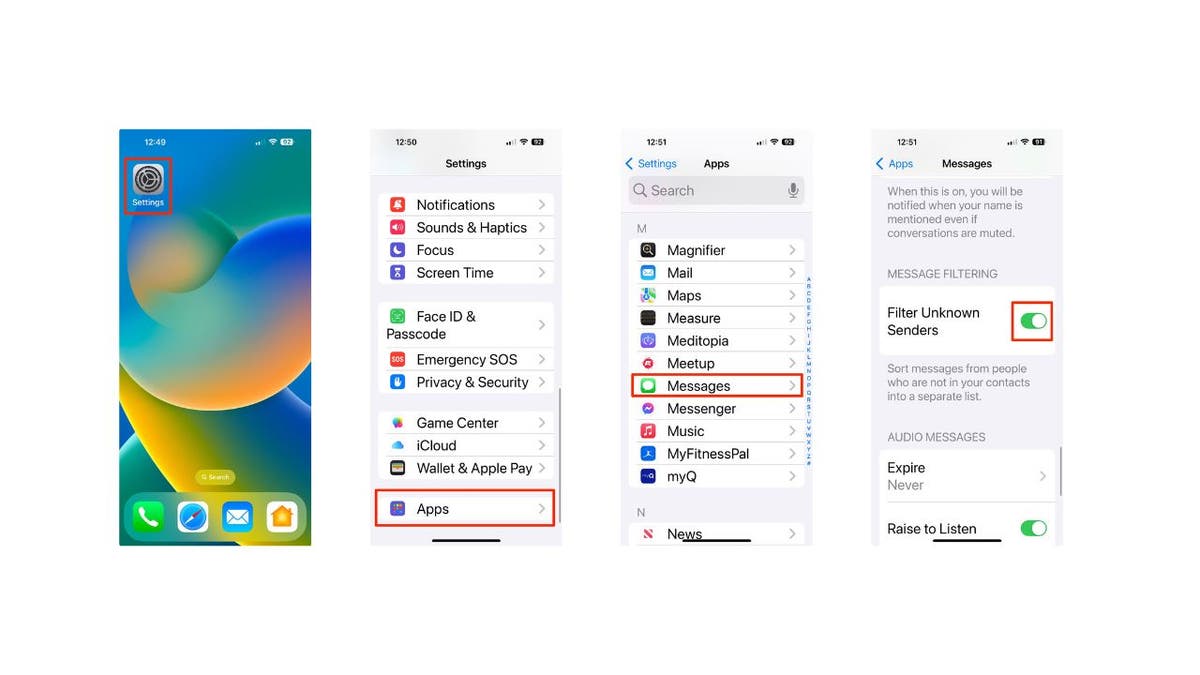
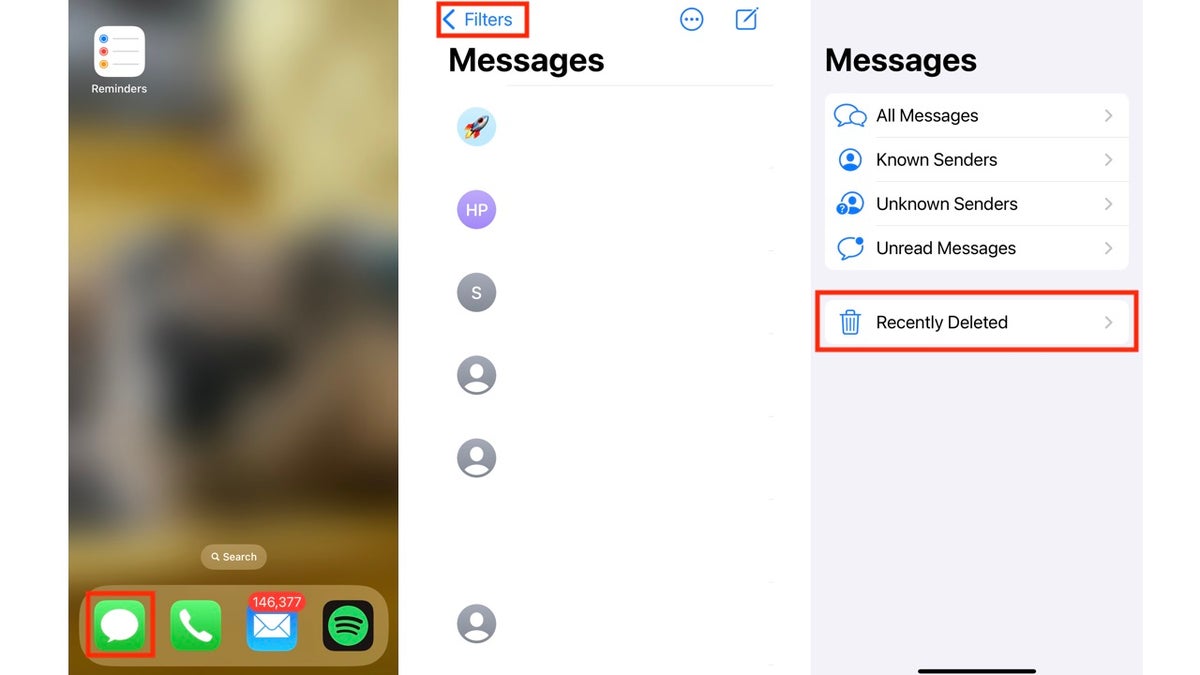
Deleted a text message or conversation thread on your iPhone or iPad? The directions below depend on whether you have turned on Message Filtering or not. What Message Filtering does is categorize your messages into separate lists, such as known senders, unknown senders and unread messages. However, some of you may not have this feature enabled yet. If you want to enable Message Filtering, here are the steps:
Open the Settings app on your iPhone or iPad
Scroll down and tap Apps
Tap Messages
Scroll to the Message Filtering section and turn on the switch for Filter Unknown Senders
Steps to enable Message Filtering on iPhone(Kurt “CyberGuy” Knutsson)
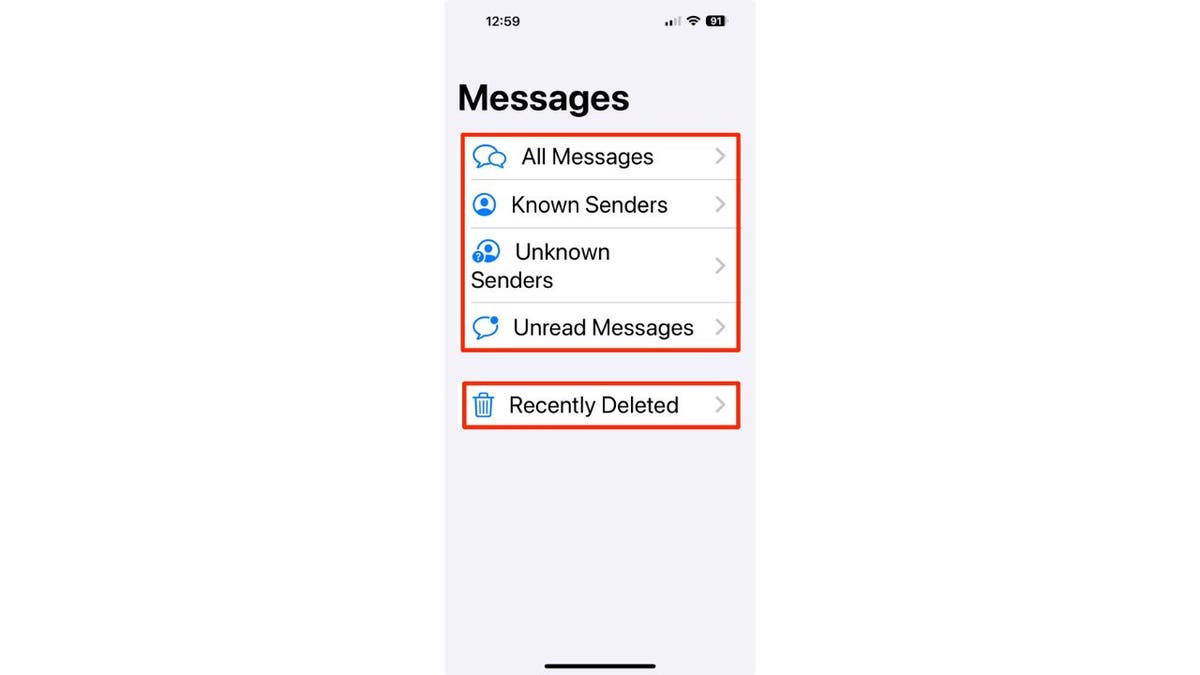
Once enabled, this feature will automatically sort your messages into different categories, making it easier to manage your inbox and reduce clutter from spam or unwanted texts. You’ll be able to view filtered messages by tapping the “Filters” button in the top-left corner of the Messages app. With Message Filtering turned on, you’ll have access to four main categories:
All Messages: Shows all your texts, regardless of sender
Known Senders: Displays messages from contacts in your address book
Unknown Senders: Lists messages from numbers not in your contacts
Unread Messages: Shows all unread texts
Message Filtering categories on iPhone(Kurt “CyberGuy” Knutsson)
This filtering system not only helps organize your messages but also reduces notifications from unknown senders, potentially decreasing the number of interruptions from spam or unwanted texts.
How to recover deleted text messages on your iPhone or iPad
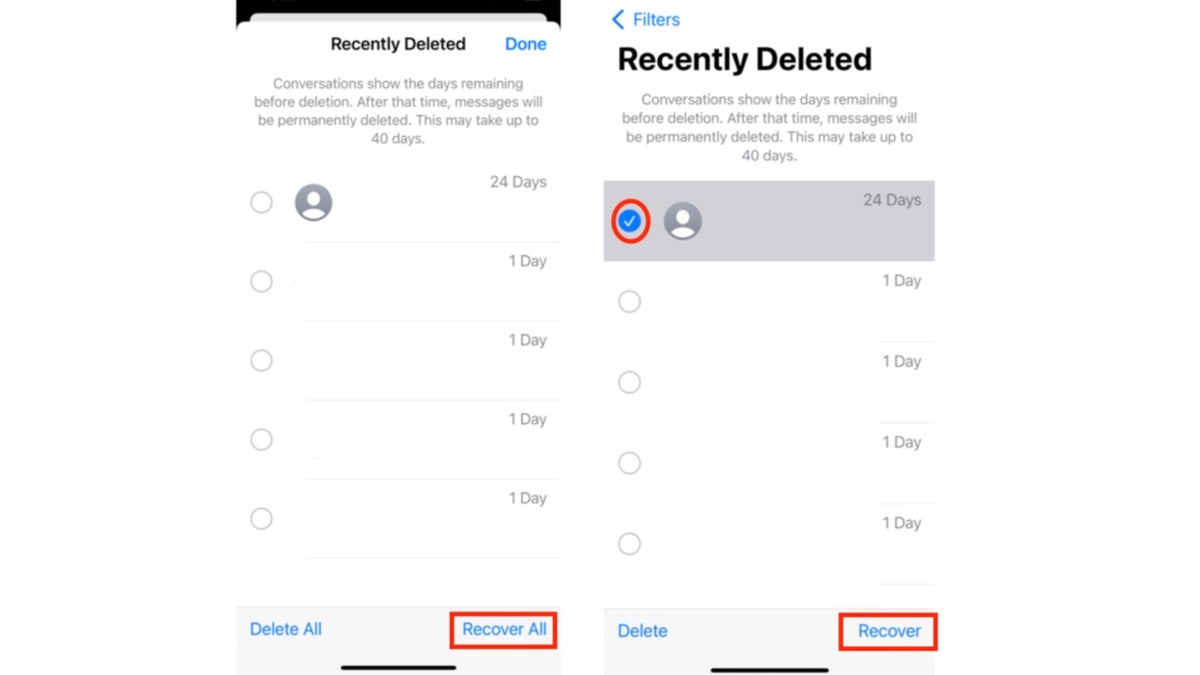
Now, let’s recover those deleted messages on the iPhone or iPad. For devices running iOS 16 later or iPadOS 16.1 or later, you can retrieve deleted conversations in the Messages app using the following steps:
If you have not turned on Message Filtering
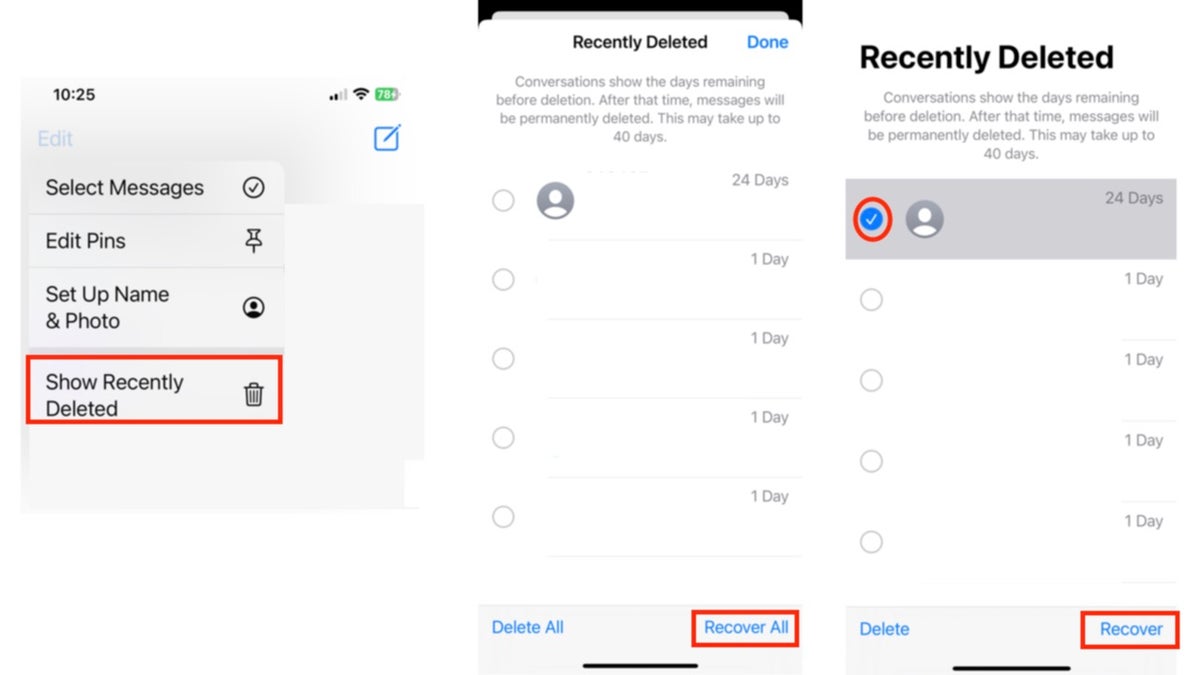
On your phone or iPad, open the Messages app
Tap Edit in the top left corner
Steps to recover a deleted text message if you have not turned on Message Filtering(Kurt “CyberGuy” Knutsson)
Select Show Recently Deleted in the drop-down menu
You can either tap Recover All in the bottom-right corner if you want to recover all deleted texts, then confirm your choice by tapping Recover Messages;
Or you can tap the individual text message you want to recover, then select Recover in the bottom-right corner and then confirm your choice by tapping Recover Message
Steps to recover a deleted text message if you have turned on Message Filtering(Kurt “CyberGuy” Knutsson)
You can either tap Recover All in the bottom-right corner if you want to recover all deleted texts, then confirm your choice by tapping Recover Messages;
Or you can tap the individual text message you want to recover, then select Recover in the bottom-right corner and then confirm your choice by tapping Recover Message
Steps to recover a deleted text message if you have turned on Message Filtering(Kurt “CyberGuy” Knutsson)
Please note: Only messages and conversations deleted within the last 30-40 days can be recovered. Additionally, if you deleted a message before you updated to iOS 16 or iPadOS 16.1 or later, you cannot recover these messages or conversations.
Whether your fingers were moving too fast and you accidentally hit delete or you now need to refer to a message you have already deleted, Apple has built in an option to help you recover your recently deleted messages. If you are running the latest OS, you should be able to recover recently deleted messages easily.
Have you ever accidentally deleted a text message you realized later you needed? How did you recover your messages? Let us know by writing us atCyberguy.com/Contact.
For more of my tech tips and security alerts, subscribe to my free CyberGuy Report Newsletter by heading to Cyberguy.com/Newsletter.
Kurt “CyberGuy” Knutsson is an award-winning tech journalist who has a deep love of technology, gear and gadgets that make life better with his contributions for Fox News & FOX Business beginning mornings on “FOX & Friends.” Got a tech question? Get Kurt’s free CyberGuy Newsletter, share your voice, a story idea or comment at CyberGuy.com.