


RPR Comando is back with “Creating an Engaging Social Media Giveaway: A Step-by-Step Guide”. Whether you’re looking to promote your latest book or enhance your PR distribution strategy, an engaging giveaway, particularly through social media, can be the perfect tool. This article first appeared on https://rprcomando.com/creating-an-engaging-social-media-giveaway-a-step-by-step-guide/ #BookMarketing #VideoShorts #PressReleaseMarketing📖
Bayeux Tapestry research suggests revealing monastic dining hall origin theory

NEWYou can now listen to Fox News articles!
New historical research is challenging centuries of assumptions about why the Bayeux Tapestry — one of the most iconic pieces of medieval art — was created.
The tapestry vividly depicts the Norman Conquest and the Battle of Hastings — and is widely believed to date to the 1070s.
The scenes show how the Normans invaded England from France and seized power from the Anglo-Saxons, all culminating in the death of Harold Godwinson at Hastings.
ANCIENT ROMAN FORT YIELDS 2,000-YEAR-OLD FRUIT THAT SURVIVED THE CENTURIES, PLUS OTHER TREASURES
Scholars have traditionally believed that the Bayeux Tapestry was meant to be hung inside the nave of Bayeux Cathedral, which was built in 1077 — but new research suggests it was meant for monks’ mealtime viewing instead.
Benjamin Pohl, a medieval history professor at the University of Bristol, published his research in the journal Historical Research on Dec. 12.
New research suggests the Bayeux Tapestry may have been designed for monastic dining halls rather than cathedral display. (Universal History Archive/Universal Images Group via Getty Images; Ann Ronan Pictures/Print Collector/Getty Images)
Speaking to Fox News Digital, Pohl said he believes the tapestry was designed specifically for the monastic refectory of St. Augustine’s Abbey in Canterbury.
Pohl’s research suggests the masterpiece “only came to Bayeux in the 15th century, more by accident than by design.”
“From a practical perspective, a cathedral nave does not offer a particularly suitable space for hanging an embroidery of this length and weight in such a way that its contents can be seen and understood easily,” he said.
CLICK HERE TO SIGN UP FOR OUR LIFESTYLE NEWSLETTER
On the other hand, he said a monastic refectory would have been “a much better-suited space, one in which the artifact could have been suspended easily at head height so that its images and text could be appreciated most effectively.”
The expert also noted that the Bayeux Tapestry’s text is written in a particular type of Latin — one that he says “matches the diverse levels of literacy found in a medieval monastery.”
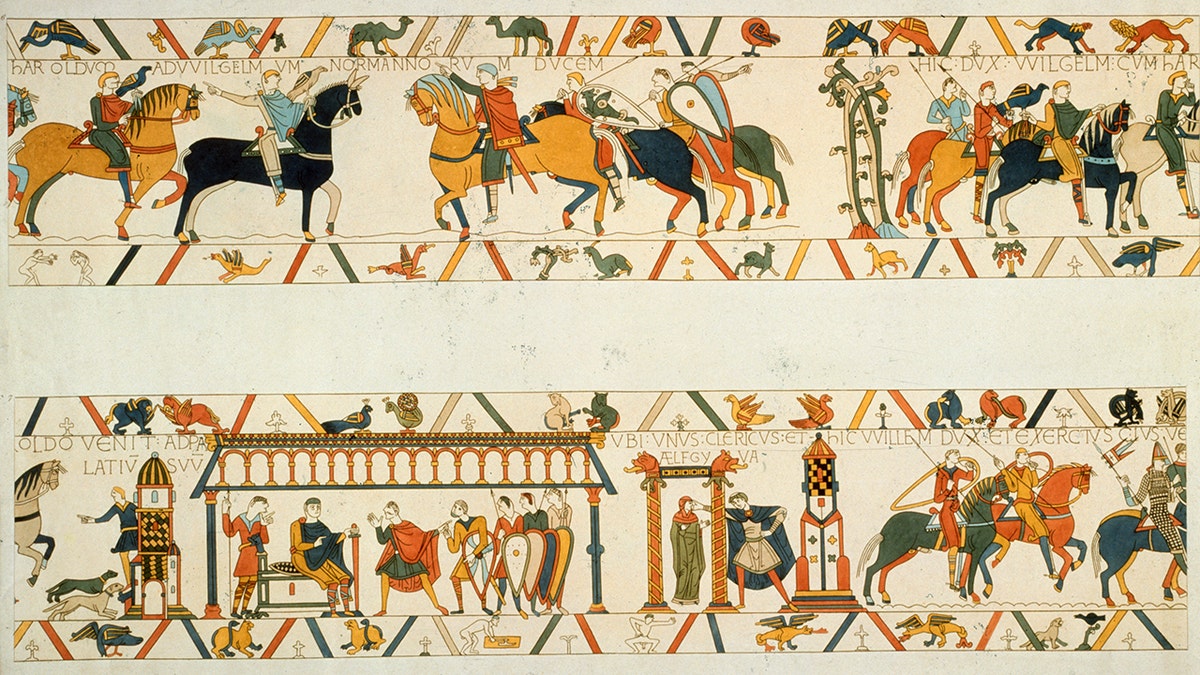
The Bayeux Tapestry depicts the Norman Conquest and the Battle of Hastings, culminating in the death of Harold Godwinson. (Hulton Archive/Getty Images)
“The Bayeux Tapestry’s narrative can be interpreted as a moral story in keeping with the kinds of texts monks were contemplating regularly during mealtimes,” he said.
“The surviving evidence we have… indicates that the refectory walls of St Augustine’s would have been large enough to hang the Bayeux Tapestry in its entirety, probably covering most of its four internal walls,” added Pohl.
CLICK HERE FOR MORE LIFESTYLE STORIES
But if anyone is imagining medieval monks toasting mugs of beer and enjoying a royal feast while viewing the tapestry — they would be mistaken.
Instead, the artwork was probably viewed in silence, Pohl said — while the monks ate plain and simple food, like light beer, bread, fish and a rare serving of meat.
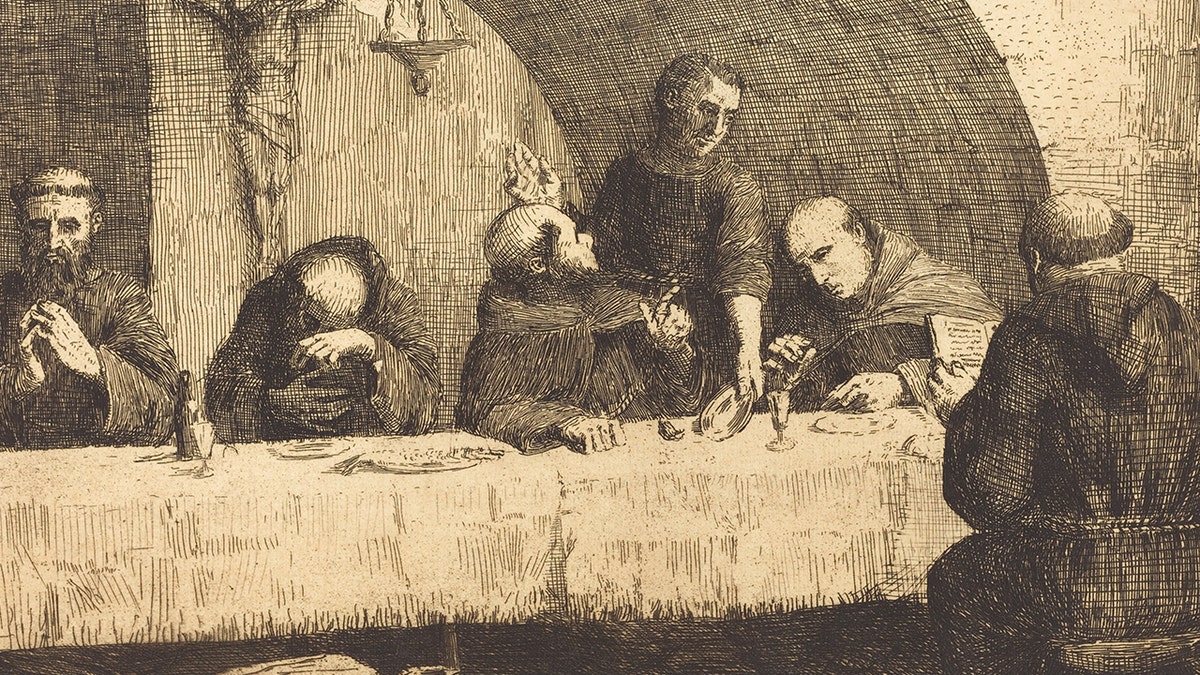
The embroidery’s moral narrative aligns with religious texts traditionally read during monastic meals. (Heritage Art/Heritage Images via Getty Images)
“Following the rule of St. Benedict, which governed monastic life across much of medieval Europe, medieval monks were expected to maintain complete silence while eating, aside from the voice of the reader delivering the day’s text,” he said.
Pohl added, “These readings delivered moral instruction to the diners, in a setting where any visual imagery would have reinforced spoken words and offered a focus for contemplation.”
TEST YOURSELF WITH OUR LATEST LIFESTYLE QUIZ
If Pohl’s theory proves correct, it would mean the refectory of St. Augustine’s was meant to be built in the 1080s — and the Bayeux Tapestry may have been “kept in a box and was perhaps forgotten about” before the refectory was finished in 1120.
The latest research comes after the medieval masterpiece made several headlines in 2025.
“[N]obody could have foreseen that it would take almost 50 years for the refectory to be completed, so the plan might well have been to only keep it in storage for a few years,” the professor added.
“But the massive delay may have extended this storage period for nearly two generations.”
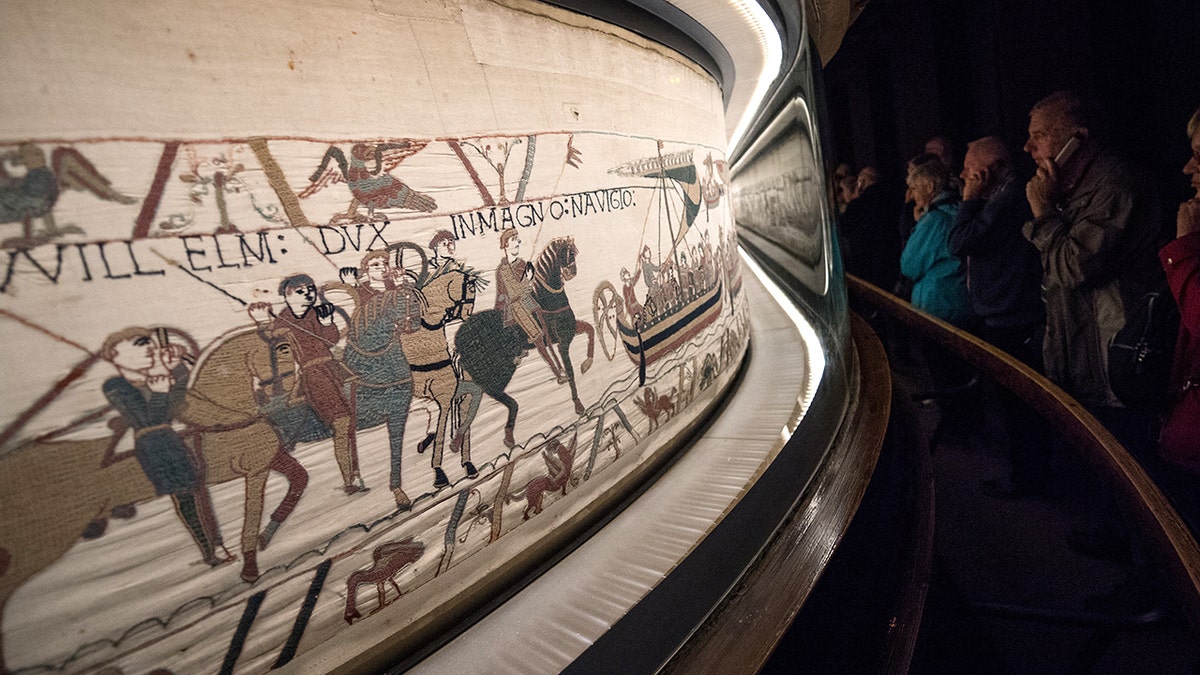
“From a practical perspective, a cathedral nave does not offer a particularly suitable space for hanging an embroidery of this length and weight in such a way,” said an expert. (Loic Venance/AFP via Getty Images)
The latest research comes after the medieval masterpiece made several headlines in 2025.
In July, officials announced that the Bayeux Tapestry would be shown in the British Museum from Sept. 2026 to July 2027 — the first time it will cross the English Channel in centuries.
CLICK HERE TO GET THE FOX NEWS APP
Earlier in 2025, Newcastle University announced the discovery of Harold Godwinson’s residence in Bosham, a site that was depicted in the tapestry.
Robots learn 1,000 tasks in one day with single demonstrations breakthrough

NEWYou can now listen to Fox News articles!
Most robot headlines follow a familiar script: a machine masters one narrow trick in a controlled lab, then comes the bold promise that everything is about to change. I usually tune those stories out. We have heard about robots taking over since science fiction began, yet real-life robots still struggle with basic flexibility. This time felt different.
Sign up for my FREE CyberGuy Report
Get my best tech tips, urgent security alerts, and exclusive deals delivered straight to your inbox. Plus, you’ll get instant access to my Ultimate Scam Survival Guide — free when you join my CYBERGUY.COM newsletter.
ELON MUSK TEASES A FUTURE RUN BY ROBOTS
Researchers highlight the milestone that shows how a robot learned 1,000 real-world tasks in just one day. (Science Robotics)
How robots learned 1,000 physical tasks in one day
A new report published in Science Robotics caught our attention because the results feel genuinely meaningful, impressive and a little unsettling in the best way. The research comes from a team of academic scientists working in robotics and artificial intelligence, and it tackles one of the field’s biggest limitations.
The researchers taught a robot to learn 1,000 different physical tasks in a single day using just one demonstration per task. These were not small variations of the same movement. The tasks included placing, folding, inserting, gripping and manipulating everyday objects in the real world. For robotics, that is a big deal.
Why robots have always been slow learners
Until now, teaching robots physical tasks has been painfully inefficient. Even simple actions often require hundreds or thousands of demonstrations. Engineers must collect massive datasets and fine-tune systems behind the scenes. That is why most factory robots repeat one motion endlessly and fail as soon as conditions change. Humans learn differently. If someone shows you how to do something once or twice, you can usually figure it out. That gap between human learning and robot learning has held robotics back for decades. This research aims to close that gap.
THE NEW ROBOT THAT COULD MAKE CHORES A THING OF THE PAST
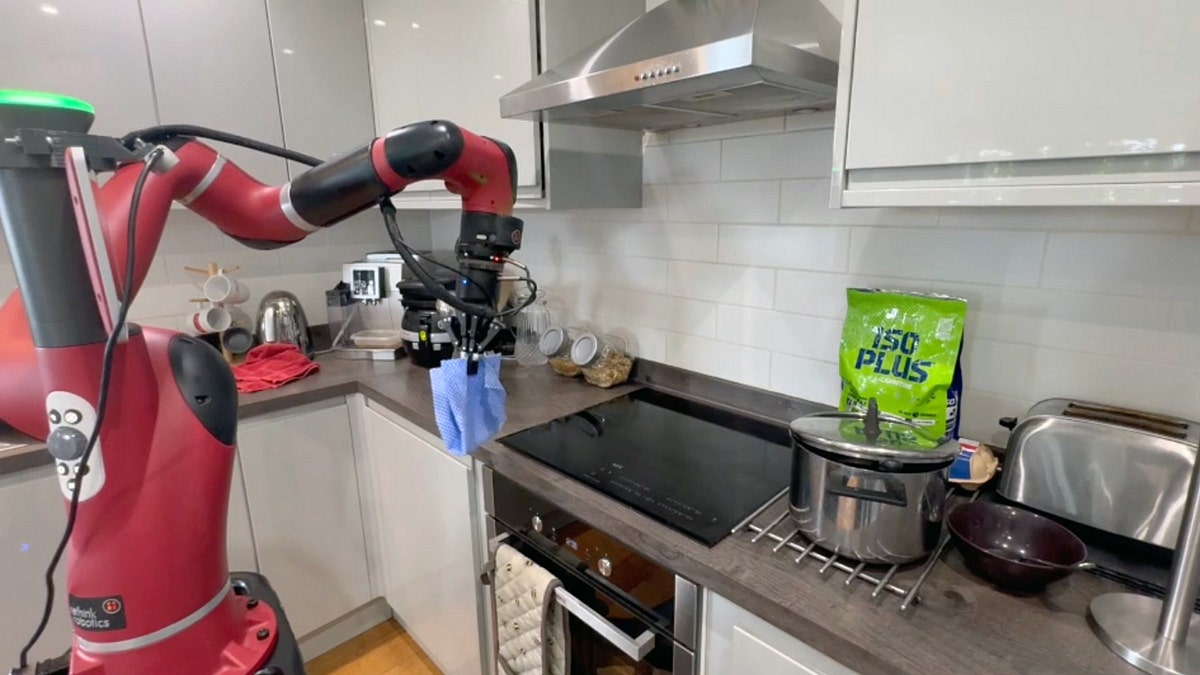
The research team behind the study focuses on teaching robots to learn physical tasks faster and with less data. (Science Robotics)
How the robot learned 1,000 tasks so fast
The breakthrough comes from a smarter way of teaching robots to learn from demonstrations. Instead of memorizing entire movements, the system breaks tasks into simpler phases. One phase focuses on aligning with the object, and the other handles the interaction itself. This method relies on artificial intelligence, specifically an AI technique called imitation learning that allows robots to learn physical tasks from human demonstrations.
The robot then reuses knowledge from previous tasks and applies it to new ones. This retrieval-based approach allows the system to generalize rather than start from scratch each time. Using this method, called Multi-Task Trajectory Transfer, the researchers trained a real robot arm on 1,000 distinct everyday tasks in under 24 hours of human demonstration time.
Importantly, this was not done in a simulation. It happened in the real world, with real objects, real mistakes and real constraints. That detail matters.
Why this research feels different
Many robotics papers look impressive on paper but fall apart outside perfect lab conditions. This one stands out because it tested the system through thousands of real-world rollouts. The robot also showed it could handle new object instances it had never seen before. That ability to generalize is what robots have been missing. It is the difference between a machine that repeats and one that adapts.
AI VIDEO TECH FAST-TRACKS HUMANOID ROBOT TRAINING

The robot arm practices everyday movements like gripping, folding and placing objects using a single human demonstration. (Science Robotics)
A long-standing robotics problem may finally be cracking
This research addresses one of the biggest bottlenecks in robotics: inefficient learning from demonstrations. By decomposing tasks and reusing knowledge, the system achieved an order of magnitude improvement in data efficiency compared to traditional approaches. That kind of leap rarely happens overnight. It suggests that the robot-filled future we have talked about for years may be nearer than it looked even a few years ago.
What this means for you
Faster learning changes everything. If robots need less data and less programming, they become cheaper and more flexible. That opens the door to robots working outside tightly controlled environments.
In the long run, this could enable home robots to learn new tasks from simple demonstrations instead of specialist code. It also has major implications for healthcare, logistics and manufacturing.
More broadly, it signals a shift in artificial intelligence. We are moving away from flashy tricks and toward systems that learn in more human-like ways. Not smarter than people. Just closer to how we actually operate day to day.
Take my quiz: How safe is your online security?
Think your devices and data are truly protected? Take this quick quiz to see where your digital habits stand. From passwords to Wi-Fi settings, you’ll get a personalized breakdown of what you’re doing right and what needs improvement. Take my Quiz here: Cyberguy.com
CLICK HERE TO DOWNLOAD THE FOX NEWS APP
Kurt’s key takeaways
Robots learning 1,000 tasks in a day does not mean your house will have a humanoid helper tomorrow. Still, it represents real progress on a problem that has limited robotics for decades. When machines start learning more like humans, the conversation changes. The question shifts from what robots can repeat to what they can adapt to next. That shift is worth paying attention to.
If robots can now learn like us, what tasks would you actually trust one to handle in your own life? Let us know by writing to us at Cyberguy.com
Sign up for my FREE CyberGuy Report
Get my best tech tips, urgent security alerts, and exclusive deals delivered straight to your inbox. Plus, you’ll get instant access to my Ultimate Scam Survival Guide — free when you join my CYBERGUY.COM newsletter.
Copyright 2025 CyberGuy.com. All rights reserved.
Nicolás Maduro’s capture compared to 1989 Manuel Noriega operation

NEWYou can now listen to Fox News articles!
The U.S. capture of Venezuelan leader Nicolás Maduro and his wife on Saturday is reviving memories of the dramatic 1989 takedown of Panamanian dictator Manuel Noriega, which coincidentally took place 36 years ago to the day of Maduro’s Jan. 3 capture.
Under former President George H.W. Bush, U.S. forces launched a surprise invasion of Panama in the early hours of Dec. 20, 1989, accusing Noriega of conspiring with drug traffickers to funnel cocaine into America.
He had also faced allegations of manipulating the country’s 1989 presidential election.
MADURO MET CHINESE ENVOY HOURS BEFORE US CAPTURE FROM CARACAS AS BEIJING SLAMS OPERATION
“The goal was to restore the democratically elected government of Guillermo Endara and arrest Noriega on drug trafficking charges,” the U.S. Army’s website states. “At the time, Operation Just Cause was the largest and most complex combat operation since the Vietnam War.”
Similarly to Saturday’s operation involving Maduro, the Panama invasion proceeded without explicit authorization from Congress, according to Axios.
Panamanian dictator Manuel Noriega at a ceremony commemorating the death of the national hero, Omar Torrijos, in Panama City. (Bill Gentile/CORBIS/Corbis via Getty Images)
Noriega’s capture, however, unfolded over several weeks as he evaded arrest by taking refuge inside the Vatican’s embassy in Panama City.
U.S. troops used psychological warfare to force Noriega out of hiding.
In a tactic known as Operation Nifty Package, military vehicles with loudspeakers blasted non-stop rock music with a playlist that included songs by The Clash, Van Halen and U2, BBC News reported.
Noriega surrendered to U.S. forces Jan. 3, 1990, 36 years to the day before the U.S. capture of Maduro, and was flown to America to stand trial, Axios reported.
MADURO-BACKED TDA GANG’S EXPANSION INTO US CITIES EMERGES AS KEY FOCUS OF SWEEPING DOJ INDICTMENT

Former Panamanian strongman Manuel Noriega is pictured in this Jan. 4, 1990, file photo. (Reuters/HO JDP)
The operation resulted in the deaths of 23 U.S. service members and left 320 others wounded. The Pentagon estimated that roughly 200 Panamanian civilians and 314 Panamanian military personnel were killed, according to The Associated Press.
In 1992, Noriega was convicted on drug trafficking charges in a Miami federal court and received a 40-year prison sentence.
He was granted prisoner-of-war status, housed in a separate bungalow away from other inmates and was allowed to wear his Panamanian military uniform and insignia in court, the AP reported.
WASHINGTON POST PRAISES TRUMP’S VENEZUELA OPERATION AS ‘UNQUESTIONABLE TACTICAL SUCCESS’

Venezuelan President Nicolás Maduro addresses supporters during a rally marking the anniversary of the 19th-century Battle of Santa Ines in Caracas, Venezuela, Dec. 10. (Pedro Rances Mattey/Anadolu via Getty Images)
After serving 17 years in a U.S. prison, he was extradited to France and later Panama. He died in 2017.
President Donald Trump announced Saturday that Maduro and his wife had been captured and flown out of the country as part of Operation Absolute Resolve.
CLICK HERE TO DOWNLOAD THE FOX NEWS APP
In recent months, the U.S. military has carried out a series of strikes on suspected drug vessels allegedly liked to the Venezuelan regime in the Caribbean Sea and Eastern Pacific.
Until a permanent leader can be found, the U.S. government will “run” Venezuela, Trump said, “until such time as we can do a safe, proper and judicious transition.”
Numerous Caribbean flights are canceled after US attack on Venezuela

NEWYou can now listen to Fox News articles!
U.S. airlines began canceling Caribbean flights early Saturday morning after the “large-scale attack” on Venezuela.
President Donald Trump announced that Venezuelan leader Nicolás Maduro and his wife were captured and flown out of the country — and will stand trial for criminal charges in New York.
Following the successful mission, the FAA issued a slew of Notices to Airmen (NOTAMS) over Venezuela as well as the Caribbean airspace, barring any flights without FAA approval.
US RENEWS ‘DO NOT TRAVEL’ ALERT OVER TERRORISM, KIDNAPPING AMID TRUMP NARCO-TERROR FIGHT
The NOTAMs are set to last through late Saturday night. As of this writing, it is unclear if they will be extended.
The FAA directed Fox News Digital to the Department of War for comment.
President Donald Trump announced that Venezuelan leader Nicolás Maduro and his wife have been captured and flown out of the country. (Jonathan Ernst/Reuters)
Airports in the U.S. Virgin Islands, Puerto Rico, Barbados and Aruba are among the many impacted.
Some stranded holiday travelers are looking for a way home in the New Year.
CLICK HERE TO SIGN UP FOR OUR LIFESTYLE NEWSLETTER
“As a result of the FAA-mandated airspace closures in the Eastern Caribbean, American is adjusting its flight schedule for the region,” an American Airlines spokesperson told Fox News Digital on Saturday.

The FAA has closed Eastern Caribbean airspace for now, prompting dozens of flight cancellations. (iStock)
“We recognize the disruption these restrictions have on our customers and are doing all we can to take care of them, including providing additional flexibility for customers whose travel is affected,” the spokesperson added.
Delta Air Lines issued a travel waiver for customers traveling to or from 13 impacted airports between Jan. 3-6.
CLICK HERE FOR MORE LIFESTYLE STORIES
“Delta teams continue to monitor the situation closely as the safety and security of our customers and people comes before all else,” read their press release.

Airports in the U.S. Virgin Islands, Puerto Rico, Barbados and Aruba are among the many impacted. (iStock)
American Airlines issued a travel alert to 19 airports due to the “FAA airspace closure” in the Eastern Caribbean, offering change fee waivers.
CLICK HERE TO DOWNLOAD THE FOX NEWS APP
“Due to international airspace restrictions affecting portions of the Caribbean, some commercial flights may be impacted,” JetBlue announced in a travel alert.
TEST YOURSELF WITH OUR LATEST LIFESTYLE QUIZ
JetBlue will waive change and cancel fees for travelers impacted.
About 16.8 million Americans visited the Caribbean in 2024, according to the Caribbean Tourism Organization.
For those stuck inside, quiet winter alternatives to busy seasonal events get new focus
NEWYou can now listen to Fox News articles!
Amid the cold and chill of winter, more people are opting out of traveling to packed seasonal venues and instead turning to cozier, easier and more restorative ways to spend their time.
They’re turning their backs on busy holiday markets, long lines and jammed events to choose home-based activities — a shift widely reflected in posts shared across social media.
For some, the shift comes after the intensity of the holidays, which can leave people feeling drained and stressed — and wanting to renew themselves.
BUDGET TRAVELERS VALUE HARD-TO-BEAT COSTCO VACATIONS, BUT SERVICE MAY NOT BE FOR EVERYONE
Jessica Watrous, a licensed psychologist and chief clinical officer at Modern Health in San Francisco, said people often feel burned out after the holidays due to social pressure and expectations — making slower routines and quieter activities more appealing during the winter months.
“If you’re starting to feel overwhelmed or overstimulated, take time to decompress with quiet, calming activities,” Watrous said.
Slower routines and quieter, home-based activities can be very appealing during the winter months — especially right after the holidays. (iStock)
Here are five low-key winter activities people are turning to this season — and why.
Puzzles and brain games
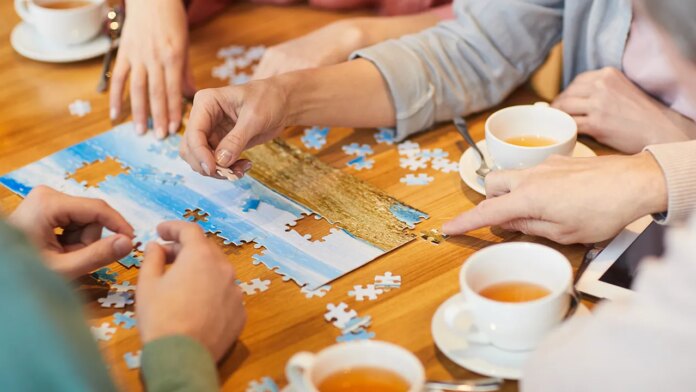
Jigsaw puzzles, logic games and crosswords are getting renewed attention as people look for screen-free ways to unwind indoors.
Many are choosing larger or more detailed puzzles and treating them as ongoing winter projects, rather than something to finish in just one or two sittings.
HOLIDAY DREAMS FALL SHORT: 5 OF AMERICA’S ‘MOST COMPLAINED-ABOUT’ CHRISTMAS ATTRACTIONS
Some people say puzzling offers more than simple entertainment. In online forums such as Reddit, users have shared that working on puzzles helps them manage stress, anxiety and low moods during particularly difficult periods.
“I just started puzzling this year, and I am so happy to find that when I’m working on a puzzle, my mind is no longer spinning out of control and stressing,” one user wrote.

Puzzles and logic games are gaining popularity as calming, screen-free ways to pass the time, entertain the mind and manage stress. (iStock)
Watrous noted that even brief, grounding activities can help quiet the nervous system and bring people back to the present.
WARDING OFF DEMENTIA MEANS MORE READING, PRAYING AND LISTENING TO MUSIC: STUDY
Other users on Reddit said puzzles are appealing because they can be enjoyed alone or casually with family or friends.
Knitting and other fiber crafts
Knitting, crocheting and other fiber crafts are also gaining traction this winter, according to posts shared by social media users.
CREATIVE HOBBIES KEEP THE BRAIN YOUNG, STUDY FINDS — HERE ARE THE BEST ONES TO PURSUE
People say the hobby offers calmness and a sense of control.
Many knitters describe the activity as a way to channel anxious or restless energy into something tangible.
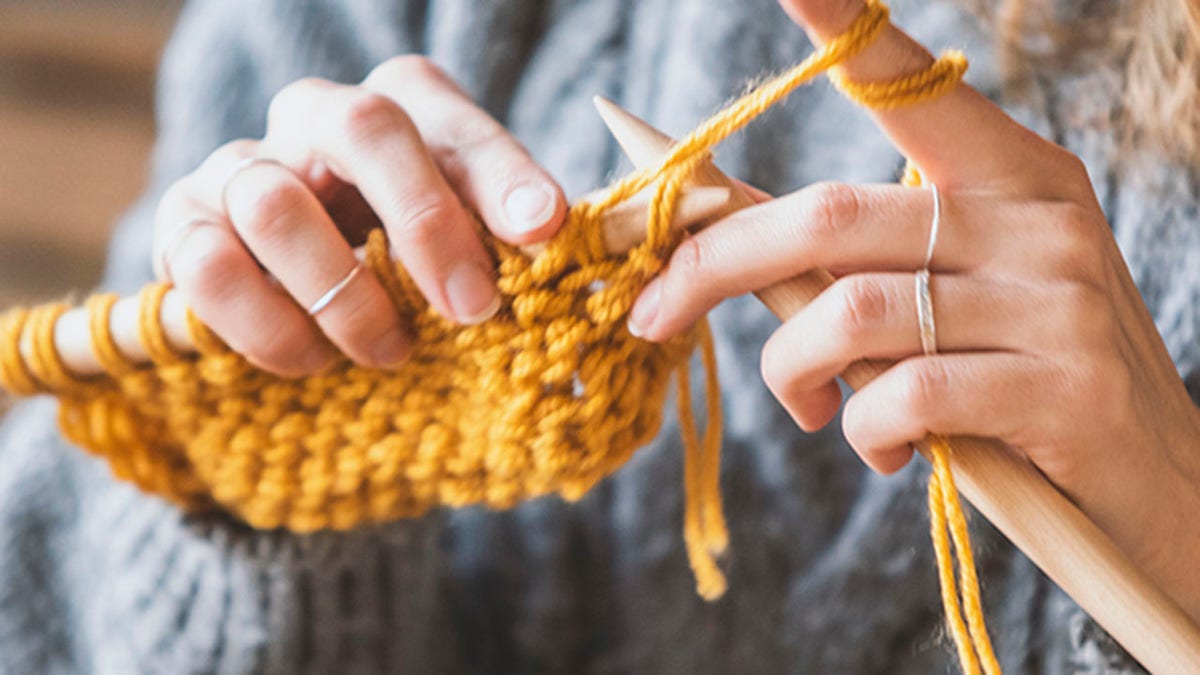
Knitting or crocheting can offer calmness and a sense of control. (iStock)
One user on Reddit wrote that knitting helped her “channel my nervous and anxious energy into something productive,” whether that was making gifts for others or creating something for herself.
Others say the repetitive nature of knitting helps quiet the mind and replace habits like scrolling on phones and tablets.
LEGO building
LEGO building is also finding a place in quieter winter routines — particularly among adults looking for a creative outlet that doesn’t require prior skill or ongoing commitment.
CLICK HERE TO SIGN UP FOR OUR LIFESTYLE NEWSLETTER
Unlike some other hobbies or activities, LEGO sets come with clear instructions and a defined endpoint, which may make the activity feel approachable and low-pressure.
On TikTok, users say they enjoy the sense of order and structure that comes with assembling a set, especially during a season that can otherwise feel overwhelming or disorganized.
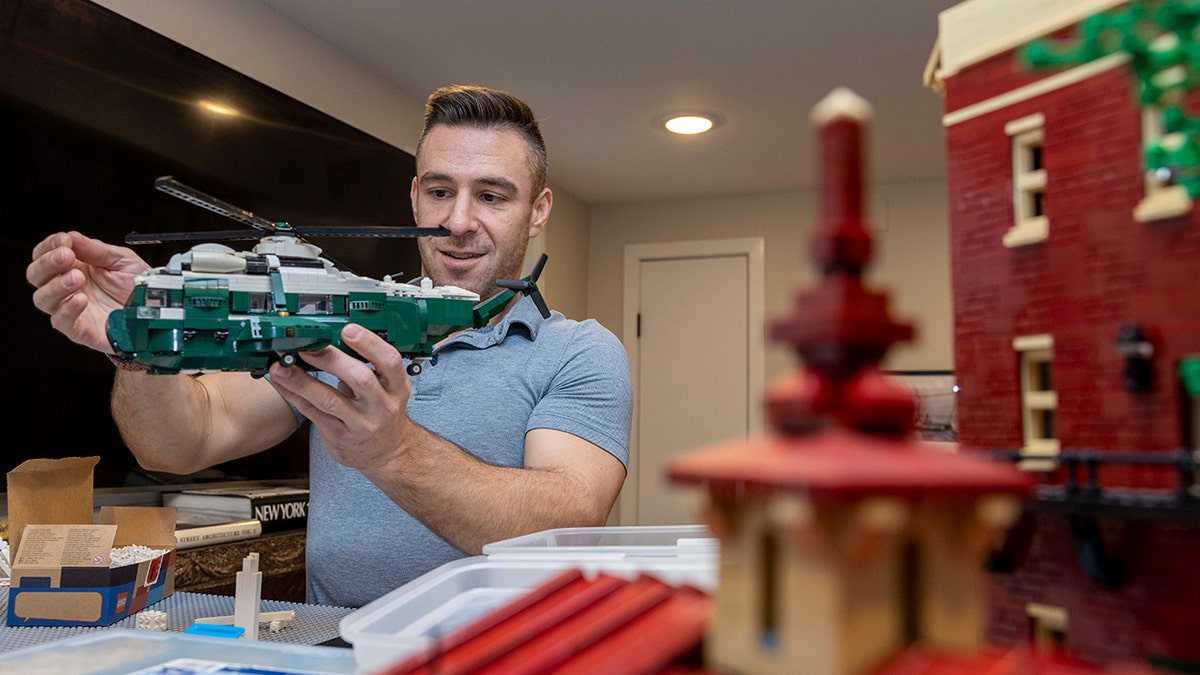
LEGO building among adults is gaining traction in quieter winter routines, especially among those drawn to its structured, low-pressure creativity. (The Washington Post)
Others say LEGO building taps into nostalgia, allowing them to revisit a childhood pastime in a way that feels relaxing rather than demanding.
CLICK HERE FOR MORE LIFESTYLE STORIES
“LEGO sets are perfect for winter days, offering endless screen-free play that benefits children’s development and overall well-being, while bringing families closer together. With options for all ages and interests, LEGO sets nurture creativity and foster connection,” the company told Fox News Digital in response to a request for comment.
Cooking and baking
Cooking and baking, already a big part of many people’s winter routines at home, are getting fresh attention.
And instead of making complicated dishes, many are choosing straightforward recipes they can make again and again.
TEST YOURSELF WITH OUR LATEST LIFESTYLE QUIZ
Social media users say making soup, baking bread or committing to a familiar recipe each week offers a sense of rhythm without pressure.

Cooking and baking are increasingly part of people’s winter routines today, with many turning to simple, repeatable recipes for comfort. (iStock)
Others say cooking at home feels like a practical way to slow down while still doing something useful, especially during a season when motivation can dip and schedules feel less defined.
Reading
Popular for generations, reading a physical book has once again become a go-to winter activity for people seeking a calming break from screens, noise and activity.
IVANKA TRUMP SHARES BOOKS THAT ‘SHAPED’ HER IN 2025, FROM TOP NOVELS TO ANCIENT WISDOM
Many social media users say they’re reading in small increments — rather than setting ambitious targets they’ll never meet.
Some describe reading as a way to mentally step away from stress, even if only for a few pages at a time.
CLICK HERE TO DOWNLOAD THE FOX NEWS APP
One Reddit user recommended keeping expectations low.
The person wrote, “Have a daily goal. For me, this is just five pages before [going] to sleep.”
Minnesota child care providers face Jan. 9 deadline or lose funding

NEWYou can now listen to Fox News articles!
Minnesota officials have until next week to turn over information on child care providers and parents receiving federal funds or risk losing federal child care funding, according to a notice sent to providers.
Minnesota’s Department of Children, Youth and Families (DCYF) told child care providers in an email Friday that information about funding recipients has to be sent to the federal government by Jan. 9, The Associated Press reported.
The notification came after the U.S. Department of Health and Human Services (HHS) said Tuesday it will freeze all child care payments to Minnesota following fraud allegations involving some child care centers.
“We recognize the alarm and questions this has raised,” DCYF said in the email. “We found out about the freezing of funds at the same time everyone else did on social media.”
MINNESOTA FRAUD COMMITTEE CHAIR CLAIMS WALZ ‘TURNED A BLIND EYE’ TO FRAUD WARNINGS FOR YEARS
HHS Deputy Secretary Jim O’Neill announced the halt of childcare subsidies to Minnesota on Dec. 30. (HHSTV1 via YouTube)
The DCYF instructed providers and families relying on the frozen funds to continue the program’s “licensing and certification requirements and practices as usual.” The email does not say if recipients need to take any action or provide any information.
The state agency said it “did not receive a formal communication from the federal government until late Tuesday night,” after the DHS announced it would freeze all child care payments to Minnesota.
All states must submit additional verification before receiving more child care funding.

Nick Shirley upended the news cycle last week with a 42-minute video investigating Minnesota daycare centers that appeared inactive despite receiving millions of dollars in government funding. (Nick Shirley)
On Friday, the DCYF said the state Office of Inspector General conducted on-site compliance checks this week at nine child care centers referenced in a viral video by independent journalist Nick Shirley, who was accusing them of committing fraud.
In his video, Shirley visited several Minnesota child care facilities, including the Quality Learning Center in Minneapolis, which he said appeared inactive despite receiving state child care assistance funds.
Investigators found the centers operating “as expected,” according to DYCF, and children were present at all sites except for one, which it said was not yet open for families at the time of the visit.
The department said it has ongoing investigations at four of the centers, and has 55 open investigations involving providers receiving funding through the Child Care Assistance Program.
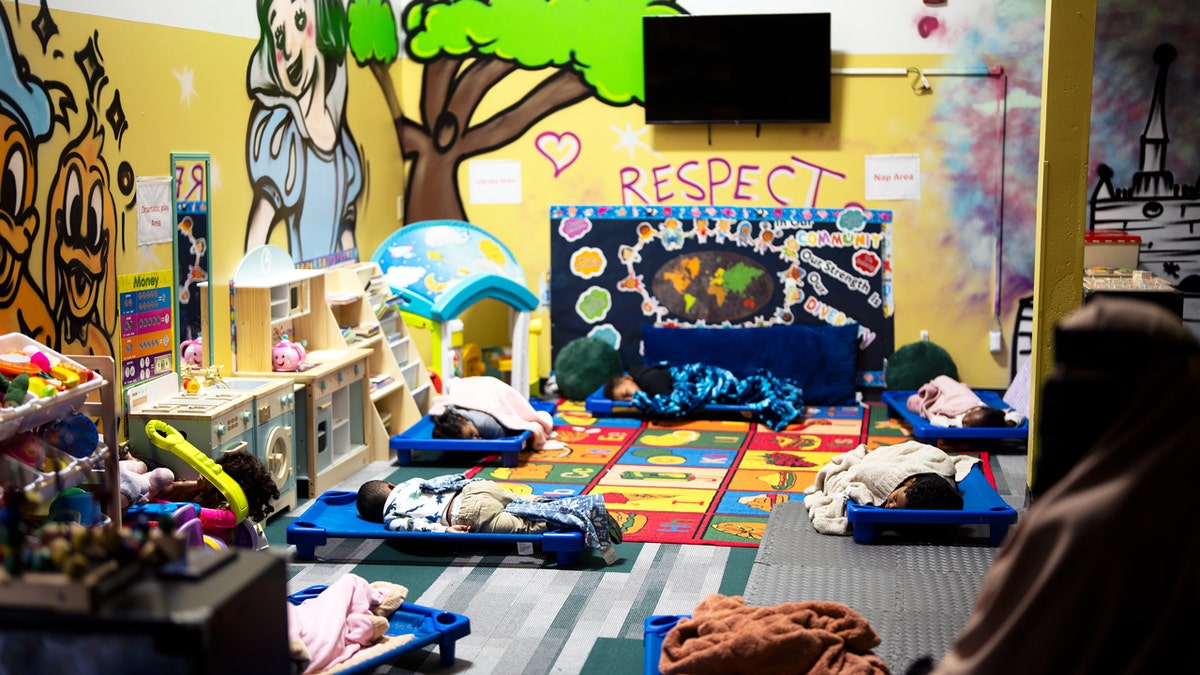
Children sleep during nap time at Minnesota Child Care in Minneapolis, Minn., on Dec. 30. (Renee Jones Schneider/The Minnesota Star Tribune via Getty Images)
At a news conference Monday, Minnesota DCYF Commissioner Tikki Brown said prior inspections of the centers did not uncover fraud, noting that regulators are conducting unannounced visits in response to concerns raised by the video.
“We are aware of a video that’s being circulated that has gained local and national attention about childcare centers in Minnesota,” Brown said. “While we have questions about some of the methods that were used in the video, we do take the concerns that the video raises about fraud very seriously.”
CLICK HERE TO DOWNLOAD THE FOX NEWS APP
Fox News Digital has reached out to Minnesota’s Department of Children, Youth, and Families for comment.
Fox News Digital’s Greg Wehner, Louis Casiano and The Associated Press contributed to this report.
Hawaii cruise tax halted by federal court injunction ruling decision

NEWYou can now listen to Fox News articles!
Hawaii’s “Green Fee” bill was set to raise tourist taxes quite substantially to help fund “climate change” mitigation this year — but now a judge has halted the provision.
The Cruise Lines International Association (CLIA), along with a cruise ship supplier, filed a lawsuit in early September challenging state tax and county finance officials in the Aloha State, as Fox News Digital previously reported.
On Dec. 31, the Ninth U.S. Circuit Court of Appeals issued an injunction pending appeal.
HISTORIC LANDMARK TO BEGIN CHARGING FOREIGN VISITORS AMID OVERCROWDING BATTLES
It temporarily blocks enforcement of the cruise-ship tax while the appeals proceed, The Associated Press (AP) reported.
The Transient Accommodations Tax (TAT) planned to raise the tax on tourists who stay at Hawaii hotels while imposing a new 11% tax on cruises, according to the text of the bill.
Hawaii’s “Green Fee” cruise ship tax has been temporarily blocked by a Ninth Circuit court injunction after the Cruise Lines International Association filed a lawsuit challenging the 11% tourist tax. (iStock)
Toni Schwartz, spokesperson for the Hawaii attorney general’s office, told AP the office “remain[s] confident that Act 96 is lawful and will be vindicated when the appeal is heard on the merits.”
Fox News Digital reached out to the CLIA for comment.
Portions of the revenue raised would go into the “Climate Mitigation and Resiliency Special Fund.”
The association previously told Fox News Digital it “believe[s] the extension violates both the U.S. Constitution and federal law, while imposing an additional financial burden on passengers already subject to substantial fees and taxes.”
CLICK HERE TO SIGN UP FOR OUR LIFESTYLE NEWSLETTER
The association also pointed out the benefits that cruise tourism brings as a major economic driver of the state.
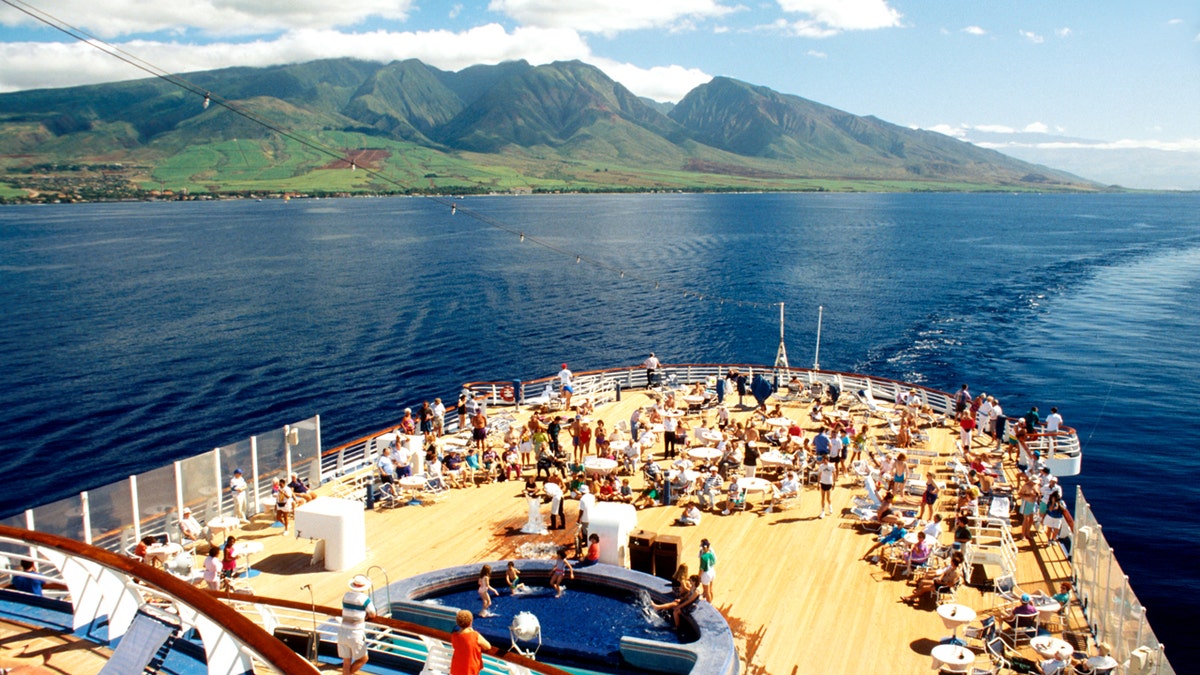
“We remain confident that Act 96 is lawful and will be vindicated when the appeal is heard on the merits,” said a spokesperson for the Hawaii attorney general’s office. (Jeffrey Greenberg/Education Images/Universal Images Group via Getty Images)
“Extending the TAT to cruise passengers threatens to deter visitors whose spending fuels this economic engine, risking job losses and eroding the financial stability of businesses dependent on tourism,” CLIA added.
The lawsuit points out that the state’s counties each add their own 3% surcharge on top of the state’s tax — bringing the total tax to 14%.
CLICK HERE FOR MORE LIFESTYLE STORIES
Portions of the revenue raised would go into the “Climate Mitigation and Resiliency Special Fund” and the “Economic Development and Revitalization Special Fund,” according to the bill.

Some 168,123 visitors traveled to Hawaii by cruise ship in the year 2024. (iStock)
The bill addresses invasive species, wildlife conservation, and beach management and restoration.
It will also help fund a “green jobs youth corps,” as well as areas of environmental concern.
CLICK HERE TO DOWNLOAD THE FOX NEWS APP
In 2024, 168,123 visitors traveled to Hawaii by cruise ship, according to the Hawaii Tourism Authority.
The “Green Fee” is projected to generate $100 million annually, according to the release.
TEST YOURSELF WITH OUR LATEST LIFESTYLE QUIZ
The Associated Press contributed reporting.
Professor says modern history curriculum misrepresents colonialism, slave trade

NEWYou can now listen to Fox News articles!
A professor and author who penned a book rebutting much of the modern teaching of American history in classrooms nationwide told Fox News Digital that today’s curriculum intentionally presents Western culture in a negative light.
Wilfred Reilly is the author of “Lies My Liberal Teacher Told Me” and an associate professor of political science at Kentucky State University. He said his book is a response to “Lies My Teacher Told Me: Everything Your American History Textbook Got Wrong,” Howard Zinn’s “A People’s History” series, as well as other left-wing curriculum like the 1619 Project.
“There are all these books that try to do two things really,” Reilly said. “One is [to] present Western culture as probably the worst culture in the history of the world, and the other is kind of take this sort of sneaky approach to that by saying like, ‘and I bet you didn’t know these facts, these hidden facts that they’re not telling you in school.'”
Wilfred Reilly speaks with Fox News Digital about his book, “Lies My Liberal Teacher Told Me,” in December 2025. (Fox News Digital)
Reilly takes issue with what he sees as an often oversimplified and non-contextualized curriculum regarding colonialism and slavery, among other topics.
“So, I actually responded to what we’re actually learning by looking through these guys, like the 1619 curriculum, and kind of focusing on what they got wrong from the left,” said Reilly.
In the case of slavery, Reilly noted that modern educators are teaching only a sliver of the whole story.
“What we’re teaching is a focus on kind of the latter part of the Atlantic slave trade, which was one of about 20 global slave trades,” he said. “And the reason that we’re teaching this is because it allows the pedagogue, the professor or the teacher, a chance to segue into the modern oppression of Black people. That’s it. That’s why that’s a focus.”
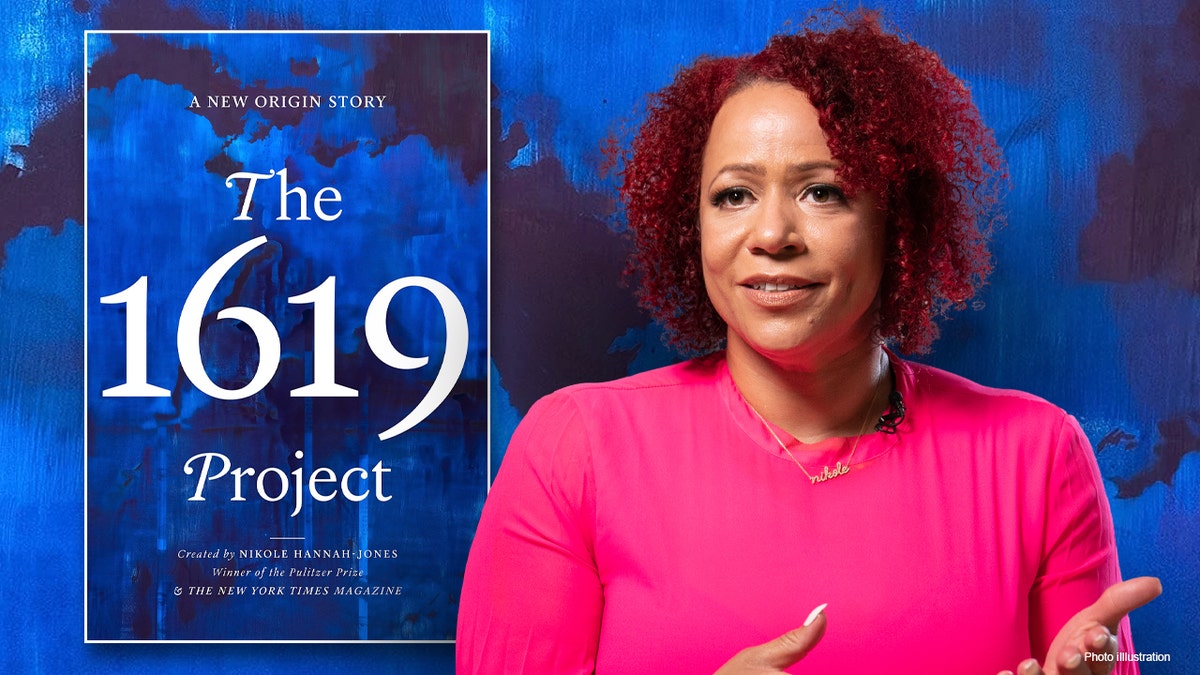
Conservatives, and critical historians, have generally argued that the 1619 Project distorted the true history of the U.S. with many of Nikole Hannah-Jones’ claims, but the mainstream media has largely turned a blind eye to negative feedback. (AP Photo/John Minchillo)
CRITICS SAY K-12 ETHNIC STUDIES PUSH TEACH STUDENTS ABOUT CISHETERONORMATIVITY, BLACK PANTHER PARTY
Native American history also lacks critical context, according to Reilly.
“I think the current presentation of Native Americans would be that they were peaceful, Gaia-worshiping people who were intentionally exterminated by the Europeans, and that’s fantastically false,” said Reilly.
“The Natives were people who had their own motivations, incentives, and drives, and who often competed very successfully with the Europeans,” he continued. “They were also some of the greatest warriors in history, especially the Plains Indians, on par with the Mongols. The Indian Wars took 400 years. The United States is 2% Native today. I mean, so the depiction is just completely factually false.“
Colonialism, he said, isn’t unique to the United States, either.

Blackfoot People Native Americans dressed in full ceremonial traditional clothing at an annual stamppage, Browning, Montana, around 1930. (Herbert C. Lanks/FPG/Archive Photos/Getty Images)
“Most countries, from time to time, engaged in international wars and took land,” he said. “This was not simply something that White countries did.”
CLICK HERE TO DOWNLOAD THE FOX NEWS APP
Like the Mongol and Persian Empires, according to Reilly, White Europeans conquered land, which was completely normal throughout most of history.
“Anyway, in that world, White colonialism, European colonialism, was just one variant on if you invite us in as a partner or if we win a war with you, we’re going to take some land, and we’re going to impose external governance on that land. No one thought of the imposition of external governance as evil.”
Ancient bathtub and statue fragments found by archaeologists in Ephesus ruins in Turkey

NEWYou can now listen to Fox News articles!
Extraordinary ancient finds were recently unearthed in Ephesus, the Turkish city where Paul the Apostle once preached.
The discovery was announced by Anadolu Agency (AA), a state-run outlet in Ankara, on Dec. 12. Ephesus is also known as being one of the seven churches of Asia mentioned in the Book of Revelation.
The star of the excavation was a Roman-era marble bathtub, along with the fragment of a male statue’s torso that was later reused as a paving stone.
GOLD TREASURE SURVIVES 1,400 YEARS AT ANCIENT CHRISTIAN MONASTERY IN BIBLICAL JUDEAN DESERT
Archaeologist Serdar Aybek, speaking to AA, said the bathtub dates back to the first century A.D. Unlike Ephesus’s large, public bath complexes, the one that was recently uncovered was likely “intended for domestic use.”
“It is an unusual discovery because it is not something we encounter frequently,” Aybek said.
Archaeological finds uncovered in Ephesus, the ancient city where Paul the Apostle once preached, include a Roman-era marble bathtub and a statue fragment reused as a paving stone. (Art Media/Print Collector/Getty Images; Mehmet Emin Menguarslan/Anadolu via Getty Images)
“We believe it belonged to the Terrace Houses and was used in the first century A.D.,” he added. “We found it during work at the theater, and its size shows it was used in a house.”
CLICK HERE TO SIGN UP FOR OUR LIFESTYLE NEWSLETTER
The bathtub was found along the ancient Stadium Street. It likely belonged to Ephesus’s Terrace Houses complex, where wealthy Roman families lived in lavish villas.
CLICK HERE FOR MORE LIFESTYLE STORIES
The bathtub was carved with Greco Scritto marble — a regional variety with distinct black veins — and measured almost 5 feet long, 2.5 feet wide and 2 feet high, authorities said.
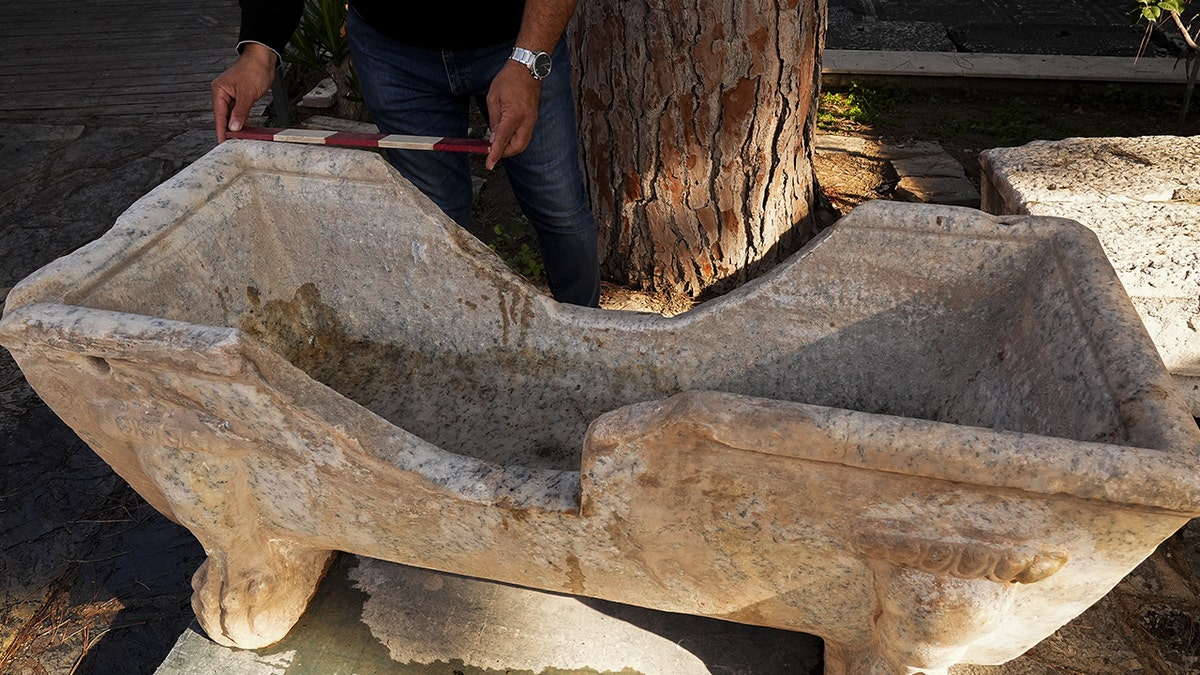
Researchers say the Roman-era bathtub was likely used in a private home rather than at the large public bath complexes. (Mehmet Emin Menguarslan/Anadolu via Getty Images)
After being used by a high-income household, the bath was later repurposed as a fountain trough.
Aybek also described the discovery of the statue fragment, which dated between the first century B.C. and the first century A.D., as “completely unexpected.”
The statue of the unidentified man was carved into multiple parts and attached together before it was later dismantled.
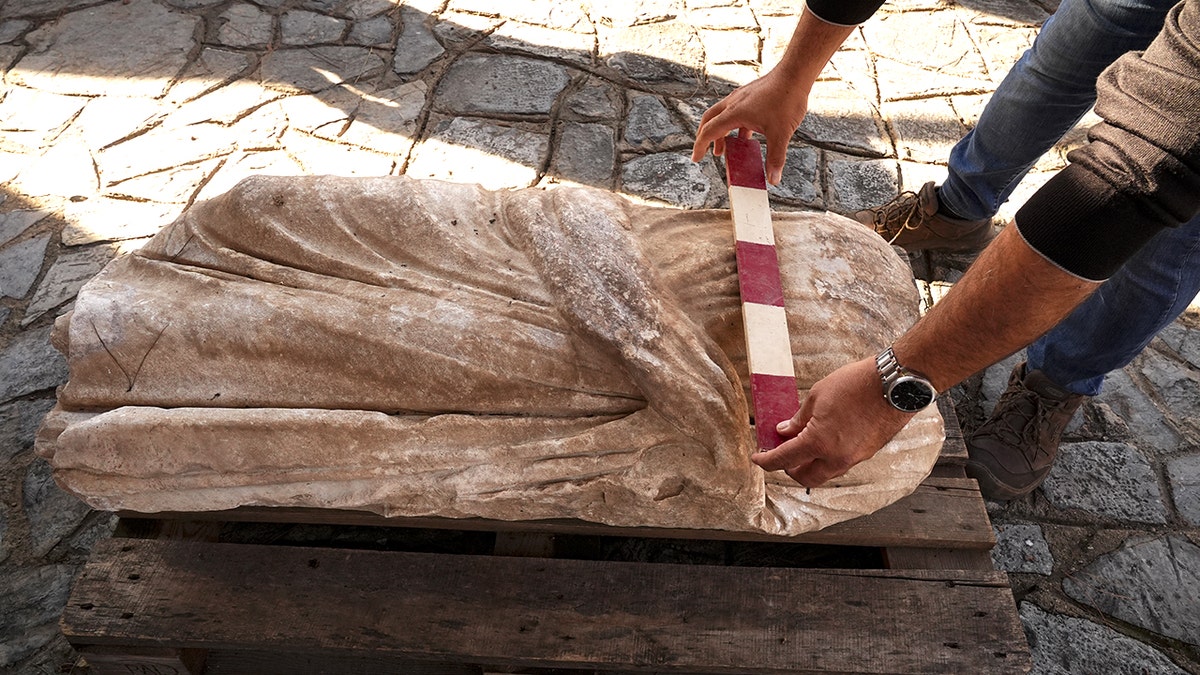
The statue fragment dates between the first century B.C. and the first century A.D., archaeologists said. (Mehmet Emin Menguarslan/Anadolu via Getty Images)
Archaeologists found it face-down — and said it was used as a paving stone in the roadway.
TEST YOURSELF WITH OUR LATEST LIFESTYLE QUIZ
The discoveries have come on the heels of many recent Asia Minor discoveries linked to early Christian history.
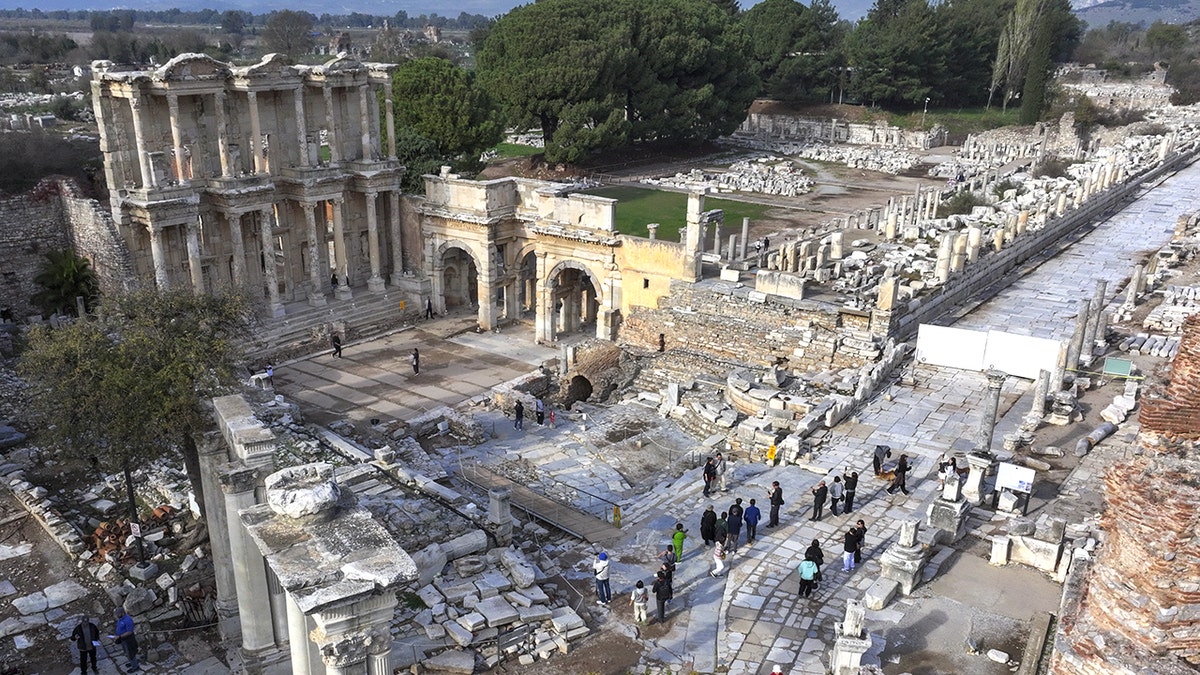
Ephesus is known for being one of the seven churches of Asia mentioned in the Book of Revelation. (Mehmet Emin Menguarslan/Anadolu via Getty Images)
In October, a 1,500-year-old Christian floor mosaic was found in Urfa, a city traditionally regarded as the birthplace of Abraham.
CLICK HERE TO GET THE FOX NEWS APP
In Laodicea — a city also mentioned in the Book of Revelation — the remains of a massive Roman council hall were unearthed this summer.