The largest cryptocurrency, fresh from a recovery from snap volatility the day prior, failed to hold its ground at $43,000 as Bitcoin bulls were denied upside continuation.
BTC price weakness accompanied news that the United States Securities and Exchange Commission had refused a request by major exchange Coinbase to rework the rules for crypto.
“Today, the Commission denied a Petition for Rulemaking filed on behalf of Coinbase Global, Inc.,” a statement from SEC Chair Gary Gensler read.
“I was pleased to support the Commission’s decision for three reasons. First, existing laws and regulations apply to the crypto securities markets. Second, the SEC addresses the crypto securities markets through rulemaking as well. Third, it is important to maintain Commission discretion in setting its own rulemaking priorities.”
The SEC is already implicated in the current crypto market narrative thanks to expectations that it will approve the first U.S. Bitcoin spot price exchange-traded funds (ETFs) in early 2024.
In an interview with Bloomberg on Dec. 13, Gensler acknowledged recent legal proceedings linked to the agency’s repeated rejections of Bitcoin spot ETF applications.
The SEC, he said, “does things according to our authorities and how courts interpret our authorities, and that’s what we’ll do here as well.”
Analyzing the latest setup on order books, popular trader Skew flagged increasing bid support intensifying at $41,000.
“Increasing bid depth around $41K, will be interesting from here. Active supply around $44K,” part of a post on X (Twitter) noted.
BTC/USDT order book data for Binance. Source: Skew/X
Subsequent analysis highlighted low-timeframe exponential moving averages, or EMAs, now back in play.
$BTC 4H Price contesting 4H EMAs again & RSI below 50 currently, important close coming up
Zooming out, meanwhile, Keith Alan, co-founder of trading resource Material Indicators, revealed an ongoing struggle to flip a key weekly level back to support.
This came in the form of the 0.5 Fibonacci retracement line near $42,500, one of several key hurdles to overcome on the way toward $69,000 all-time highs.
If we look at the #Fibonacci levels from the ATH to the macro swing low for #Bitcoin we find ourselves testing support inside the Golden Pocket. That’s bullish if the .5 Fib holds and leads to a break out above the .618 level, but at the moment there seems to be a battle to hang… pic.twitter.com/b5J6ajKbjh
Material Indicators further showed large-volume traders increasing buying activity at the time of writing.
“Mega Whales are buying, and trying to reclaim $42k,” part of X commentary summarized.
BTC/USDT liquidity heatmap for Binance. Source: Material Indicators/X
This article does not contain investment advice or recommendations. Every investment and trading move involves risk, and readers should conduct their own research when making a decision.
Ripple chief legal officer Stuart Alderoty has shared insights on the future of the cryptocurrency landscape in 2024. He discussed predictions about Ripple’s legal dispute with the United States Securities and Exchange Commission (SEC), the judiciary’s influence on crypto regulations and potential legislative challenges in the U.S. Congress.
Alderoty predicts the possible resolution of Ripple’s lawsuit with the SEC in 2024, and he cautions against the SEC’s persistent “regulation by enforcement” strategy, highlighting its potential consequences for the crypto industry.
Alderoty predicts a significant role for the judiciary in curbing SEC overreach, suggesting that ongoing legal conflicts could escalate to a confrontation in the U.S. Supreme Court.
On regulations, Alderoty expects U.S. lawmakers to agree on the need for crypto regulations. However, he expects a deadlock in implementation, which could leave U.S. crypto firms vulnerable while other countries advance in regulatory clarity and innovation.
The SEC filed a lawsuit against Ripple Labs and its current and previous CEOs in 2020. The SEC alleged that the executives held an initial public offering of XRP (XRP), which it claims was an unregistered security at the time. According to the lawsuit, Ripple raised funds by selling XRP tokens in unregistered security offerings to investors in the U.S. and worldwide.
However, in July, Ripple scored a legal victory against the SEC, as a judge granted summary judgment in favor of Ripple Labs, ruling that the XRP token is not a security but only in regard to programmatic sales on digital asset exchanges.
Crypto analysts and fans argue that Ripple’s legal clash with the SEC hindered its growth and acceptance in the United States. Pro-XRP attorney John Deaton asserted that the lawsuit was weaponized, stating that evidence from the past three years supports this claim. Despite Ripple’s global success, he says the case harmed XRP adoption in the United States.
Bitcoin (BTC) will likely reach $1 million in the “days to weeks” following the approval of a spot BTC exchange-traded fund (ETF), according to Jan3 CEO Samson Mow.
“You’re hitting a very limited supply of Bitcoin on the exchanges and available for purchase with a torrent of money,” Mow said, referring to the inflow of institutional capital that is expected following a potential spot ETF approval.
“This is why you can go really high all at one time,” he added.
“Money printing is like boiling the water very slowly,” he explained. “It takes years for that to permeate the economy.”
Unlike previous rallies that led Bitcoin to new highs in a matter of months, Mow said the post-ETF approval rally to $1 million will be much quicker.
“The run up in 2017 was nine months to 20x,” he recalled.
“Given that we’re going to have billions and billions pouring in all at once on ETF approvals, I think it’s going to be a much shorter time frame,” Mow said.
To find out more about the rationale behind Mows’ price prediction, check out the full interview on the Cointelegraph YouTube channel, and don’t forget to subscribe!
Ethereum layer-2 network Arbitrum One has experienced an outage on December 15 for approximately 78 minutes, but is now back online, according to a statement made by the network’s Discord community manager, Ricardo “Gordan.” Gas fees on the network are still abnormally high, but should “normalize”
Message from Arbitrum community manager. Source: Arbitrum Discord.
The sequencer “stalled” at 10:29 am ET (13:29 UTC) during a “significant surge in network traffic,” according to an alert that was posted to Arbitrum’s official status page. At 5:58 pm UTC, Arbitrum’s block explorer, Arbiscan, showed that some blocks were being produced. However, they appeared to be only processing two transactions in each block.
Arbitrum outage alert. Source: Arbitrum
Some users took to X (Twitter) to speculate about whether the outage was caused by inscriptions, as this would explain the small number of transactions in each block. This was later confirmed by the team. Inscriptions are a type of data format used in some blockchain networks and are often used to carry collectible images. Inscriptions originated on Bitcoin but have recently been used on Arbitrum thanks to the MemeOrdi protocol.
According to blockchain analytics platform Layer2Beat, users of Abitrum can withdraw their assets to Ethereum even if the sequencer is down, although this will take 24 hours to process. If proposer validators are also down, the process will take at least six days, eight hours, 43 minutes, and 36 seconds. The network was down for less than two hours.
Update (Dec. 15, 8:34 pm UTC): This article has been updated to include a statement from the team that the network is up and running.
This is a developing story, and further information will be added as it becomes available.
A single night of binge-drinking is more likely to cause liver disease than a few drinks spread across the week, a study revealed.
According to a study done by the University College London, first reported by the London Standard, measuring the pattern of alcohol intake was more accurate than volume for predicting the risk of developing alcohol-related cirrhosis (ARC).
According to Johns Hopkins Medicine, ARC is a stage of liver disease where the liver has become significantly scarred and may cause the liver to stop working correctly.
The scientists analyzed data from 312,599 active alcoholic drinkers in the United Kingdom to assess the impact of the pattern of drinking, genetic predisposition and type-2 diabetes on the likelihood of developing ARC.
Group of young people hands toasting and cheering aperitif beers(iStock)
Dr Linda Ng Fat, a first author of the study from UCL Epidemiology and Public Health, said that the study’s approach was a “better indicator of liver disease risk than volume alone.”
“We took a different approach by focusing on the pattern of drinking and found that this was a better indicator of liver disease risk than volume alone,” Dr. Fat told the London newspaper. “The other key finding was that the more risk factors involved, the higher the ‘excess risk’ due to the interaction of these factors.”
A woman drinking a glass of wine(iStock)
Dr. Fat said the study revealed that those who engaged in heavy binge-drinking, which is defined as having 12 units of alcohol in a day, were three times as likely to develop ARC.
Pamela Healy, Chief Executive of the British Liver Trust told the London Standard that this study revealed that the way people drink alcohol is important and that excessively drinking can have “servious consequences.”
“This research is important because it reveals that it’s not just how much you drink overall but the way that you drink matters,” Healy said. “Drinking a lot, quickly, or drinking to get drunk can have serious consequences for your liver health.”
Grayscale is evaluating the possible tax consequences associated with spot Bitcoin (BTC) exchange-trade funds (ETF), prompted by inaccurate reports circulating about unfavorable tax implications.
In a series of posts on X (formerly Twitter), Grayscale clarifies that retail investors of the Grayscale Bitcoin Trust (GBTC) are not expected to incur tax implications when the fund sells Bitcoin to generate cash for meeting share redemptions.
As we work to obtain the appropriate regulatory approvals to uplist $GBTC to NYSE Arca, we’re considering the potential tax implications for spot Bitcoin ETFs needing to sell $BTC holdings for cash to fulfill share redemptions. Here’s why we’re talking about this now. (1/7)
Grayscale noted that this is due to the GBTC is structured as a grantor trust, which means the entity establishing the trust is regarded as the proprietor of the assets and property for income and estate tax purposes.
“Cash redemptions of grantor trusts are not taxable events for non-redeeming shareholders like retail investors,” the post stated,while explaining its difference from mutual funds:
“Unlike mutual funds and many other ETFs, substantially all spot commodity ETFs (e.g., gold) are structured to be grantor trusts for tax purposes. We take the position that GBTC is properly treated as a grantor trust.”
This follows recent reports indicating that the United States Securities and Exchange Commission (SEC) held another meeting with Grayscale to further discuss its spot Bitcoin ETF application.
On December 8, Cointelegraph reported that Grayscale and Franklin Templeton sat down with the SEC to review their applications, only a day after representatives from Fidelity appeared before the SEC.
Meanwhile, just days before, on December 5, the SEC pushed back the decision on Grayscale spot Ethereum ETF until January 24, 2024.
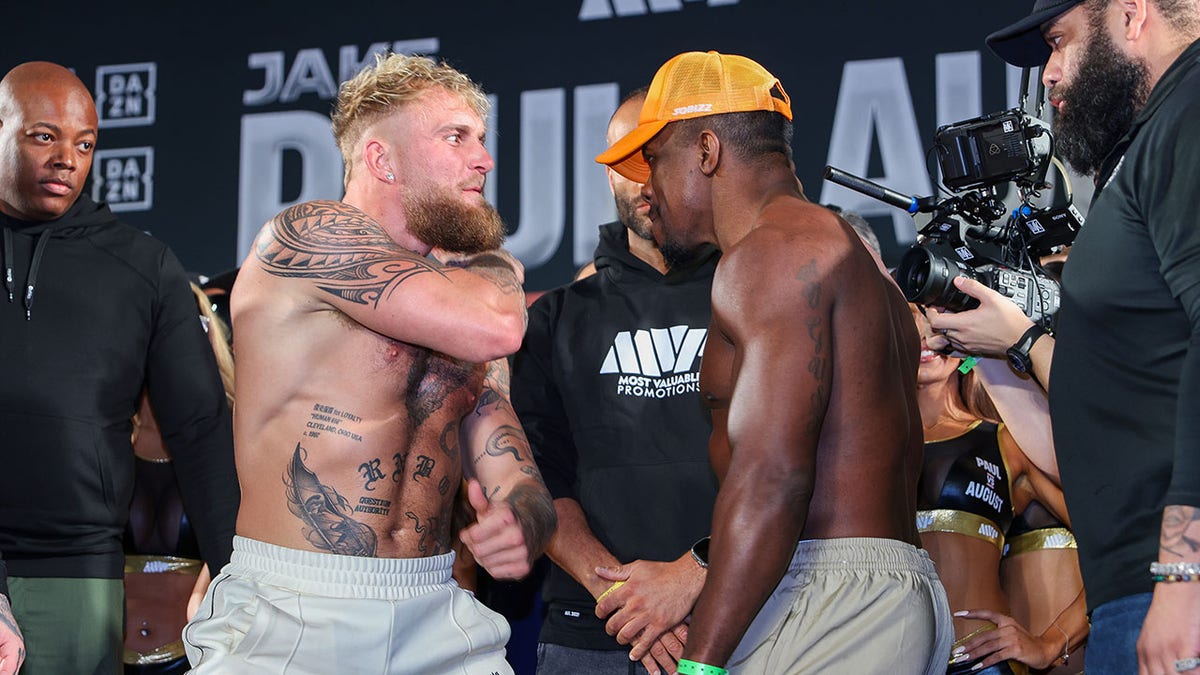
Jake Paul knocks out Andre August in the first round at Caribe Royale Orlando. (Nathan Ray Seebeck-USA TODAY Sports)
August slumped to the mat, and Paul waved goodbye while standing over his opponent.
The fight lasted just two minutes and 32 seconds.
In rather damning analysis, ringside commentator Ariel Helwani said August looked “terrified” right before the fight and “didn’t want to speak.” He also added that he was a “dead man walking,” and his locker room “looked like a funeral home,” perhaps because of the sudden bright lights August found himself under. August, admittedly in an interview to Fox News Digital, said it was a bit of a culture shock.
Paul took the ring to Brenda Lee’s “Rockin’ Around the Christmas Tree” playing, not exactly the best way to get pumped up – but perhaps Paul wanted to stay mellow.
DraftKings, the fight’s main sportsbook sponsor, had Paul at -900 to win, but +2200 to win via knockout in the first round. So, talk about a cashout.
Jake Paul reacts after the win against Nate Diaz in a boxing match at American Airlines Center. (Kevin Jairaj-USA TODAY Sports)
“I said first-round knockout all week. I manifested this. This is the power of manifestation…” Paul said postfight.
“He went night-night. I told him – he don’t need a CELSIUS to wake up,” Paul added, plugging his energy drink.
Paul often pulls out the “silence” celebration as a way of saying he’s going to continue silencing the critics.
“Everyone who has something to say about me…Shut the f— up,” he said.
Paul moved to 8-1 in his career with five knockouts. After the fight, he took time to reflect on his journey from Disney Channel to the ring, and offered some advice to those who may need it.
“Right now, I’m focused on being the best in the world and creating one of the greatest sports stories in the history of sports,” he said. “Being able to become world champion from Disney Channel, three years ago not even knowing how to throw a jab or uppercut, none of this. And that, to me, is incredible. To inspire these young kids or anyone out there to chase their dreams. And no matter where you start – if it’s late in your life, whatever it is that you want to do, you can pursue it and rise to the top.”
Jake Paul gestures toward Andre August during the Jake Paul v Andre August – Weigh-in at the Caribe Royale Orlando on December 14, 2023 in Orlando, Florida. (Alex Menendez/Getty Images)
Strategically navigating the cryptocurrency market when it surges isn’t just a skil. It’s an art. Volatility is constant. Volatility measures the price movements of assets and demands a sophisticated approach from players in the market. Similar to the ebb and flow of tides, it can be navigated strategically.
Decoding the dynamics of market surges
Bitcoin (BTC) peaked at $69,000 during the 2021 bull run, while Ether (ETH) did the same at $4,800. Despite the market hitting an all-time high of $3 trillion in market capitalization, that figure sits a little below $1.7 trillion as of Dec. 15 — a difference of just more than 30 percent. While significant, the comparison obviously doesn’t do justice to what a rollercoaster the market has been.
Understanding the driving forces behind that volatility is key to navigate it. Market sentiment, technological breakthroughs, and regulatory developments play crucial roles. It is crucial to comprehend the prevailing mood and adapt to market dynamics, leveraging insights analyzing social sentiment, news sentiment, and technical analysis indicators.
Beyond the surface-level hype, dynamics that contribute to the complexities of crypto surges include global economic conditions, investor speculation, partnerships, market liquidity, and halving events (for certain cryptocurrencies).
Fundamental analysis
The bedrock of any successful trading strategy is the quality of fundamental analysis backing it. Cryptocurrencies with robust fundamentals consistently outperform those lacking a strong foundation, a principle supported by the efficient-market hypothesis (EMH).
Information about Polygon (MATIC) as displayed by DefiLlama as of Dec. 14, 2023. Source: DefiLlama
This hypothesis, tested across various markets, underlines the significance of fundamental analysis in navigating crypto surges, offering investors a compass to identify projects with great potential. Staying informed on developments and narratives in crypto requires leveraging research and analysis tools like DefiLlama (one of my go-tos). Real-time data and in-depth analysis are helping for monitoring trends and making informed decisions.
The art of mastering technical analysis
While fundamentals set the stage, technical analysis is the script. Indicators like moving averages, the relative strength index (RSI), and Bollinger Bands decipher market trends. Technical analysis has become an art form among traders, significantly influencing trading decisions and boosting annual returns for those versed in its intricacies. Beyond chart patterns, it is about understanding market psychology, enabling traders to make informed decisions that strategically impact the crypto market. All exchanges offer these tools. TradingView is a top choice for more in-depth analysis.
During short-term swing trading in the 15-minute timeframe, the RSI indicator is my north star. Its simplicity, versatility, and function as a momentum oscillator help to identify overbought and oversold conditions, signaling potential reversals or buying opportunities. My own trading decisions are a blend of technical and fundamental analysis, evaluating trend patterns, support, and resistance levels, market sentiment, broader market conditions, token/project-specific developments, and relevant news events.
Know when to sell
“The year after Bitcoin’s halving is usually the bull year,” former Binance CEO Changpeng Zhao noted on Twitter Spaces in July.
Scheduled to occur in April, Bitcoin’s halving will see the number of new Bitcoin issued to miners cut by half from a current block reward of 6.25 Bitcoin to 3.125 Bitcoin. JPMorgan analysts also anticipate the 2024 halving will double Bitcoin’s mining cost, potentially establishing a new price floor. As a savvy trader, you can capitalize on these predictions by strategically acquiring assets that could run on Bitcoin’s coattails, and by knowing when to divest.
The process you take to conclude when to sell your crypto is a nuanced one that demands a strategic blend of market analysis, risk assessment, and a deep understanding of your financial objectives. I typically get into projects that I see solving vital problems at very early stages. I do this to contribute to positive change that affects the world and make it a little better. That’s my fulfillment. In my experience, when you solve a real problem, you eventually turn a profit. I take profit when getting some financial reward from a project makes sense.
This strategy doesn’t work for everyone. Something that helps that you may want to consider is setting predefined profit targets. It’s often prudent to secure profit on a investment if it has met or exceeded your expected returns. Eschew greed and you’ll be just fine.
Market Fear & Greed Index as of Dec. 15, 2023.
In addition, access to the overall valuation of the cryptocurrency is essential. A rapid and unsustainable surge in value mostly signals potential overvaluation, and it might be an opportune moment to sell, especially if it deviates significantly from fundamental factors. These fundamentals include alterations in project development, the underlying technology, or regulatory framework that can undermine the cryptocurrency’s long-term potential.
Include external elements such as significant news events, economic conditions, and changes in market sentiment when making decisions. Ultimately, you achieve a holistic approach to managing your cryptocurrency by aligning your sell decisions with your risk tolerance, financial goals, and the need for portfolio diversification. Regularly reassessing your investment strategy with these factors in mind can contribute to a proactive and informed stance in the market.
The best trades I’ve made came from paying attention to what was being said in the industry and then acting on it. My most successful trades have come from finding information (“alpha”) by being active and alert and byacting on it before it became mainstream news. To that end, it helps to join “alpha groups” and trader channels. You hear about updates on these platforms before they get to the market. These updates give you a brief window to take position before a large percentage of the market does.
This is how you win. In sharp contrast, the worst trades I’ve made came out of acting in haste. Calmness is a good quality to possess as a trader. As the saying goes, “Timing the market is a lot more important than time in the market.”
Navigating the market demands more than surface-level strategies. It requires a comprehensive understanding of the nuances that define the blockchain space. Beyond analytics and statistics, the industry demands the wisdom to recognize that, in the delicate dance of trading and investing in blockchain, strategy is not just a tool. It’s what we use to chase down success in the market.
Evan Luthra is a crypto entrepreneur who sold his first company, StudySocial, for $1.7 million at the age of 17 and had developed more than 30 mobile apps before he was 18. He became involved with cryptocurrency in 2014 and is currently building CasaNFT. He has invested in more than 400 crypto projects.
This article is for general information purposes and is not intended to be and should not be taken as legal or investment advice. The views, thoughts and opinions expressed here are the author’s alone and do not necessarily reflect or represent the views and opinions of Cointelegraph.
The United States Securities and Exchange Commission has denied a Coinbase petition for rulemaking on transactions with cryptocurrencies that are securities. Coinbase filed the petition in July 2022 and pushed steadily for a response.
SEC Chair Gary Gensler announced the commission’s decision in a Dec. 15 statement. He gave three reasons for denying Coinbase’s petition, which requested “rules to govern the regulation of securities that are offered and traded via digitally native methods, including potential rules to identify which digital assets are securities.”
Gensler first argued that existing laws and regulations already apply to crypto. His phrasing was nuanced:
“There is nothing about the crypto securities markets that suggests that investors and issuers are less deserving of the protections of our securities laws.”
Coinbase chief legal officer Paul Grewal, who signed the petition, had foreseen this argument and appended to the petition a discussion of the Howey test and Reves decision, U.S. Supreme Court “articulations” that are crucial to modern securities law. Gensler responded to the arguments in the Coinbase appendix. That was the only part of the 32-page petition that Gensler addressed directly.
Gensler went on to say the timing is wrong for the rulemaking proposed by Coinbase. He said the SEC is currently soliciting comments on rules applicable to crypto. Finally, Gensler said rules are made at the discretion of the agency:
“We thoughtfully consider the timing and priorities of our regulatory agenda and how to best utilize our talented and hardworking staff.”
SEC Commissioners Hester Peirce and Mark Uyeda released a joint statement criticizing the decision. They acknowledged the latter two points made by Gensler but suggested that the issues raised in the petition deserved to be addressed. “Any exploration of these issues should include public roundtables, concept releases, and requests for comment, which would afford us the opportunity to hear from a wide range of market participants and other interested parties,” they wrote.
Coinbase filed a writ of mandamus, which would require the SEC to respond to its petition under court order, in April, nine months after it filed the petition and one month after it received a Wells notice warning it that the SCE may take legal action against it. The SEC replied in May that Coinbase has no right to mandamus, and rulemaking could take years.
After more rounds of court filings, the SEC committed to responding to the Coinbase petition by Dec. 15.
Today the SEC denied Coinbase’s petition for rules for crypto. After 18 months of silence, we went to court to get the response the law requires. With appreciation for the Third Circuit, later today we’ll again seek its help by challenging the SEC’s abdication of its duty. ⬇️ pic.twitter.com/tFjiW53eF7
Grewal responded to the SEC decision in a post on X (formerly Twitter). “With appreciation for the Third Circuit [Court], later today we’ll again seek its help by challenging the SEC’s abdication of its duty,” he wrote.
With the Taiwan presidential election looming within a month, residents of Taiwan have been reportedly warned against using cryptocurrency betting platforms to wager on the presidential outcome. This advice comes amid an ongoing investigation, with several individuals already called for questioning.
According to a recent local report, a number of Taiwanese citizens have utilized the decentralized betting platform Polymarket to place bets on the upcoming presidential election scheduled for January 13, 2024.
“The community reported that several individuals have been summoned for investigation by prosecutors and investigators for participating in Polymarket bets,” the report stated.
However, participating in election-related gambling activities in Taiwan is against the law. It was noted that it potentially violates Article 88-1 of the Election and Recall Act.
The report added there is a potential for a six-month imprisonment, detention, or a fine up to NT$100,000, which is approximately $3,188 USD.