The NHL and NHLPA are investigating a report that a member of the Arizona Coyotes was left untreated at a Dallas hospital after taking a puck to the face and was told to find a hotel.
On Nov. 14, Jusso Valimaki took a 93 mph slapshot to the mouth against the Dallas Stars and was transported to a Dallas-area hospital via ambulance.
After arriving at the hospital, Valimaki reportedly was untreated for several hours and was even told to go to a hotel and return in the morning as “overworked” employees were focused more on incoming trauma patients.
Arizona Coyotes defenseman Juuso Valimaki in action during a game against the Dallas Stars at the American Airlines Center. (Jerome Miron/USA Today Sports)
Valimaki was with his wife and a Coyotes employee at the hospital. The shot to the face left him “unable to function,” and he reportedly had a hole in his mouth and significant internal bleeding, according to Daily Faceoff.
Five hours after first arriving at a hospital, Valimaki received 55 stitches. He lost three teeth and had a fractured bone.
Doctors later reportedly told Valimaki that if he went to a hotel, he could have died by asphyxiation of his own blood.
Juuso Valimaki of the Arizona Coyotes skates against the Boston Bruins Dec. 9, 2023, at the TD Garden in Boston. (Steve Babineau/NHLI via Getty Images)
A spokesperson for the NHLPA confirmed it is “jointly investigating this matter” with the NHL. Neither the league nor the Coyotes immediately responded to an email.
The hospital reportedly originally told Valimaki he could not have surgery until two days later, but the NHLPA stepped in for him to have surgery in the early morning hours. Valimaki reportedly sat in the ER for an hour without care, and it took four hours until his faced was even cleaned up.
Stars doctors tended to Valimaki at the arena, where they said surgery at a hospital was necessary. The team told Daily Faceoff it is cooperating with the investigation.
Juuso Valimaki of the Arizona Coyotes skates with the puck against the Philadelphia Flyers at Mullett Arena Dec. 7, 2023, in Tempe, Ariz. (Norm Hall/NHLI via Getty Images)
Ether (ETH) price is down on Dec. 15 after failing to break above the $2,320 resistance level. The recent price correction can be attributed to negative remarks from regulators, a hack that affected nearly the entire Web3 ecosystem, reduced activity in the Ethereum network, and criticism from a former Ethereum Foundation developer.
Ether price index, USD. Source: TradingView
A broader analysis of the time frame provides a different perspective on the relatively narrow 7.6% daily close fluctuations over the past 11 days. Ether saw a 40% rally before entering the current $2,190 to $2,360 range. Consequently, the lack of a clear direction could simply indicate an accumulation period.
SEC chair Gary Gensler speaks and Ledger undergoes a major hack
The price of Ether has also been influenced by the hype surrounding spot exchange-traded funds (ETFs), especially after the $9-trillion global asset manager, BlackRock, confirmed its plans to launch a spot Ether ETF on Nov. 9. Momentum continued to build on Nov. 21 when Bloomberg ETF analysts reiterated a 90% probability of Bitcoin (BTC) ETF approval by Jan. 10.
However, the regulatory landscape changed on Dec. 15 when the U.S. Securities and Exchange Commission (SEC) released a statement regarding its denial of a petition from the Coinbase exchange. SEC Chair Gery Gensler alleged that existing laws and regulations apply to “crypto securities markets” and added that “now is the right time for regulatory action.”
What is more concerning is that the SEC’s latest note cites “outsize fraud, abuse, and noncompliance” in the cryptocurrency market and emphasizes that “the investing public benefits when intermediaries are registered and overseen.” Regarding Coinbase’s main complaint about “discretionary rulemaking,” Gensler noted that such actions are “a critical element of our ability to faithfully execute Congress’s mandate.”
The Ledger connector hack on the morning of Dec. 14 is also responsible for the recent negative impact on Ether’s price. The incident exploited Ledger’s tool that enabled communication between its hardware wallets and various decentralized applications (DApps). The hacker used a phishing exploit to gain access to a former Ledger employee’s Node Package Manager JavaScript account.
According to the Linea team, a zero-knowledge rollup by ConsenSys, the attack also impacted the leading wallet provider, MetaMask, and affected the entire Ethereum Virtual Machine (EVM) ecosystem. The issue was addressed in less than an hour, but it exposed how the Web3 ecosystem still heavily depends on code developed and maintained by corporations. Essentially, the breach negatively impacted investors’ perception of the decentralized finance (DeFi) industry.
The Ethereum network is also facing its own problems, opening the door for competing blockchains like Solana (SOL) and Avalanche (AVAX). For instance, Ethereum’s average transaction fee of $9.90 is impractical for most transactions, forcing users to deal with the added complexity and risks of resorting to layer-2 solutions.
These issues are reflected in Ethereum’s total value locked (TVL), which has declined by 5% since Nov. 30 to the current ETH 12.26 million, hovering near its lowest level since August 2020. In comparison, Solana’s TVL increased by 14% in SOL terms during the same period. Still, not every DApp requires large deposits, and even DeFi applications are optimizing their liquidity pools. Consequently, one should also analyze the activity in terms of volumes.
Ethereum and Solana daily DApp volumes in USD. Source: DefiLlama
Notice that decentralized application volumes in Ethereum have remained below the $1.8 billion threshold for over a month, while the Solana network experienced a healthy increase to $700 million per day. Avalanche’s current $250 million daily average might seem small compared to leading blockchains, but it represents a 250% growth since late November.
Negative remarks from a former Ethereum Foundation developer have also caused a stir among Ether investors after a Dec. 14 post from Andrew Howard on the X social network.
Lane Rettig, former developer at the Ethereum Foundation:
“I was just pumping Joe Lubin’s bags” (Joe Lubin is the Co-Founder of Ethereum)
It is worth noting that the social network post came at a time when Ether was already facing pressure from other sources, notably regulation and declining network activity, which might have exacerbated its negative appeal.
This article does not contain investment advice or recommendations. Every investment and trading move involves risk, and readers should conduct their own research when making a decision.
St. Louis Blues star Jordan Kyrou became emotional when asked about being booed by the team’s own fans for his remark about former coach Craig Berube, who was fired earlier this week amid the team’s sluggish start to the season.
Berube, who led the Blues to the franchise’s first Stanley Cup win in 2019, was fired Tuesday after going 13-14-1 to start the season. He was in his sixth year with the team.
Jacob Bernard-Docker, #24 of the Ottawa Senators, is unable to block a shot from Jordan Kyrou, #25 of the St. Louis Blues, on December 14, 2023, at the Enterprise Center in St. Louis, Missouri.(Scott Rovak/NHLI via Getty Images)
“I feel personally responsible for the situation that we’re in,” general manager Doug Armstrong said Wednesday. “It’s not a great day, but it’s a new day. Now we move forward.”
But the real controversy came when Kyrou was asked about his relationship with Berube on Thursday.
“I’ve got no comment. He’s not my coach anymore,” he said, via ESPN, adding that the Blues are hoping to “get our culture back a little bit” under interim coach Drew Bannister.
The comment was not received well by fans, who liked Berube. They let him know that during Thursday night’s win over the Ottawa Senators when Kyrou was booed during his introduction and several times when he touched the puck.
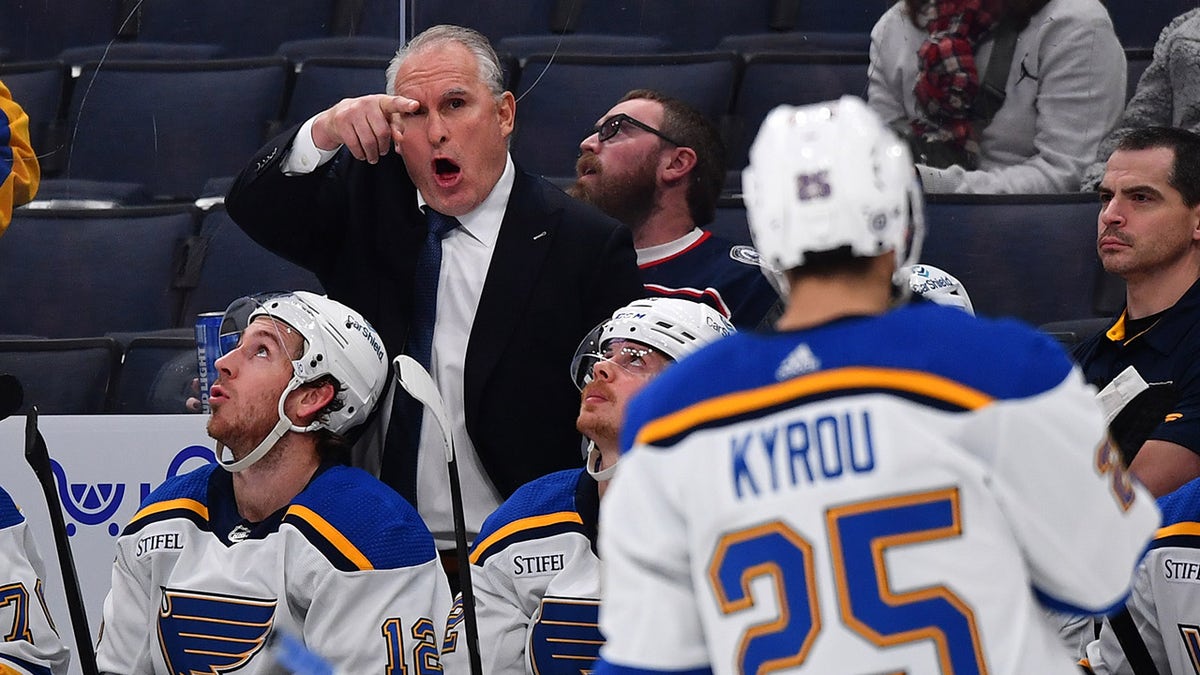
Head coach Craig Berube of the St. Louis Blues instructs Jordan Kyrou, #25 of the St. Louis Blues, during the third period of a game against the Columbus Blue Jackets at Nationwide Arena on December 8, 2023, in Columbus, Ohio. (Ben Jackson/NHLI via Getty Images)
“I obviously respect chief,” Kyrou said after the game. “He’s been my coach for the whole time I’ve been here. I respect everything he’s done here. He’s done a great job – he won a Cup.”
“All I really meant was, I’m just trying to focus on my future and focus on what I can do to help my team win. That’s all I really meant.
Kyrou said he “definitely heard” the crowd’s reaction. He became emotional when discussing the impact it had on him during the game.
“It’s not easy, obviously, but I see where they’re coming from with how my comment sounded. That’s definitely tough. I love playing here, I love playing in front of the fans.”
When pressed further about why he was emotional about the situation, Kyrou broke down.
“It’s just tough, right. I love playing here, so it’s just tough to hear the fans booing me there.”
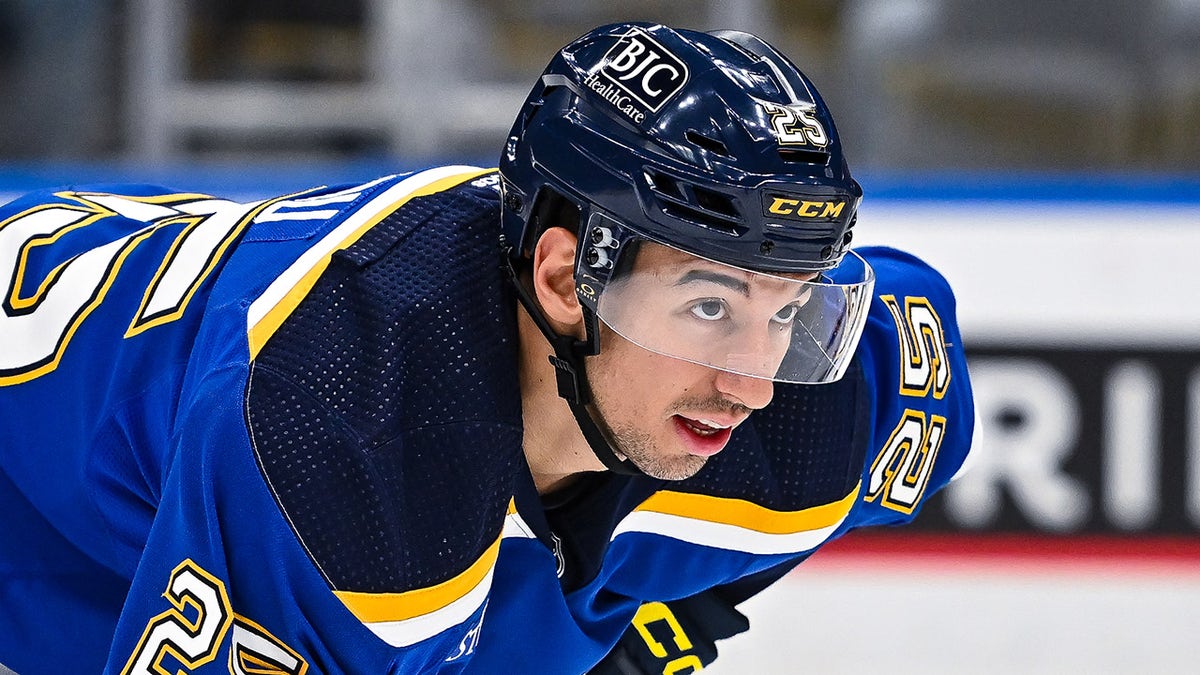
St. Louis Blues center Jordan Kyrou (25) during a regular season game between the Nashville Predators and the St. Louis Blues on November 24, 2023, at the Enterprise Center in St. Louis, Missouri. (Rick Ulreich/Icon Sportswire via Getty Images)
Thursday’s game was the Blues’ first since Berube’s firing. St. Louis ranks 26th in the NHL in goals per game (2.82). and have the second-worst power play (7 for 83) in the league at 8.4%.
Kyrou ranks third for the Blues with 18 points this season. Last season, he led the team with 73 points.
Cam Newton recently came under fire for calling San Francisco 49ers quarterback Brock Purdy a “game-manager.”
The 2015 NFL MVP said the same for Dak Prescott, Tua Tagovailoa and Jared Goff, adding that they were not “game-changers.”
The argument is rather strongest in Purdy’s case. The final pick of the 2022 NFL Draft helped the Niners to an NFC championship appearance last season, and they are 10-3 this season.
Brock Purdy, #13 of the San Francisco 49ers, celebrates after a touchdown by Jordan Mason, #24, during the fourth quarter against the Dallas Cowboys at Levi’s Stadium on October 8, 2023 in Santa Clara, California.(Ezra Shaw/Getty Images)
However, Newton and many others believe that Purdy is riding the coattails of Christian McCaffrey, Brandon Aiyuk, George Kittle, Deebo Samuel, Kyle Shanahan, an elite offensive line and stagnant defense.
“When I think about the 49ers, it’s not Brock Purdy. This is Christian McCaffrey, Deebo Samuel, that unbelievable defensing line, Kyle Shanahan,” Newton said in a video on X, formerly Twitter, early Friday morning.
“As an organization, going into the offseason, our main emphasis on trying to decide a quarterback is ‘We gotta go find us another [Aaron Rodgers], the next Patrick Mahomes, Josh Allen, Lamar Jackson . . . .” he continued. “They don’t say ‘I’m going into the draft to find another Dak Prescott, Brock Purdy, Jared Goff or Tua Tagovailoa.”
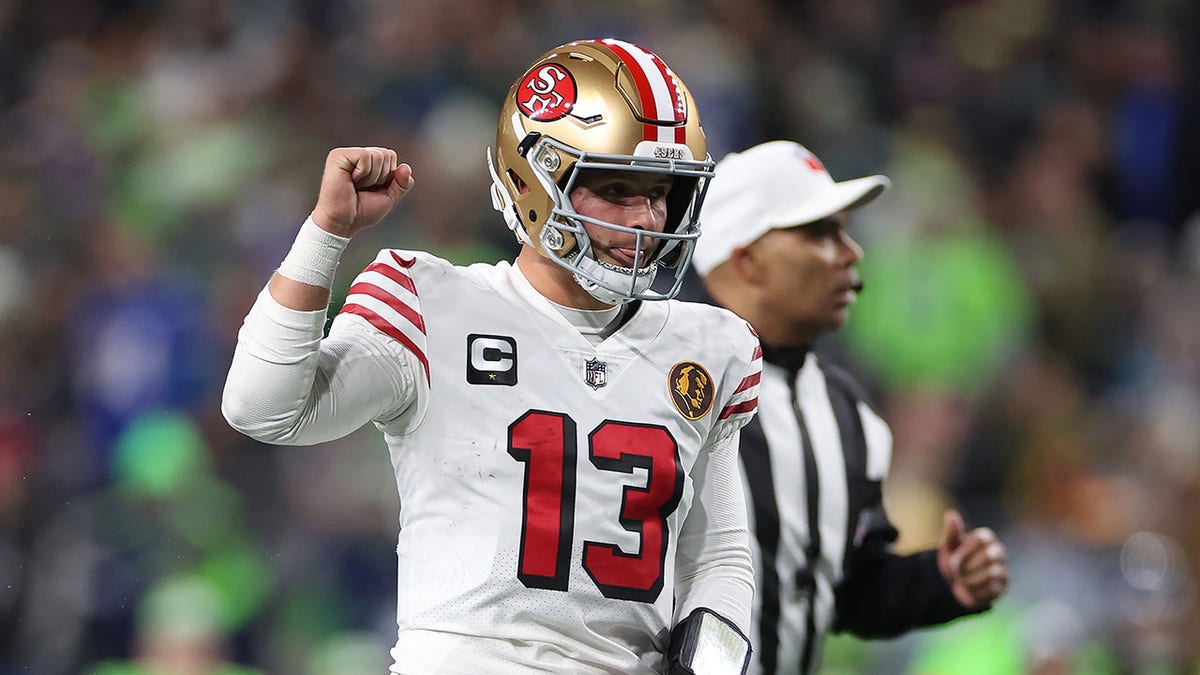
Brock Purdy, #13 of the San Francisco 49ers, reacts to a touchdown during the second quarter of a game against the Seattle Seahawks at Lumen Field on November 23, 2023, in Seattle, Washington. (Steph Chambers/Getty Images)
Newton tried to convince his followers that the term doesn’t have a negative connotation, but just about everyone would agree.
But Purdy is just ignoring Newton altogether. He was asked on Thursday whether he considered himself a “game-manager.”
“I don’t know. I don’t want to comment on that,” he said Thursday, via PFF.” Like I said, I’m playing quarterback, trying to win games, and we’ll see at the end of all of it.”
Say what you want about Purdy, but he is having one heck of a season numbers-wise. His 70.2 completion percentage ranks atop the league among qualified QBs, and his 3,553 passing yards are the third-most, putting him right in the MVP conversation.
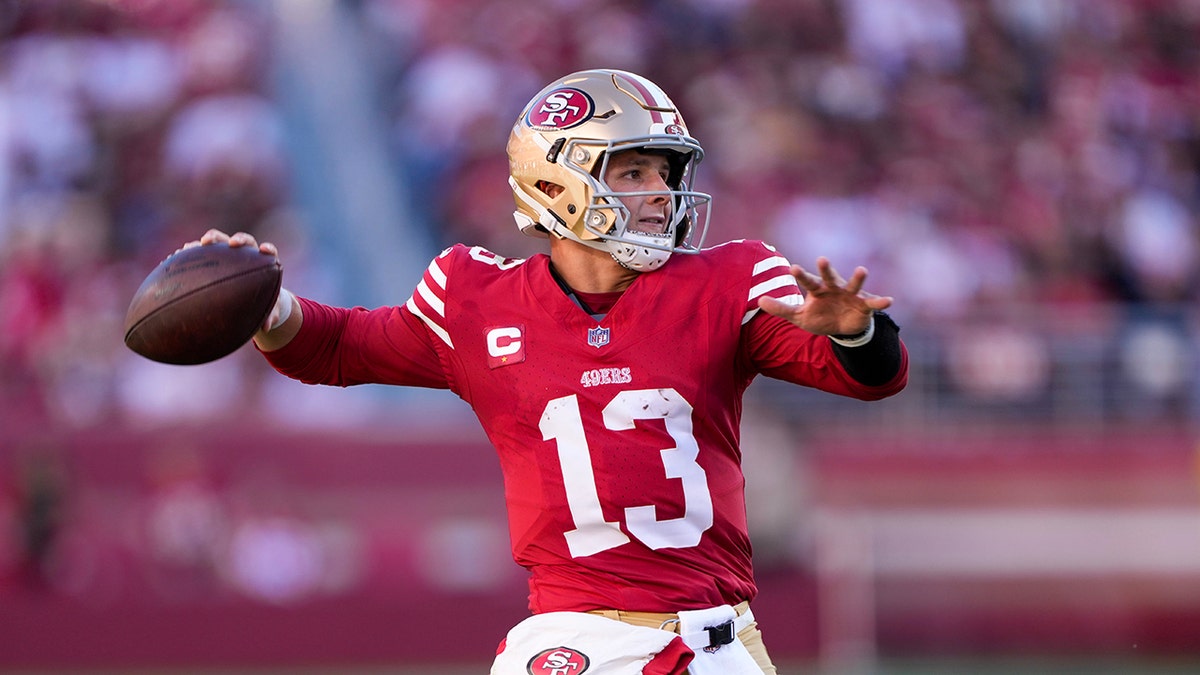
Brock Purdy, #13 of the San Francisco 49ers, throws a pass during the fourth quarter of the game against the Cincinnati Bengals at Levi’s Stadium on October 29, 2023, in Santa Clara, California.(Thearon W. Henderson/Getty Images)
Welcome to Finance Redefined, your weekly dose of essential decentralized finance (DeFi) insights — a newsletter crafted to bring you the most significant developments from the past week.
The past week in DeFi saw an unprecedented chain of events unfold on Dec. 14 when a malicious actor exploited a vulnerability in the Ledger hardware wallet’s connector library. The exploit put the entire decentralized application (DApp) ecosystem at risk. On-chain analysts and DApps like SushiSwap and MetaMask advised users not to interact with their wallets at all.
Ledger released a patch within hours to contain the vulnerability, but the exploiter drained over $650,000 in assets from multiple victims. However, considering the number of wallets and DApps at risk, the drained amount was considerably lower than it could have been.
How the Ledger Connect hacker tricked users into making malicious approvals
The “Ledger hacker,” who siphoned at least $484,000 from multiple Web3 apps on Dec. 14, did so by tricking Web3 users into making malicious token approvals, according to the team behind blockchain security platform Cyvers.
Ledger patches vulnerability after multiple DApps using connector library were compromised
The front end of multiple decentralized applications (DApps) using Ledger’s connector, including Zapper, SushiSwap, Phantom, Balancer and Revoke.cash were compromised on Dec. 14. Nearly three hours after the security breach was discovered, Ledger reported that the malicious version of the file had been replaced with its genuine version around 1:35 pm UTC.
Ledger is warning users “to always Clear Sign” transactions, adding that the addresses and the information presented on the Ledger screen are the only genuine information. “If there’s a difference between the screen shown on your Ledger device and your computer/phone screen, stop that transaction immediately.”
Yearn.finance pleads with arb traders to return funds after $1.4 million multisig mishap
Decentralized finance protocol Yearn.finance is hoping arbitrage traders will return $1.4 million in funds after a multisignature scripting error drained a large amount of the protocol’s treasury.
“A faulty multisig script caused Yearn’s entire treasury balance of 3,794,894 lp-yCRVv2 tokens to be swapped,” according to a Dec. 11 GitHub post by Yearn contributor “dudesahn.”
OKX DEX suffers $2.7 million exploit after proxy admin contract upgrade
OKX decentralized exchange (DEX) suffered a $2.7 million hack on Dec. 13 after the private key of the proxy admin owner was reported to have been leaked.
On Dec. 13, the blockchain security firm SlowMist Zone posted on X (formerly Twitter) that OKX DEX “encountered an issue.” According to the report, the issue began on Dec. 12, 2023, at approximately 10:23 pm UTC after the proxy admin owner upgraded the DEX proxy contract to a new implementation contract, and the user began to steal tokens.
Data from Cointelegraph Markets Pro and TradingView shows that DeFi’s top 100 tokens by market capitalization had a bullish week, with most trading in the green on the weekly charts. The total value locked into DeFi protocols remained above $60 billion.
Thanks for reading our summary of this week’s most impactful DeFi developments. Join us next Friday for more stories, insights and education regarding this dynamically advancing space.
The Texas Rangers‘ title defense won’t start off easily.
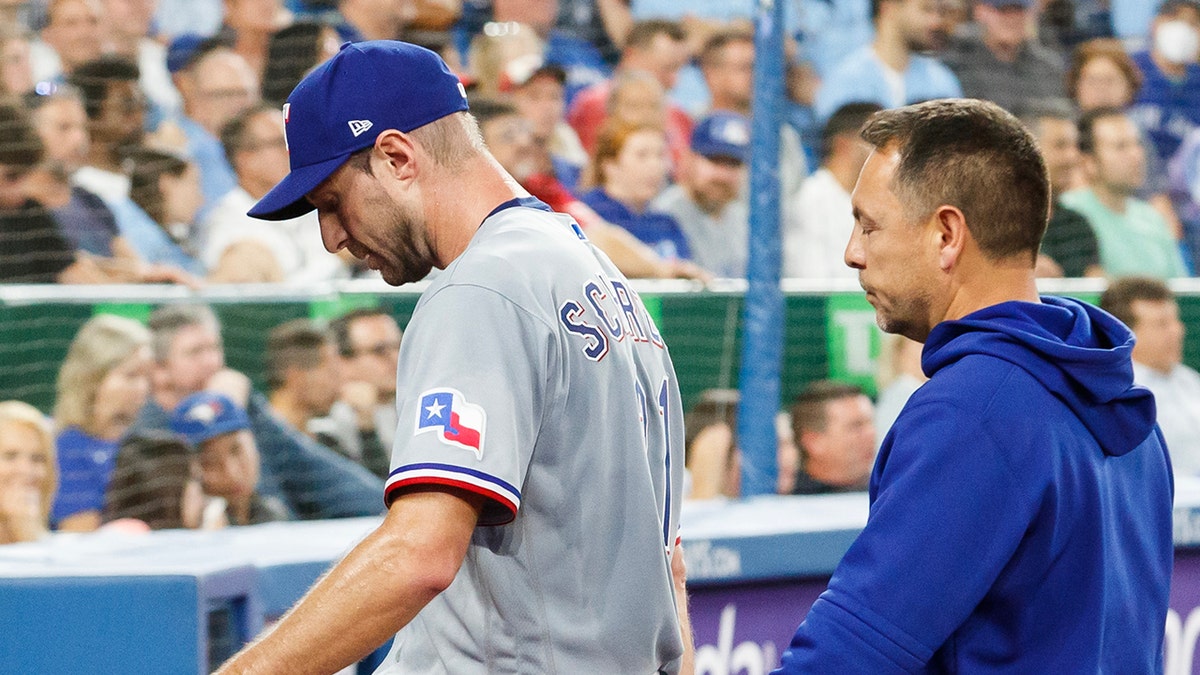
The team announced Friday pitcher Max Scherzer underwent surgery to repair a herniated disk in his lower back.
Scherzer was traded to the Rangers from the New York Mets near the trade deadline, but he suffered a right teres muscle strain in September, which kept him out until the postseason.
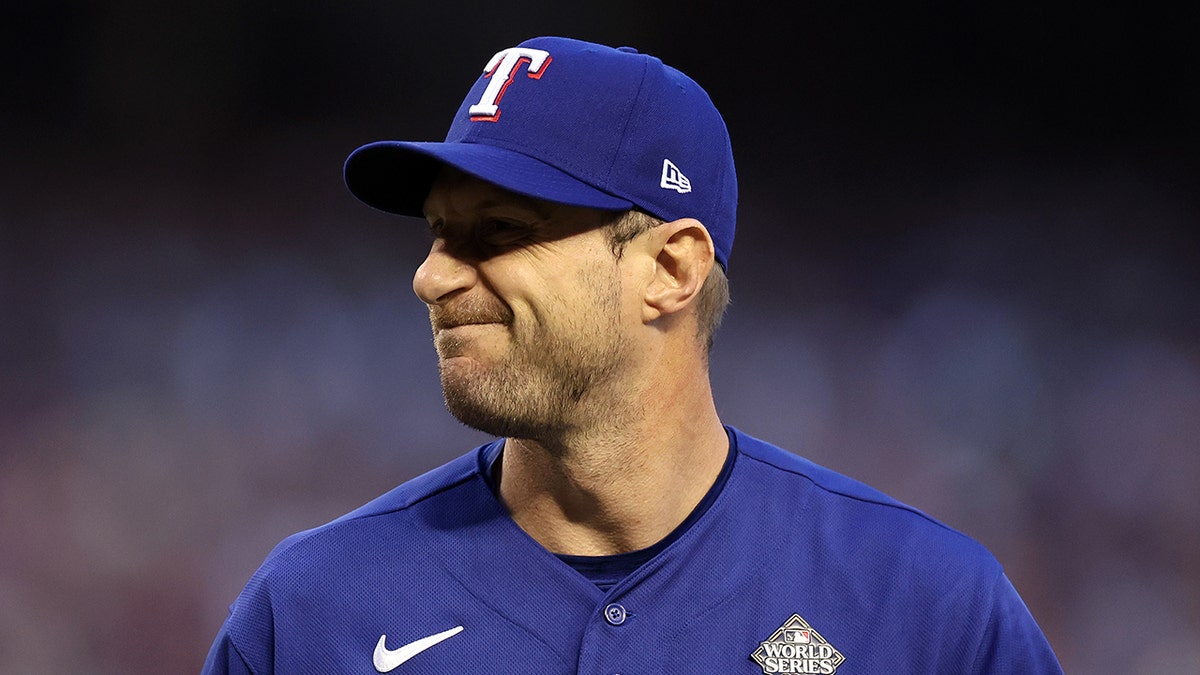
Max Scherzer of the Texas Rangers, left, walks off the field after leaving Game 3 of the World Series at Chase Field Oct. 30, 2023, in Phoenix, Ariz., due to injury in the fourth inning against the Arizona Diamondbacks. (Christian Petersen/Getty Images)
When he returned, he was yanked from his start in Game 3 of the World Series due to back issues. Texas won the World Series over the Arizona Diamondbacks in five games.
Scherzer said his back pain got worse after he returned home following the World Series, and he likely will be out until June or July.
“Getting this procedure done now will give me the best chance to pitch as much as possible for the Rangers in 2024,” Scherzer said. “I look forward to putting in the rehab work and getting back on the mound next summer.”
Scherzer had a left oblique strain last year while with the Mets and had neck spasms last season.
The Rangers have Nathan Eovaldi, and it remains to be seen whether Jordan Montgomery, now a free agent, will return. They also await the return of Jacob deGrom from Tommy John surgery, but he, too, has dealt with various injuries.
Max Scherzer of the Texas Rangers, left, leaves a game in the sixth inning against the Toronto Blue Jays at Rogers Centre Sept. 12, 2023, in Toronto.(Cole Burston/Getty Images)
“Obviously not the best news, but nonetheless, we’re glad that we have a diagnosis and a solution,” general manager Chris Young said. “Max is recovering and feeling better already, and we look forward to getting him healthy and back out there next summer.”
The World Series win was Scherzer’s second. He won in 2019 with the Washington Nationals.
Scherzer, a three-time Cy Young Award winner, went 13-6 last season with a 3.77 ERA in 27 starts, striking out 174 in 152.2 innings.
Max Scherzer of the Texas Rangers walks off the field after the second inning against the Arizona Diamondbacks during Game 3 of the World Series at Chase Field Oct. 30, 2023, in Phoenix, Ariz.(Christian Petersen/Getty Images)
Cam Newton recently came under fire when he said that multiple NFL MVP candidates were “game-managers.”
The 2015 NFL MVP said that Dak Prescott, Brock Purdy, Tua Tagovailoa and Jared Goff, all of whom lead their respective divisions, are “game-managers.”
“They’re not difference-makers,” Newton said earlier this week. “[They’re being asked] not to lose. . . .I don’t give a damn what you do. You don’t have to score every time. You just don’t have to throw a pick every time either. If we’re going to call a spade a spade, a game-manager is different than a game-changer.”
The term often has bleak undertones, but Newton disagrees.
Brock Purdy, #13 of the San Francisco 49ers, and Dak Prescott, #4 of the Dallas Cowboys, talk after their game at Levi’s Stadium on October 8, 2023, in Santa Clara, California.(Ezra Shaw/Getty Images)
“Game-manager is not a negative connotation,” Newton said in a video he posted to X, formerly Twitter, early Friday morning. “‘Cam, what do you mean by game-manager?’ My definition of that managing player is a player who has the ability to make the right play at the right time, protecting the football at all costs.”
“Game-changer and game-manager is not something where I’m saying this person is not physically capable of making some great plays. I’m not saying that, or I am not saying that they’re not good players.”
Despite that compliment, though, he noted that those four quarterbacks have had help in being successful due to their surrounding talent.
“[Purdy’s] putting it in guys’ (hands) like Deebo Samuel and Christian McCaffrey. That’s my point,” he said.
Brock Purdy, #13 of the San Francisco 49ers, throws a pass during the fourth quarter of the game against the Cincinnati Bengals at Levi’s Stadium on October 29, 2023, in Santa Clara, California.(Thearon W. Henderson/Getty Images)
As for Prescott, Newton says that the MVP favorite is “playing lights-out ball right now.”
“But the first thing I think about is the lights-out defense,” he said.
“When I think about the Miami Dolphins, it’s Tyreek Hill. It’s not Tua. That’s not to say Tua’s not having a great season. When I think about the 49ers, it’s not Brock Purdy. This is Christian McCaffrey, Deebo Samuel, that unbelievable defensing line, Kyle Shanahan. . . .
“As an organization, going into the offseason, our main emphasis on trying to decide a quarterback is ‘We gotta go find us another A-Rod, the next Patrick Mahomes, Josh Allen, Lamar Jackson. . . . They don’t say ‘I’m going into the draft to find another Dak Prescott, Brock Purdy, Jared Goff or Tua Tagovailoa.”
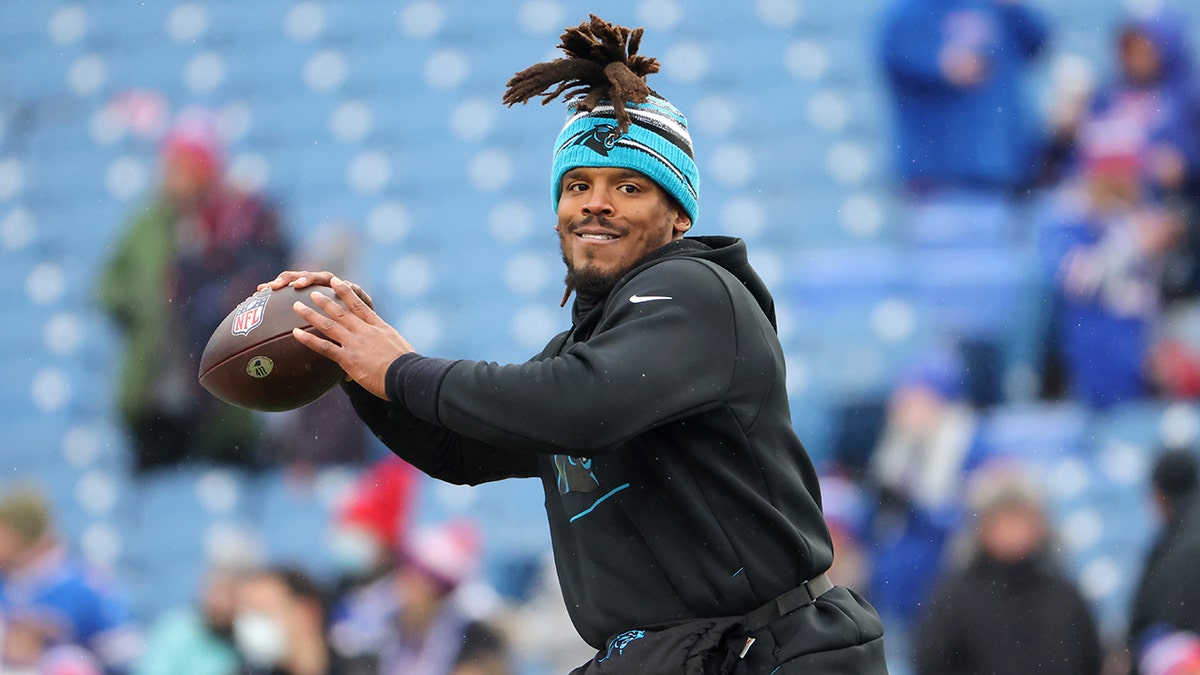
Cam Newton, #1 of the Carolina Panthers, warms up prior to the game against the Buffalo Bills at Highmark Stadium on December 19, 2021, in Orchard Park, New York.(Timothy T Ludwig/Getty Images)
The Civil War football matchup between Oregon and Oregon State will continue at least through the 2025 season despite the Ducks making a move to the Big Ten.
Oregon announced the continuation of the in-state rivalry Thursday, a home-and-home with Oregon State in 2024 and 2025.
An Oregon State Beavers helmet on the field at Autzen Stadium before a game between the Oregon Ducks and the Oregon State Beavers at Autzen Stadium Nov. 24, 2023, in Eugene, Ore. (Tom Hauck/Getty Images)
The future of the rivalry, which dates to 1894, had been up in the air with Oregon departing the Pac-12 for the Big Ten in 2024.
Oregon State is one of just two teams that has not found a new conference to play in after a summer in which eight teams left the Pac-12, following USC and UCLA out the door.
The continuation of the rivalry was made possible due to scheduling adjustments by Oregon, which will no longer play Texas Tech in 2024 or Boise State in 2025 and will have seven home games each season.
The Oregon-Oregon State game is the fifth-most played rivalry game in college football, with the two schools squaring off 127 times.
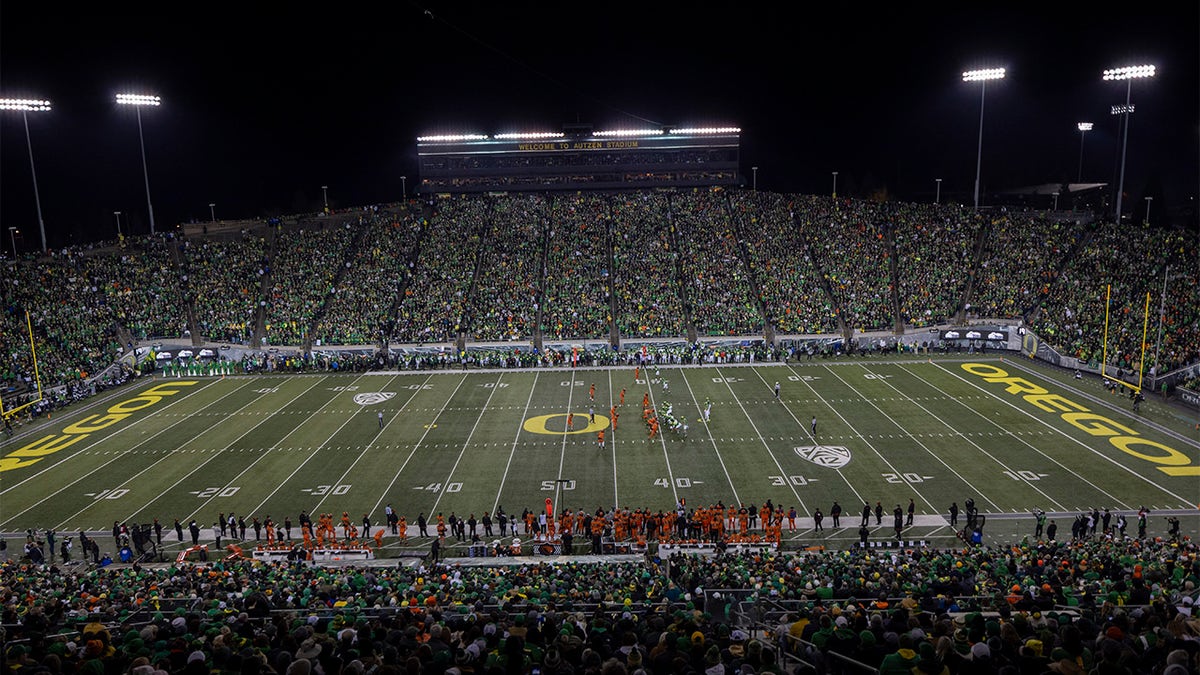
A game between the Oregon Ducks and the Oregon State Beavers at Autzen Stadium Nov. 24, 2023, in Eugene, Ore. (Tom Hauck/Getty Images)
Oregon defeated the Beavers in 2023, securing a spot in the Pac-12 championship game before losing to Washington. The game was played at Autzen Stadium before a crowd of 59,987, the fourth-largest crowd in the history of the stadium, according to Oregon.
“I think games like this are really important,” Oregon head coach Dan Lanning said before the November matchup, according to The Oregonian. “And it would be great if that’s something we could make happen and continue to make happen. I know everybody on our end would love to see that continue.”
Conference realignment has shaken up traditional rivalries across the country as schools are forced to schedule their rivals in the non-conference slate.
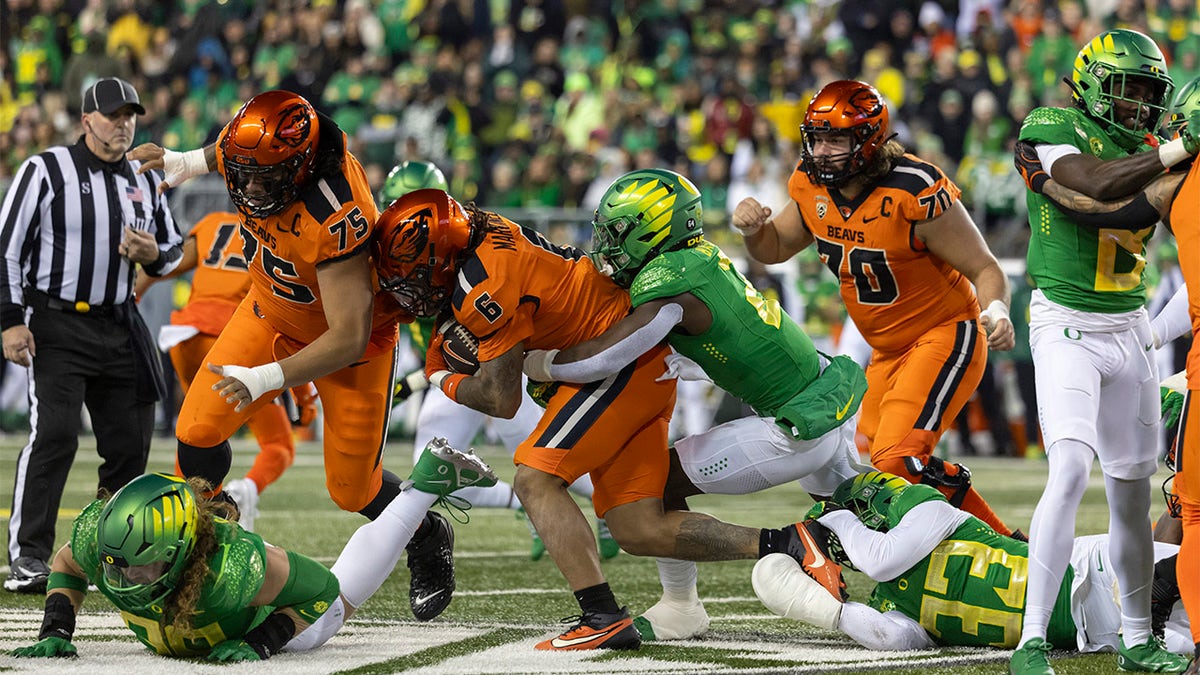
Linebacker Jeffrey Bassa (2) of the Oregon Ducks tackles running back Damien Martinez (6) of the Oregon State Beavers at Autzen Stadium Nov. 24, 2023, in Eugene, Ore. (Tom Hauck/Getty Images)
Washington, which will join Oregon in the Big Ten next season, agreed in principle to extend its Apple Cup rivalry with Washington State through 2028.
“For more than a century, fans across the state have been circling the Apple Cup date on their calendars. We are pleased that we will be able to continue this beloved tradition for future generations of Coug fans,” Washington State President Kirk Schulz said, according to ESPN.
The United States Securities and Exchange Commission has held a new round of discussions with asset managers proposing a spot Bitcoin (BTC) exchange-traded fund (ETF) in the U.S., this time with officials from Gary Gensler’s office participating in the meetings.
Based on court filings, the regulator received representatives from BlackRock on Dec. 14 to discuss the proposed rule change that would enable the crypto investment vehicle to be traded on major exchanges. According to Bloomberg ETF analyst Jayme Seyffart, this is the third meeting between BlackRock and the SEC to review the application.
Meetings between asset managers and the SEC had intensified over the previous weeks. On Dec. 8, Grayscale and Franklin Templeton also sat down with regulators to go over their applications, a day after representatives of Fidelity appeared before the SEC.
In late November, Chair Gensler’s staff also met with the Hashdex team to address concerns over market manipulation and investor protections. Specifically, the discussion focused on the use of cash creations and redemptions as well as the acquisition of spot Bitcoin from physical exchanges within the Chicago Mercantile Exchange market, Cointelegraph has learned.
Several large asset managers are planning to launch spot Bitcoin ETFs, including WisdomTree, BlackRock, Invesco, Fidelity and Grayscale. Over the years, the SEC has denied similar proposals. Now, the regulator is pushing its next decisions to early January, when most applicants’ latest deadlines will expire.
Upon approval, the biggest cryptocurrency will trade on Wall Street’s major exchanges, opening up Bitcoin to a broader audience of investors backed by the world’s most influential investment firms. If denied, investment managers will likely appeal the ruling, which will prolong the waiting even further.
A spot Bitcoin ETF directly tracks the real-time market price of Bitcoin, holding actual Bitcoin. Its value reflects the current price of BTC under its ownership. Conversely, a futures Bitcoin ETF invests in Bitcoin futures contracts, which are agreements on the future price of Bitcoin, rather than holding the cryptocurrency itself. The SEC approved the first futures Bitcoin ETF in 2021.
Bitcoin’s (BTC) rally has been taking a breather for the past few days but its strong rally in 2023 has not gone unnoticed. A survey of United States financial services companies by crypto firm Paxos showed that 99% of the firms were putting as much or more focus on crypto projects this year as compared to previous years.
Analysts are increasingly bullish on Bitcoin and the crypto space in 2024. Bitwise senior research analyst Ryan Rasmussen made ten predictions for the crypto industry in 2024 in an X (formerly Twitter) post on Dec. 13. He believes Bitcoin will soar to $80,000 in 2024 and “more money will settle using stablecoins than using Visa.”
Along with crypto-specific issues, expectations of rate cuts by the Federal Reserve in 2024 are adding to the bullish sentiment. Arthur Hayes, the former CEO of crypto exchange BitMEX, reiterated his bullish view on crypto in an X post on Dec. 14. He said that the fiat was “a filthy piece of trash” and there was no reason not to be long crypto.
What are the vital support levels that could arrest the fall in Bitcoin and altcoins? Let’s analyze the charts of the top 10 cryptocurrencies to find out.
Bitcoin price analysis
Bitcoin has been stuck between the downtrend line and the 20-day exponential moving average ($41,221) for the past few days. This tightening of the price action suggests that a range breakout is possible in the short term.
If the price turns down and breaks below the 20-day EMA, it will signal that the bulls are aggressively booking profits. That could sink the BTC/USDT pair to the 50-day simple moving average ($38,050). Buyers are expected to fiercely defend this level.
Alternatively, if the price bounces off the 20-day EMA and pierces the downtrend line, it will signal that the bulls remain in control. The pair could rise to the 52-week high at $44,700 and if this level is cleared, the next stop is likely to be $48,000.
Ether price analysis
Ether (ETH) rebounded off the $2,200 support on Dec. 13, but the relief rally is facing selling near $2,332. This suggests that bears are selling on rallies.
The negative divergence on the RSI also suggests that the bullish momentum is slowing down. Sellers will try to strengthen their position by pulling the price below $2,200. If they manage to do that, the ETH/USDT pair could tumble to the 50-day SMA ($2,049) and later to the solid support at $1,900.
Contrarily, if the price once again rebounds off $2,200, it will suggest that the bulls have flipped the level into support. That will increase the likelihood of a rally to $3,000.
BNB price analysis
The bulls are struggling to push BNB (BNB) above the overhead resistance at $260, but a minor positive is that they have not ceded ground to the bears.
The gradually upsloping 20-day EMA ($240) and the RSI in the positive territory indicate advantage to buyers. If the price turns up from the current level or rebounds off the 20-day EMA, the bulls will again attempt to drive the price to the neckline of the inverse head-and-shoulders pattern.
Instead, if the price dips below the moving averages, it will suggest that the bulls are losing their grip. The pair may then slump to the strong support at $223, indicating a range-bound action between $223 and $260.
XRP price analysis
XRP (XRP) is witnessing a tough battle between the bulls and the bears at the moving averages.
The flat 20-day EMA ($0.63) and the RSI near the midpoint suggest a balance between supply and demand. If the price closes below the moving averages, the XRP/USDT pair could slide to $0.56. This is an important level for the bulls to defend because a break below it could yank the pair to $0.46.
If the price rebounds off the moving averages, the pair will again attempt to rally above $0.67. If that happens, the pair could surge to $0.74. The bears are expected to mount a strong defense at this level.
Solana price analysis
Solana (SOL) bounced off the 20-day EMA ($66) on Dec. 13 and rose above the overhead resistance at $78 on Dec. 15.
If buyers sustain the breakout, the SOL/USDT pair is likely to jump to the psychological level of $100. The upsloping moving averages signal advantage to the bulls but the negative divergence on the RSI cautions that the bullish momentum may be weakening.
The crucial support to watch on the downside is the 20-day EMA. A break and close below the 20-day EMA could hit the stops of several short-term traders. That may start a pullback to the 50-day SMA ($55).
Cardano price analysis
Cardano (ADA) turned up from the 50% Fibonacci retracement level of $0.51 on Dec. 11 and surged above $0.65 on Dec. 13.
If buyers maintain the price above $0.65, the ADA/USDT pair could reach $0.70 and subsequently $0.78. However, the risk of a correction looms large as the RSI has been trading in the overbought territory for the past several days.
The first sign of weakness will be a drop below $0.61. That may start a pullback toward the 20-day EMA ($0.51). This remains the key level to watch out for because a break below it will indicate a trend change in the near term.
Dogecoin price analysis
Dogecoin (DOGE) bounced off the 20-day EMA ($0.09) on Dec. 13 but the bulls are finding it hard to push the price above the $0.10 level.
The bears will try to pull the price below the 20-day EMA. If they do that, the selling could intensify and the DOGE/USDT pair may slump to the 50-day SMA ($0.08). This level may act as a support but if broken, the pair may decline to $0.07.
Both moving averages are sloping up and the RSI is in the positive territory, indicating that buyers hold the edge. If the price rebounds off the 20-day EMA, it will suggest that bulls continue to buy the dips. That will increase the likelihood of a rally to $0.11.
Avalanche (AVAX) snapped back from the 38.2% Fibonacci retracement level of $34.36 on Dec. 13, indicating that the buyers are not waiting for a deeper correction to buy.
The bulls are trying to push the price above the overhead resistance of $42.89. If they can pull it off, the AVAX/USDT pair could start the next leg of the uptrend. The next target objective on the upside is $50 and then $70.
The risk to the upside is that the RSI is trading in deeply overbought levels. That suggests the pair is vulnerable to a correction or consolidation in the short term. If the price turns down from $42.89, the pair could slide to the 20-day EMA ($30.40).
Polkadot price analysis
The bulls again tried to push Polkadot (DOT) above the overhead resistance of $7.90 on Dec. 14, but the bears held their ground.
The repeated failure of the bulls to clear the overhead hurdle may have tempted short-term traders to book profits. Although the bulls purchased the dip on Dec. 14, they could not sustain the higher levels. Renewed selling on Dec. 15 is threatening to sink the DOT/USDT pair to the 20-day EMA ($6.43).
A strong rebound off the 20-day EMA will suggest that the sentiment remains positive. The bulls will then again try to propel the pair to $7.90. The short-term trend will turn bearish on a break below the 20-day EMA.
Polygon price analysis
Polygon (MATIC) has been trading near $0.89 since Dec. 12, but the bulls have failed to drive the price above the resistance. This suggests that the bears are aggressively defending the level.
The 20-day EMA ($0.84) is the important support to watch out for. If the price rebounds off the 20-day EMA, it will indicate that lower levels are being bought. That will improve the prospects of a rally above $0.89. If this resistance is overcome, the MATIC/USDT pair could soar to $1.
On the other hand, if the price slips below the 20-day EMA, it will suggest that the bulls have given up in the short term. That may start a fall to the 50-day SMA ($0.78) and thereafter to the solid support at $0.70.
This article does not contain investment advice or recommendations. Every investment and trading move involves risk, and readers should conduct their own research when making a decision.