Cointelegraph was on the ground during the second edition of the Madeira Blockchain 2023, held between Nov. 30 and Dec. 1. The event featured regional Web3 developments, as well as how the Portuguese islands are looking for startups and tech talent to grow their economy in the digital age.
During a roundtable discussion at the conference, studios working on blockchain features discussed the challenges associated with integrating the technology into games, including acceptance from game developers, players and publishers.
Redcatpig is a Web3 studio engaged in developing blockchain features, but the firm ran into obstacles integrating the technology into its pipeline. “One of the toughest challenges I faced was communicating with my internal team to help them understand that this [blockchain] technology can greatly benefit gamers and enhance games,” noted Marco Bettencourt, CEO of Redcatpig.
Developers at Redcatpig have been collaborating on blockchain gaming solutions. The company’s first blockchain-based game, HoverShock, will be released in 2024 and feature nonfungible token-based skins and drones that can be traded on a marketplace within the game, and purchased with fiat or cryptocurrencies.
Despite the studio’s extensive work on blockchain features, it has avoided buzzwords associated with the technology. “We all know there is new technology. We all know about NFTs and proprietary technology. And you won’t sell games using the buzzwords. […] Players don’t need to know that it is Web3 or blockchain. The only thing they need to know is that if they buy a skin, they own it, and they can sell it tomorrow if they want,” Bettencourt added.
Gaming roundtable at the Madeira Blockchain 2023. Source: Ana Paula Pereira/Cointelegraph.
Another company reporting backlash for integrating blockchain into their development is VEU. Founded in Los Angeles, the firm specializes in AI-powered solutions for navigating virtual worlds, but its community was not supportive about the introduction of blockchain technology.
“Players don’t even need to know what we do, they just need to perceive the product. […] I don’t need to know about a technology to use it. […] So I think that’s the pivot, that’s the twitch that the industry needs to face. Just like before, other types of technologies weren’t accepted until people stopped talking about them,” said Nuno Rivotti, chief product officer at VEU.
Even after backlashes, game developers haven’t slowed their blockchain integration. In Portugal, the technology has become one of the most important innovations incorporated into gaming product pipelines and government investment strategies through the eGames Lab, a consortium of 22 public and private entities aiming to support the video game industry in the country towards internationalization.
“As part of the Recovery and Resilience Plan, there is a specific agenda for blockchain, incorporating training components, in addition to research and development, software production, and marketing,” said Pedro Dominguinhos, president of the National Monitoring Commission for the Recovery and Resilience Plan (PRR) in Portugal, told Cointelegraph.
Plus get unlimited access to thousands of articles, videos and more with your free account!
Please enter a valid email address.
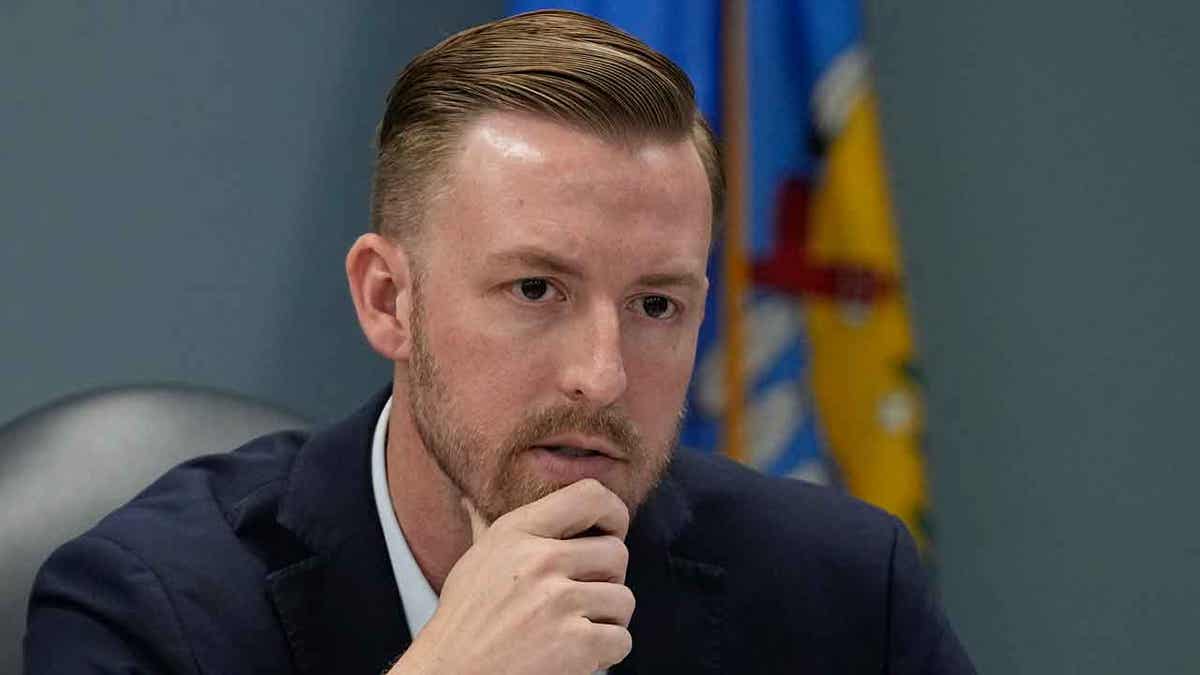
Oklahoma state superintendent Ryan Walters called on Education Secretary Miguel Cardona to resign in a statement posted on social media in response to the latest Program for International Student Assessment (PISA) results.
The exam, according to Walters, compares the academic performance of students in the U.S. against those in other countries. Walters, in a post on X, wrote that Cardona “only wants to indoctrinate and not educate.”
He added that the education secretary should “resign immediately.”
“Joe Biden and the Democrats have dialed out kids,” Walters said in a statement. “They have put America on a path of decline. Their school closures and anti-parent policies have resulted in a dramatic decline in our math scores and left America in a weakened position internationally.”
Secretary of Education Miguel Cardona in the Eisenhower Executive Office Building in Washington, D.C., Aug. 8, 2022. (REUTERS/Evelyn Hockstein)
Walters criticized Cardona for claiming “success” when “kids are falling behind so badly.”
“In light of his latest failure of leadership, he should resign immediately to make way for someone who knows the difference between student success and self-serving Washington spin,” he said.
Walters, an outspoken critic of Critical Race Theory (CRT), told Fox News Digital in November that he sent a letter to textbook companies warning that they would be checking for it in books.
“I sent out a letter to all textbook companies involved with the state and say, Listen, we will be checking for these things now. Do not give us textbooks that have critical race theory in them,” he said.
Oklahoma Superintendent of Public Instruction Ryan Walters speaks during a special state Board of Education meeting discuss to the U.S. Department of Education’s “Proposed Change to its Title IX Regulations on Students’ Eligibility for Athletic Teams,” April 12, 2023, in Oklahoma City. (AP Photo/Sue Ogrocki, File)(AP Photo/Sue Ogrocki, File)
“And if a vendor cannot produce textbooks that actually help our students understand math and understand better science, well, then they can go somewhere else. We’ve got plenty to choose from, and I know that there’s going to be plenty of folks that are able to get us great materials for our schools,” Walters added.
During an interview with The Associated Press in September, Cardona criticized people who are “misbehaving in public” and “acting like they know what’s right for kids.”
“There was civility. We could disagree. We could have healthy conversations around what’s best for kids,” he said. “I respect differences of opinion. I don’t have too much respect for people that are misbehaving in public and then acting like they know what’s right for kids.”
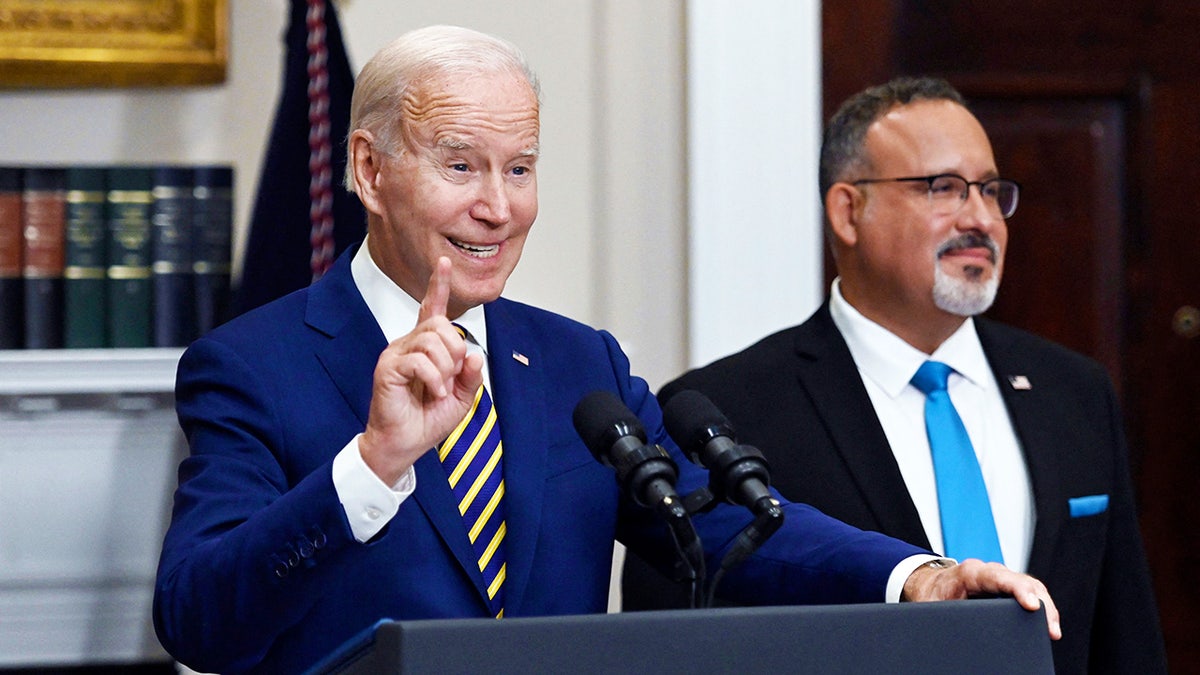
President Joe Biden with Education Secretary Miguel Cardona, right, on Aug. 24, 2022 in the Roosevelt Room of the White House in Washington, D.C.(OLIVIER DOULIERY/AFP via Getty Images)
Cardona, responding to the PISA results on Tuesday, said, “there’s much work to be done.”
The results found that U.S. students were behind in math compared to their counterparts in other countries.
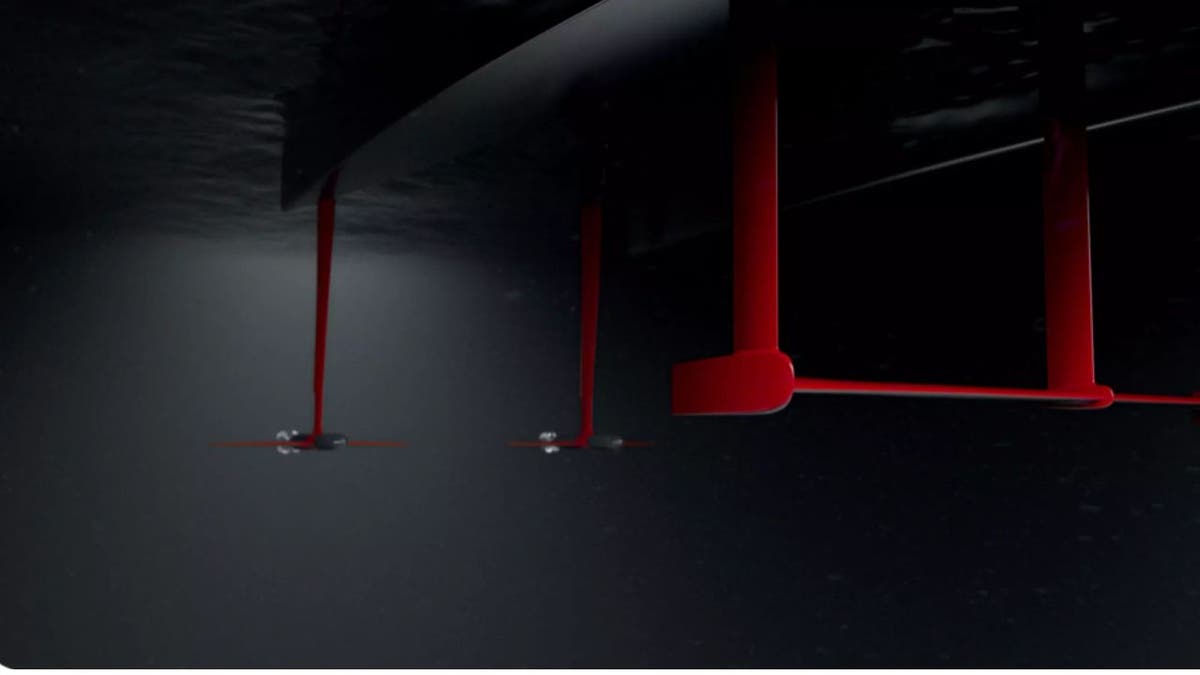
The Candela P-12 is not a typical boat. It is designed to “fly” above the water using hydrofoils, wing-like structures that lift the hull out of the water when the boat reaches a certain speed. This reduces the drag force from the water and allows the boat to consume less energy and travel faster.
The P-12 can reach speeds of up to 29 miles per hour, which is about twice as fast as a conventional ferry. The P-12 is also powered by a 252 kilowatt/hour battery, which makes it fully electric and emission-free. The battery can last for up to 2.5 hours of operation and can be recharged at any standard dock. The company also made sure to allocate space for bicycles, strollers and wheelchairs.
There are three versions of the P-12, which are designed for public transport fleets, VIP services, or private customers.
Shuttle: Fast electric commuting (Can carry up to 30 passengers)
Business: Premium comfort at sea (Can carry up to 20 passengers)
Voyage: Bespoke interior for unique cases (Can carry up to 12 passengers)
The P-12 also features a digital flight control system, which automatically adjusts the hydrofoils to the wave conditions and stabilizes the boat. This makes the ride smoother and more comfortable for the passengers and reduces the likelihood of seasickness. The boat also has a touchscreen interface that allows the driver to monitor and control the boat’s performance and settings.
The P-12 pre-production vessel, named “Zero,” successfully completed its first flight test. The vessel demonstrated its amazing capabilities by lifting off the water at a speed of 16 knots (18 miles per hour) and accelerating to its designed top speed of 30 knots (34 miles per hour) in just 16 seconds.
The vessel flew smoothly and steadily above the water, showing off its sleek and futuristic design. The flight test was a milestone for the company and its vision of creating the world’s first flying electric ship.
The Candela P-12 is currently entering production and will enter its first voyage in 2024. The company plans to launch the boat in several cities around the world, including as Stockholm, London, New York and Hong Kong. On its website, Candela founder Gustav Hasselskog said,“We’re now jump-starting production to keep up with demand.”
The company hopes that the boat will offer a faster, cheaper and greener alternative to traditional water transport and will help with congested roads and slow commutes.
You might be surprised to learn that the Candela P-12 is not the first boat that can fly over water. The company behind the P-12, Candela, has been developing and producing flying boats since 2014.
Their first model, the Candela C-7, was a two-seater, electric hydrofoil boat that could reach speeds of up to 22 knots (25 miles per hour) and had a range of 50 nautical miles (57 miles). The C-7 was launched in 2018 and won several awards for its innovative design and performance.
The company then created the Candela C-8, a larger and more powerful version of the C-7, that could carry up to eight passengers and had a top speed of 30 knots (34 miles per hour). The C-8 was introduced in 2020 and was the first flying boat to be certified by the European Union Aviation Safety Agency.
The Candela P-12 is the latest and most advanced model by the company, and it is the first flying boat that was designed for mass transportation and commercial use. The P-12 is the result of years of research and development, and it showcases the company’s vision of making flying boats the future of travel.
Kurt’s key takeaways
The Candela P-12 is a remarkable innovation that combines the best of both worlds: the speed and efficiency of flying and the convenience and accessibility of boating. The boat promises to change the way we travel on water and to make our journeys more enjoyable and eco-friendly. The boat also challenges the old prediction that we would have flying cars by now. Well, what about flying boats?
What do you think of the Candela P-12? Would you like to try it out? How do you think it will impact the future of travel and transportation? Let us know by writing us atCyberguy.com/Contact.
Kurt “CyberGuy” Knutsson is an award-winning tech journalist who has a deep love of technology, gear and gadgets that make life better with his contributions for Fox News & FOX Business beginning mornings on “FOX & Friends.” Got a tech question? Get Kurt’s CyberGuy Newsletter, share your voice, a story idea or comment at CyberGuy.com.
Legendary American thrash metal band Megadeth announced a new nonfungible token (NFT) collection on Dec. 5, allowing fans exclusive access to content and physical experiences.
The band announced the NFTs on social media through a post on X, formerly Twitter, saying the 5,000-piece collection features the band’s digital mascot, Vic Rattlehead.
Introducing @MegadethDigital. Our 5000-piece generative collection featuring Vic Rattlehead brought to life in a new way by our talented artist @TheHaddy. Live on December 22nd, you’ll have the opportunity to unlock doors in the real and metaverse world alike, gaining access to… pic.twitter.com/Ed9YxqCTe6
In addition to its digital collectible, the band announced that the NFT will unlock both physical and digital experiences to be had in the metaverse, including one-on-one conversations with the band members.
“This isn’t just a fan club; it’s a community owned by YOU.”
The band and its frontman, Dave Mustaine, have millions of fans and have already received an uproar of positive responses to the initiative. Some X users have responded to the band’s post by saying, “Heavy metal and NFTs! Sign me up!”
Cointelegraph reached out to Megadeth for further comment on the collection.
Megadeth is one of the world’s most popular heavy metal groups. However, it is not the first in its genre to hop into the Web3 space. Another heavy metal sensation, Avenged Sevenfold, has also previously released NFTs to draw in their online community called the Deathbats Club.
In late November, the band released tickets for shows in their upcoming concert tour as NFTs and received an overwhelmingly positive response from fans across the digital space.
In an act of solidarity across the merging Web3 music and heavy metal spaces, M. Shadows, the lead singer of Avenged Sevenfold, congratulated Megadeth on its own entrance into the NFT space in a post, saying:
“Every project should be judged on the merit of what they provide and not the underpinning technology. Blockchain simply gives you more options and ownership. Hope to see more artists take the leap with their communities.”
This development marks yet another entrance into the world of Web3 from a mainstream music artist to enable a great connection with a fanbase. This trend is continuing despite the ongoing bear market, and NFTs and metaverses are taking a backseat to other emerging technologies like artificial intelligence (AI).
On Dec. 5, Anotherblock, a blockchain-based music platform, in partnership with Recordpool, announced the upcoming release of a previously unheard demo of Michael Jackson’s first studio recording.
The CEO of Anotherblock echoed the sentiment of other major music artists entering the space and told Cointelegraph that doing the music as a digital vinyl on-chain “makes it possible to build stories and community around the song and elevate it beyond being just a commodity.”
Marissa Lawrence, the wife of Jacksonville Jaguars star Trevor Lawrence, shared some stunning messages she received after the quarterback suffered an ankle injury during Monday night’s loss against the Cincinnati Bengals.
It’s not every day someone in the national spotlight – especially in sports – receives any kind of positive messages. But Lawrence received a full load of kindness from Jaguars fans hoping that her husband was doing OK after the ankle injury. She screen-recorded a slew of supportive direct messages.
Trevor Lawrence of the Jaguars poses with his wife Marissa during training camp at Miller Electric Center on Aug. 2, 2023, in Jacksonville.(James Gilbert/Getty Images)
“Really overwhelmed by people’s kindness and love,” Lawrence captioned the clip on her Instagram Stories. “Just wanted to share something positive and thank everyone truly for your prayers and support. Grateful and support. Grateful to be surrounded by so many amazing people.”
All hope may not be lost for Duval County after all.
Jaguars head coach Doug Pederson said Tuesday that Trevor Lawrence suffered a high-ankle sprain. He added that tests on the right ankle showed “everything’s stable, everything’s good.” He added that surgery is “is not necessarily something that would be warranted at this time.”
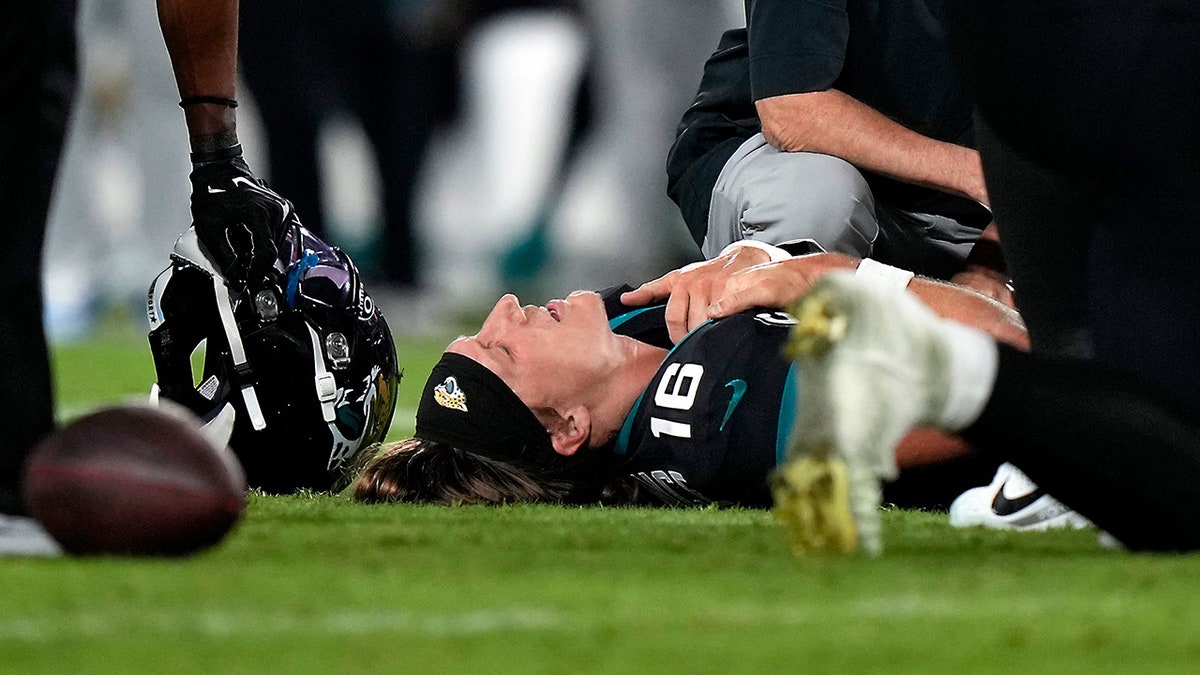
Jaguars wide receiver Zay Jones takes a knee next to quarterback Trevor Lawrence as he is examined on the field after suffering a leg injury during the Cincinnati Bengals game, Monday, Dec. 4, 2023, at EverBank Stadium in Jacksonsville.(Cara Owsley/The Enquirer/USA Today Network)
“We’ll see where he’s at in a couple days,” Pederson added.
The coach refused to give a timetable on Lawrence’s potential recovery with a game against the Cleveland Browns around the corner.
“I’m not going to put that timetable on Trevor, not going to put him in a box like that,” Pederson said. “We’ll see how he is in a couple of days.”
Trevor Lawrence is examined on the field after his fourth-quarter leg injury during the Cincinnati Bengals game, Monday, Dec. 4, 2023, at EverBank Stadium.(Cara Owsley/The Enquirer/USA Today Network)
NFL Network reported Wednesday that Lawrence is considered “day-to-day.” NFL insider Ian Rapoport described Lawrence as having an “uphill battle to be out on the field” and added he has to get “a lot better very quickly in a short week to actually to be out on the field.”
Real bipartisan legislative efforts are rare in Washington, DC, these days, but Democratic Senators Elizabeth Warren and Joe Manchin and Republican Senators Lindsey Graham and Roger Marshall have managed to come together to co-sponsor a bill focused on crypto crime.
According to the senators, the Digital Asset Anti-Money Laundering Act of 2023 aims to close loopholes in the nation’s Anti-Money Laundering rules. The bill would amend the Bank Secrecy Act and would designate a diverse range of digital asset providers as financial institutions.
The Bank Secrecy Act establishes program, recordkeeping and reporting requirements for national banks, federal savings associations, federal branches and agencies of foreign banks. Digital asset providers would be required to adhere to many of the same regulations as traditional banks.
Warren introduced the legislation to the United States Senate on July 27, 2023, on behalf of herself and Senators Joe Manchin, Roger Marshall and Lindsey Graham. The bill was then referred to the Senate Committee on Banking, Housing and Urban Affairs. It hasn’t been voted on by the entire Senate or sent to the U.S. House of Representatives for consideration. Nor has President Biden signed it, and it is not a matter of law at this time.
The same rules should apply to the same kinds of financial transactions with the same kinds of risks. So my new, bipartisan Digital Asset Anti-Money Laundering Act will make the crypto industry follow the same anti-money-laundering standards as banks, brokers, & Western Union.
The legislation would add several types of cryptocurrency providers to U.S. regulators’ list of financial institutions. These include unhosted wallet providers, digital asset miners and validators or other nodes that validate third-party transactions, miner extractable value searchers, other validators or network participants with control over network protocols, or just about anyone else who facilitates or provides services related to exchange, sale, custody or lending of digital assets.
All these organizations and individuals would be subject to the same regulations currently applied to financial institutions in the United States. The bill does include exceptions for those who use distributed ledger, blockchain technology or similar technologies for internal business purposes.
Crypto under federal review
If the bill becomes law, within 18 months of its enactment, the U.S. Treasury’s Financial Crimes Enforcement Network would announce that any U.S. person with $10,000 in digital assets or one or more digital assets overseas would have to file a report. Within the same timeframe, the U.S. Treasury would establish controls to mitigate unlawful financial risks associated with digital asset mixers and anonymity-enhanced cryptocurrency.
North entrance of the U.S. Treasury building, Washington, DC. (Wiki Commons)
Within two years of the bill’s enactment, the Treasury, in consultation with the Conference of State Bank Supervisors, will create a risk-focused examination and review process for those digital asset participants newly designated as financial institutions. They would determine if efforts to stop money laundering and to counter crypto-funded terrorism are adequate and if crypto providers and facilitators are compliant with the new rules. Subsequently, within the same time frame, the Securities and Exchange Commission and the Commodity Futures Trading Commission will consult with the Treasury on exactly the same matters.
What about my favorite BTC kiosk?
The next part of the bill is focused on digital asset kiosks. Within 18 months of the bill’s passage, FinCEN will require digital asset kiosk (ATM) owners and administrators to submit and update the physical address of their kiosks every 90 days. The kiosk owners will also need to verify the identity of each customer using a valid form of government-issued identification, and they will have to collect the name and physical address of each counterparty to each transaction.
Within 180 days, FinCEN will issue a report about any digital asset kiosks that haven’t been registered. The report would include an estimate of the number of unregistered kiosks, their locations and an assessment of additional resources that FinCEN might need to be able to investigate them.
Within a year of the enactment of the legislation, the U.S. Drug Enforcement Agency would issue a report identifying recommendations to reduce drug trafficking and money laundering associated with digital asset kiosks.
Bitcoin ATM in a liquor store in Milwaukee, Wisconsin. (Wikimedia Commons)
Crypto industry impact
Grant Fondo, co-chair of Goodwin’s digital currency and blockchain practice and a former Assistant U.S. attorney, tells Magazine that “the bill is an attempt to pull more players in the digital asset industry within regulatory control, to close gaps in what some in Congress see as not covered under the current regulatory regime.”
Fondo believes that, if passed, the legislation would have the practical effect of killing decentralized finance in the U.S. by applying an unworkable regime on DeFi protocols. Fondo sees the legislation as imposing a burden on validators and miners and also questions how realistic it would be to impose bank-like requirements on a software company validating blockchain transactions.
Hadas Jacobi, an attorney in the Financial Industry Group at Reed Smith who previously worked as a financial enforcement regulator for the State of New York, agrees. According to Jacobi, the act would apply Bank Secrecy Act requirements, depending on the context, to crypto participants that are not financial institutions.
“The act could be read as applicable to programmers and other tech providers who create the framework for financial services operations rather than provide services themselves,” Jacobi says.
Key Bank Secrecy Act /Anti-Money Laundering collaboration mechanisms. (U.S. Government Accountability Office)
Although Jacobi believes there is a need for legislative clarity in the space, she questions whether the primary intent of the legislation — the crypto sector’s threat to national security — is even relevant. Jacobi says that on-point regulation of cryptocurrency and digital asset services providers is necessary, but digital assets do not threaten national security.
“A general statement that digital assets pose a threat to U.S. national security, however, would be both inaccurate and short-sighted. Bad actors in the digital asset space pose a global threat from both a national security and a financial stability standpoint — but the digital asset industry and its underlying technology do not,” Jacobi says.
What the politicians are saying
In a written statement, Senator Marshall says that the bill addresses U.S. concerns about national security.
“This legislation is a matter of national security. Mastermind hackers from adversarial countries like Iran, Russia, and North Korea are committing cybercrimes against the United States to the tune of BILLIONS of dollars; they must be held accountable. The reforms outlined in our legislation will help us fight back and secure our digital assets by using proven methods that our domestic financial institutions have been complying with for years,” Marshall states.
Marshall says that the legislation would extend Bank Secrecy Act responsibilities to include Know Your Customer requirements for those affected, would address a “major gap” with unhosted digital wallets, would direct FinCEN to issue guidance on financial institutions to mitigate digital asset risks, would strengthen enforcement of BSA compliance, would extend BSA foreign bank account rules to include digital assets and would mitigate illicit finance risks of digital asset ATM’s.
Warren argues that U.S. authorities have warned that crypto is being used for all types of crimes and for antagonistic nations to avoid U.S. sanctions.
“Rogue nations like Iran, Russia and North Korea have used digital assets to launder stolen funds, evade American and international sanctions, and fund illegal weapons programs,” Warren says.
Suggesting that the act will help to subvert these efforts, Warren focuses her statement on North Korea’s missile program.
“Nearly half of North Korea’s missile program, for example, is estimated to be funded by cybercrime and digital assets. In 2022, illicit digital asset transactions totaled at least $20 billion — an all-time high,” Warren writes.
Manchin asked Democrats and Republicans to come together and vote for the bill. “Our bipartisan legislation would curtail these security risks and require cryptocurrency platforms to abide by the same Anti-Money Laundering rules that banks have to follow. I urge my colleagues on both sides of the aisle to support this common-sense legislation to protect Americans by preventing bad actors from using cryptocurrencies to finance their criminal activities,” Manchin says.
Fondo doesn’t see how the Anti-Money Laundering Act could minimize risks to national security but does recognize how the bill might address issues associated with anonymity-enhanced cryptocurrency.
Still, he would like to see this legislative effort well thought out before passing the bill. “No one wants terrorists and criminals masking their financial transactions. But conversely, privacy is a rare commodity, so it’s important to properly balance it with national security,” Fondo says.
Jacobi is concerned that overregulation will lead to redundancy and excessive costs that will drain the industry. She says that the act would direct FinCEN to regulate digital service providers as money transmission businesses, although she believes that they have already been doing that since 2013. Furthermore, she says that most state regulators have been examining and registering them for almost as long.
“The Act has the potential to upset the balance of the existing U.S. dual state and federal regulatory regime by creating redundancies in the supervision and examination of money transmission businesses, not to mention exposing the digital asset industry to resource-draining, duplicative enforcement actions,” Jacobi says.
Will the bill become law?
It’s anybody’s guess. The House of Representatives is just getting back on its feet after struggling for weeks to elect a new speaker.
The U.S. Senate still requires a supermajority vote to approve almost any piece of legislation, and all the while, members of Congress and President Joe Biden are hyper-focused on geopolitical matters like the Israel/Hamas conflict and the war in Ukraine.
Also, most U.S. federal-level politicians are about to enter the 2024 election season, where control of the Senate, the House of Representatives and the Presidency are all up for grabs.
Controversial legislation will certainly stall until after the election, but a potentially popular crypto bill might just be palatable to candidates on both sides of the aisle to find its way onto the president’s desk. If the Digital Asset Anti-Money Laundering Act were to become law, many cryptocurrency providers would have to learn how to comply with the same regulations as traditional financial institutions.
Subscribe
The most engaging reads in blockchain. Delivered once a
week.
Mitch Eiven
Mitch is a writer who covers cryptocurrency, politics, the intersection between the two and a handful of other, unrelated topics. He believes that crypto is the future of finance and feels privileged that he has opportunities to report on it.
Philadelphia Eagles quarterback Jalen Hurts is among the favorites to win the NFL MVP award along with fellow quarterbacks Brock Purdy, Dak Prescott, Lamar Jackson, Patrick Mahomes and Tua Tagovailoa.
Hurts’ odds took a hit as the Eagles lost to Purdy and the San Francisco 49ers, 42-19, on Sunday. Hurts was 26-for-45 with 298 yards, a touchdown pass and a rushing touchdown. It was enough for at least one NFL analyst to call for Philadelphia to make a change at starting quarterback.
Eagles quarterback Jalen Hurts kneels before the San Francisco 49ers game on Dec. 3, 2023, at Lincoln Financial Field in Philadelphia.(Kyle Ross/Icon Sportswire via Getty Images)
David Carr, a former quarterback for the Houston Texans and New York Giants, said Tuesday the Eagles should replace Hurts with Marcus Mariota. Carr cited Hurts allegedly being “uncomfortable” reading defenses while in the pocket as well as his health.
“Clearly, Jalen isn’t comfortable reading through a defense in a drop back pass scenario. Some would say he’s not even good at it,” Carr said. “I think when you look at this team, you have to have a serious conversation, if you’re Philly. And you have to say, ‘Is it better for us to play Marcus Mariota right now and get Jalen really healthy,’ because I would argue it doesn’t matter if they’re the No. 1 seed. If the 49ers come into Philly again, they do not care.
Marcus Mariota of the Philadelphia Eagles warms up before the Chiefs game at GEHA Field at Arrowhead Stadium on Nov. 20, 2023, in Kansas City, Missouri.(Perry Knotts/Getty Images)
“Put Marcus in there, win a couple of games, maybe you have the No. 1 seed still, you might have it,” Carr continued. “I’d say [Mariota] is better at playing quarterback for the Philadelphia Eagles right now. Right now, he’d be more productive.”
Hurts left the game Sunday for a few plays and the team inserted Mariota. Hurts came back, but Philadelphia still came up short.
Carr added that these are the types of conversations Nick Sirianni has to have if he has a “big picture mentality.”
Everybody in the NFL is banged up through 13 weeks of the season, but quarterbacks have dropped like flies. Derek Carr, Trevor Lawrence and Kenny Pickett left their games during Week 13. It followed Joe Burrow and Deshaun Watson being lost for the season.
Aaron Rodgers, Daniel Jones and Anthony Richardson were lost for the season. Jimmy Garoppolo, Justin Fields and Matthew Stafford also missed time with injuries.
Jalen Hurts of the Eagles during the San Francisco 49ers game at Lincoln Financial Field on Dec. 3, 2023, in Philadelphia.(Mitchell Leff/Getty Images)
As the use of artificial intelligence (AI) has permeated the creative media space — especially art and design — the definition of intellectual property (IP) seems to be evolving in real time as it becomes increasingly difficult to understand what constitutes plagiarism.
Over the past year, AI-driven art platforms have pushed the limits of IP rights by utilizing extensive data sets for training, often without the explicit permission of the artists who crafted the original works.
For instance, platforms like OpenAI’s DALL-E and Midjourney’s service offer subscription models, indirectly monetizing the copyrighted material that constitutes their training data sets.
In this regard, an important question has emerged: “Do these platforms work within the norms established by the ‘fair use’ doctrine, which in its current iteration allows for copyrighted work to be used for criticism, comment, news reporting, teaching and research purposes?”
Recently, Getty Images, a major supplier of stock photos, initiated lawsuits against Stability AI in both the United States and the United Kingdom. Getty has accused Stability AI’s visual-generating program, Stable Diffusion, of infringing on copyright and trademark laws by using images from its catalog without authorization, particularly those with its watermarks.
However, the plaintiffs must present more comprehensive proof to support their claims, which might prove challenging since Stable Diffusion’s AI has been trained on an enormous cache of 12+ billion compressed pictures.
In another related case, artists Sarah Andersen, Kelly McKernan and Karla Ortiz initiated legal proceedings against Stable Diffusion, Midjourney and the online art community DeviantArt in January, accusing the organizations of infringing the rights of “millions of artists” by training their AI tools using five billion images scraped from the web “without the consent of the original artists.”
AI poisoning software
Responding to the complaints of artists whose works were plagiarized by AI, researchers at the University of Chicago recently released a tool called Nightshade, which enables artists to integrate undetectable alterations into their artwork.
These modifications, while invisible to the human eye, can poison AI training data. Moreover, subtle pixel changes can disrupt AI models’ learning processes, leading to incorrect labeling and recognition.
Even a handful of these images can corrupt the AI’s learning process. For instance, a recent experiment showed that introducing a few dozen misrepresented images was sufficient to impair Stable Diffusion’s output significantly.
The University of Chicago team had previously developed its own tool called Glaze, which was meant to mask an artist’s style from AI detection. Their new offering, Nightshade, is slated for integration with Glaze, expanding its capabilities further.
In a recent interview, Ben Zhao, lead developer for Nightshade, said that tools like his will help nudge companies toward more ethical practices. “I think right now there’s very little incentive for companies to change the way that they have been operating — which is to say, ‘Everything under the sun is ours, and there’s nothing you can do about it.’ I guess we’re just sort of giving them a little bit more nudge toward the ethical front, and we’ll see if it actually happens,” he added.
An example of Nightshade poisoning art data sets. Source: HyperAllergic
Despite Nightshade’s potential to safeguard future artwork, Zhao noted that the platform cannot undo the effects on art already processed by older AI models. Moreover, there are concerns about the software’s potential misuse for malicious purposes, such as contaminating large-scale digital image generators.
However, Zhao is confident that this latter use case would be challenging since it requires thousands of poisoned samples.
While independent artist Autumn Beverly believes that tools like Nightshade and Glaze have empowered her to share her work online once again without fear of misuse, Marian Mazzone, an expert associated with the Art and Artificial Intelligence Laboratory at Rutgers University, thinks that such tools may not provide a permanent fix, suggesting that artists should pursue legal reforms to address ongoing issues related to AI-generated imagery.
Asif Kamal, CEO of Artfi, a Web3 solution for investing in fine art, told Cointelegraph that creators using AI data-poisoning tools are challenging traditional notions of ownership and authorship while prompting a reevaluation of copyright and creative control:
“The use of data-poisoning tools is raising legal and ethical questions about AI training on publicly available digital artwork. People are debating issues like copyright, fair use and respecting the original creators’ rights. That said, AI companies are now working on various strategies to address the impact of data-poisoning tools like Nightshade and Glaze on their machine-learning models. This includes improving their defenses, enhancing data validation and developing more robust algorithms to identify and mitigate pixel poisoning strategies.”
Yubo Ruan, founder of ParaX, a Web3 platform powered by account abstraction and zero-knowledge virtual machine, told Cointelegraph that as artists continue to adopt AI-poisoning tools, there needs to be a reimagining of what digital art constitutes and how its ownership and originality are determined.
“We need a reevaluation of today’s intellectual property frameworks to accommodate the complexities introduced by these technologies. The use of data-poisoning tools is highlighting legal concerns about consent and copyright infringement, as well as ethical issues related to the use of public artwork without fairly compensating or acknowledging its original owners,” he said.
Stretching IP laws to their limit
Beyond the realm of digital art, the influence of Generative AI is also being noticed across other domains, including academia and video-based content. In July, comedian Sarah Silverman, alongside authors Christopher Golden and Richard Kadrey, took legal action against OpenAI and Meta in a U.S. district court, accusing the tech giants of copyright infringement.
The litigation claims that both OpenAI’s ChatGPT and Meta’s Llama were trained on data sets sourced from illicit “shadow library” sites, allegedly containing the plaintiffs’ copyrighted works. The lawsuits point out specific instances where ChatGPT summarized their books without including copyright management information, using Silverman’s Bedwetter, Golden’s Ararat, and Kadrey’s Sandman Slim as key examples.
Separately, the lawsuit against Meta asserts that the company’s Llama models were trained using data sets from similarly questionable origins, specifically citing The Pile from EleutherAI, which reportedly includes content from the private tracker Bibliotik.
The authors asserted that they never consented to their works being used in such a manner and are therefore seeking damages and restitution.
As we move toward a future driven by AI tech, many companies seem to be grappling with the immensity of the technological proposition put forth by this burgeoning paradigm.
While companies like Adobe have started using a mark to flag AI-generated data, companies like Google and Microsoft have said they are willing to face any legal heat should customers be sued for copyright infringement while using their generative AI products.
The credentialing system used by the Institute of Electrical and Electronics Engineers (IEEE) will use the Avalanche blockchain to issue tamper-evident certificates in India.
India is the second-largest IEEE membership base outside the United States, with over 75,000 members. The professional association will issue IEEE credentials or certificates to all trainees and users to make the verification process tamper-proof, instant, and secure.
The IEEE will issue blockchain certificates via LegitDoc, a blockchain-based credential lifecycle management built by Zupple Labs. Speaking to Cointelegraph, Zupple co-founder Neil Martis said that the Indian public sector has become more willing over the last 12 months to implement full-fledged blockchain projects over pilots.
The decision to use Avalanche’s C-Chain as the primary settlement layer for IEEE’s certificate issuance stemmed from the need for an ecosystem that is compatible with Ethereum Virtual Machine (EVM). “However, we would be experimenting with new platforms as additional parallel settlement layers as suitable new tech emerges,” Martis added.
Devika Mittal, the head of Avalanche’s India arm supported Martis’ decision by stating:
“Avalanche’s EVM compatibility simplifies the deployment of widely used applications, including credential registries and identity management, streamlining the development process for developers.”
She also highlighted that top institutions, including SK Planet and JP Morgan Onyx, prefer Avalanche as their go-to blockchain. For organizations looking to implement blockchain, Mittal recommended identifying the pain points and then choosing a chain that can ensure the immutability, longevity and security of the solutions.
For organizations looking to implement blockchain, Mittal recommended identifying the pain points and then choosing a chain that can ensure the immutability, longevity and security of the solutions.
The IEEE-Zupple Labs partnership will result in the issuance of hundreds of thousands of tamper-proof credentials for India’s engineering community. The announcement highlights how IEEE’s endorsement of blockchain for education credentialing sets a powerful precedent and encourages broader Web3 participation.
The Hawaiian surfing pipeline has one of the most dangerous surfs in the United States, which makes it tempting for daredevils across the world to try to get ahold of the waves.
Chianca, who is ranked No. 4 in the World Surf League and finished fourth in September’s World Surf League Finals, nearly died Sunday in the waters off Honolulu, where he took a serious wipeout and was left unconscious.
People carry Brazilian surfer Joao Chianca who wiped out while practicing for the upcoming Vans 2023 Pipeline Masters event at Banzai Pipeline in Haleiwa, Oahu’s north shore, Hawaii, on Dec. 3, 2023.(BRIAN BIELMANN/AFP via Getty Images)
The 23-year-old bailed out of a wave and pin-dropped into the water. He hit his head either on the ground or on his board, according to Surfline. As he was knocked unconscious, more waves toppled over him.
“I saw it happen and had a weird feeling that where and how he fell was wrong,” Jake Maki, who was watching Chianca from afar, told Surfline. “There was a lot of carnage, boards breaking, leashes popping — from both that set and the one before it — so it was hard to identify where João was. I didn’t see him pop up, then I saw his board but was tombstoning, like he was still dragging it from underwater.”
Surfers and lifeguards rushed into the waters to help Chianca, according to Hawaii News Now.
“There was actually three more waves that he got on the head, and he was underneath water,” Honolulu Ocean Safety Lifeguard Ian Bachmann told the station. “In that moment, things happened so quick, but when we saw his body floating there, we thought we got to get to him as fast as possible.”
Brazil’s pro-surfer Joao Chianca wipes out while practicing for the upcoming Vans 2023 Pipeline Masters event at Banzai Pipeline in Haleiwa, Oahu’s north shore, Hawaii, on Dec. 3, 2023.(BRIAN BIELMANN/AFP via Getty Images)
Kala Grace was among the surfers who were shaken up over the incident.
“It was gnarly. I walked straight up, took my leash off, and I was done surfing,” he said. “I saw him laying there completely purple out cold and all the lifeguards around, and all I could see lying on the board was just me because that was just me in January.”
Chianca was described as being “completely purple” when he was pulled out of the water. He expelled the liquid from his body as lifeguards performed chest compressions on him. He was given oxygen and steadily regained his consciousness, Surfline reported.
He is reportedly in stable condition.
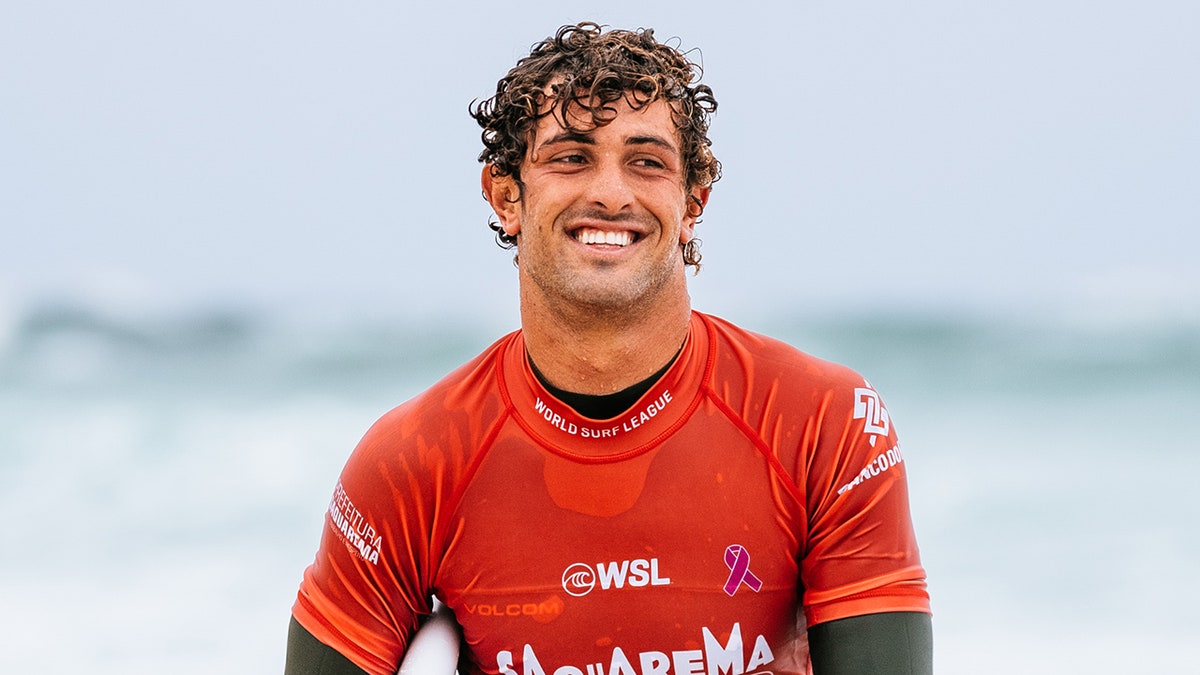
Joao Chianca after surfing in Heat 8 of the Round of 64 at the Corona Saquarema Pro on Oct. 15, 2023 at Saquarema, Rio de Janeiro.(hiago Diz/World Surf League via Getty Images)