11.3 C
New York
Tuesday, March 10, 2026
Home Blog Page 80

Gorilla charges its habitat, shattering glass at San Diego Zoo, shocking visitors

0

NEWYou can now listen to Fox News articles!

Visitors at the San Diego Zoo in California were left in shock over the weekend after an animal went bananas. 

A male gorilla charged his habitat, shattering one layer of the three-layer glass window.

Dramatic video shows the moment the western lowland gorilla stormed the tempered glass on Saturday. 

MEDIEVAL SHOE FOUND IN VULTURE NEXT REVEALS CENTURIES-OLD SECRETS IN EUROPEAN MOUNTAIN CAVES

Reactions from the crowd can be heard in the background — with zoo visitors gasping.

Zoo officials confirmed the incident to the New York Post, noting it was their 10-year-old gorilla named Denny who was responsible. 

A gorilla is shown within its enclosure at the San Diego Zoo at the time of the incident on Saturday, Oct. 11.  (Emily Holguin)

The 10-year-old gorilla was in the enclosure with another animal and was not injured. 

“It is common for male gorillas, especially in adolescence, to express these types of behaviors,” the San Diego spokesperson told the NYP.

CLICK HERE FOR MORE LIFESTYLE STORIES

The spokesperson added that “bursts of energy, charging, dragging items or running sideways are all natural [behaviors] for a young male.”

glass shattered at zoo from gorilla

Shattered glass is shown in a gorilla enclosure at the San Diego Zoo. (Emily Holguin)

Western lowland gorillas can reach 4 to 6 feet tall, weighing between 155 and 420 pounds, according to the Los Angeles Zoo and Botanical Gardens (LAZB).

CLICK HERE TO SIGN UP FOR OUR LIFESTYLE NEWSLETTER

“Gorillas at the San Diego Zoo Safari Park peel radishes with their teeth before eating them,” writes the website.

TEST YOURSELF WITH OUR LATEST LIFESTYLE QUIZ

Males tend to be twice the size of females, with most members of the species living between 35 and 50 years old, according to LAZB. 

gorilla and shattered glass at san diego zoo

A gorilla is seen at the San Diego Zoo, with the shattered glass shown at right after a young male (not pictured) charged the window.  (Emily Holguin)

The International Fund for Animal Welfare notes that the western lowlands are the smallest of the gorilla species. 

CLICK HERE TO GET THE FOX NEWS APP

Fox News Digital reached out to the San Diego Zoo for comment.

AI phishing scams are getting smarter, here’s how to protect yourself

0


NEWYou can now listen to Fox News articles!

Artificial intelligence can do a lot for us. Need to draft an email? AI has you covered. Looking for a better job? AI can help with that, too. It can even boost our health and fitness. Some tools, like AI-powered exoskeletons, can lighten heavy loads and improve performance. 

But it’s not all sunshine and progress. Hackers are also turning to AI, and they’re using it to make phishing scams smarter and harder to spot. These scams are designed to trick people into handing over personal details or money. One woman recently lost $850,000 after a scammer, posing as Brad Pitt with the help of AI, convinced her to send money. Scary, right? 

The good news is that you can learn to recognize the warning signs. Before we dive into how to protect yourself, let’s break down what AI phishing scams really are.

HOW AI BROWSERS OPEN THE DOOR TO NEW SCAMS

Sign up for my FREE CyberGuy Report
Get my best tech tips, urgent security alerts and exclusive deals delivered straight to your inbox. Plus, you’ll get instant access to my Ultimate Scam Survival Guide — free when you join my CyberGuy.com newsletter.

A woman types on a MacBook laptop.

A single click on a fake link could expose your personal information. (Kurt “CyberGuy” Knutsson)

What are AI phishing scams?

AI phishing scams are when hackers use AI to make their scams more convincing. AI helps them create super-realistic emails, messages, voices and even videos. This makes it harder for people to tell what’s real and what’s fake. Old-school phishing emails were easy to spot because of typos and bad grammar. However, thanks to AI tools like ChatGPT, hackers can now create flawless, professional-sounding emails that are much harder to detect. AI-generated phishing emails aren’t the only threat. Hackers are also using AI to pull off scams like:

  • Voice clone scams: They use AI to copy the voice of someone you know, like a friend or family member, to trick you.
  • Deepfake video scams: They create super-realistic videos of someone you trust, like a loved one or a celebrity, to manipulate you.

Here’s how you can spot these AI-driven scams before they fool you.

1) Spot common phishing email red flags

Though hackers can use AI tools to write grammatically perfect email copy, AI phishing emails still have some classical red flags. Here are some telltale signs that it is an AI-driven phishing email:

  • Suspicious sender’s address that doesn’t match the company’s domain.
  • Generic greetings like “Dear Customer” instead of your name.
  • Urgent requests pressuring you to act immediately.
  • Unsolicited attachments and links requiring you to take action

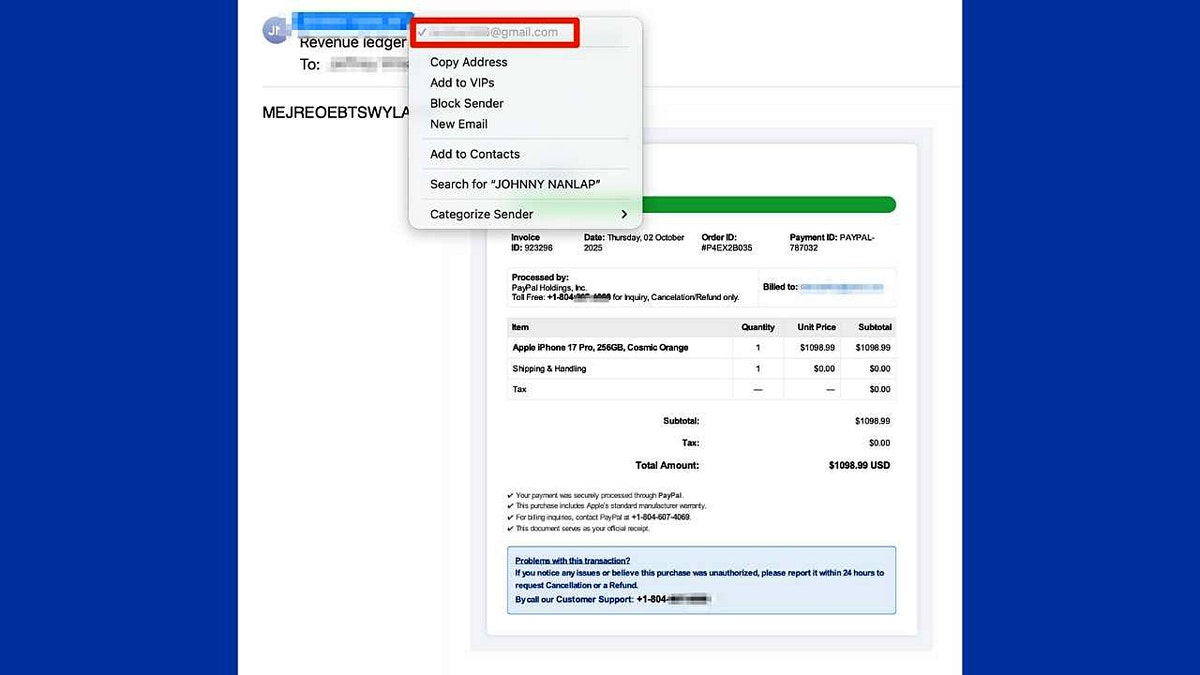
The biggest red flag is the sender’s email address. There is often a slight change in the spelling of the email address, or it is an entirely different domain name. For example, a hacker might use an email like xyz@PayPall.com or a personal address from Gmail.com, such as the email below, or Outlook.com while pretending to be from PayPal.

An example of a phishing email

Hackers are using AI to create scams that look frighteningly real. (Kurt “CyberGuy” Knutsson)

2) Analyze the language for AI-generated patterns

It used to be easier to spot phishing emails by noticing silly typos. Thanks to AI, hackers can now craft flawless emails. But you can still sense a phishing email if you analyze the language of the email body copy carefully. The most prominent sign of AI-generated email copy is that it looks highly formal with a dash of failed attempts to be personal. You might not notice it at first, but looking at it closely is likely to give a red flag. The language of such emails is often robotic.

3) Watch for AI voice clone scam warning signs 

With AI, it is possible to clone voices. So, there is no surprise that there is a steep rise in voice phishing, which is also known as vishing. Recently, a father lost $4 billion in Bitcoin to vishing. Though AI voice cloning has improved, it’s still flawed. You can spot inconsistencies by verifying the speaker’s identity. Ask specific questions that only the real person would know. This can reveal gaps in the scammer’s script. The voice, also, at times may sound robotic due to imperfections in voice cloning technology. So the next time, whenever you receive a call that creates a sense of urgency, ask as many questions as you can to verify the identity of the person. You may also consider verifying the claims through the second channel. If the person on the other side of the phone says something, you can get it confirmed by the official email to be on the safer side.

GOOGLE AI EMAIL SUMMARIES CAN BE HACKED TO HIDE PHISHING ATTACKS

4) Identify visual glitches and oddities in video calls

Deepfake videos are getting pretty convincing, but they’re not flawless yet. They have visual inconsistencies and oddities, which can make the voice or video appear fake. So watch the video carefully and try to catch the signs of unnatural eye movements, lip-sync issues, weird lighting, shadows and voice inconsistencies. You can also use a deepfake video detection tool to spot a fake video.

5) Set up and use a shared secret

A shared secret is something only you and your loved ones know. If someone claiming to be a friend or family member contacts you, ask for the shared secret. If they can’t answer, you’ll know it’s a scam.

Young professional man works on laptop

Hackers are turning to artificial intelligence to make phishing scams smarter and harder to spot. (miniseries/Getty Images)

How to protect yourself from AI phishing scams

AI phishing scams rely on tricking people into trusting what looks and sounds real. By staying alert and practicing safe habits, you can lower your risk. Here’s how to stay ahead of scammers:

1) Stay cautious with unsolicited messages

Never trust unexpected emails, texts or calls that ask for money, personal details or account access. Scammers use urgency to pressure you into acting fast. Slow down and double-check before clicking or responding. If something feels off, it probably is.

2) Use a data removal service

Protect your devices with a trusted data removal service to reduce the amount of personal info exposed online. Fewer exposed details make it harder for scammers to target you. While no service can guarantee the complete removal of your data from the internet, a data removal service is really a smart choice. They aren’t cheap, and neither is your privacy. These services do all the work for you by actively monitoring and systematically erasing your personal information from hundreds of websites. It’s what gives me peace of mind and has proven to be the most effective way to erase your personal data from the internet. By limiting the information available, you reduce the risk of scammers cross-referencing data from breaches with information they might find on the dark web, making it harder for them to target you.

Check out my top picks for data removal services and get a free scan to find out if your personal information is already out on the web by visiting CyberGuy.com.

Get a free scan to find out if your personal information is already out on the web: CyberGuy.com.

3) Check links before you click and install strong antivirus software

Hackers often hide malicious links behind convincing text. Hover your cursor over a link to see the actual URL before you click. If the address looks odd, misspelled or unrelated to the company, skip it. Clicking blindly can download malware or expose your login details. Also, install strong antivirus software on all of your devices that blocks phishing links and scans for malware. The best way to safeguard yourself from malicious links that install malware, potentially accessing your private information, is to have strong antivirus software installed on all your devices. This protection can also alert you to phishing emails and ransomware scams, keeping your personal information and digital assets safe.

Get my picks for the best 2025 antivirus protection winners for your Windows, Mac, Android and iOS devices at CyberGuy.com.

CLICK HERE TO GET THE FOX NEWS APP

4) Turn on two-factor authentication

Even if a scammer steals your password, two-factor authentication (2FA) can keep them locked out. Enable 2FA on your email, banking and social media accounts. Choose app-based codes or a hardware key over text messages for stronger protection.

5) Limit what you share online

The more personal details you share, the easier it is for hackers to make AI scams believable. Avoid posting sensitive information like travel plans, birthdays or financial updates on social media. Scammers piece these details together to build convincing attacks.

6) Verify requests through another channel

If you get a message asking for money or urgent action, confirm it in another way. Call the person directly using a number you know, or reach out through official company channels. Don’t rely on the same email, text or call that raised suspicion in the first place.

Kurt’s key takeaways 

AI is making scams more convincing and harder to detect, but you can stay ahead by recognizing the warning signs. You should watch out for suspicious email addresses, unnatural language, robotic voices and visual glitches in videos, and always verify information through a second channel. You should also establish a shared secret with loved ones to protect yourself from AI-driven voice and video scams.

Have you experienced any AI-driven phishing scams yet, and what do you think is the best way to spot such a scam? Let us know by writing to us at CyberGuy.com.

Sign up for my FREE CyberGuy Report
Get my best tech tips, urgent security alerts and exclusive deals delivered straight to your inbox. Plus, you’ll get instant access to my Ultimate Scam Survival Guide — free when you join my CyberGuy.com newsletter.

Copyright 2025 CyberGuy.com.  All rights reserved.


Source link

New reusable spacecraft can drop 500 pounds anywhere on Earth fast

0


NEWYou can now listen to Fox News articles!

A Los Angeles-based aerospace startup called Inversion Space has unveiled Arc, its first flagship spacecraft designed to deliver supplies from orbit back to Earth in record time. The reusable reentry vehicle can transport up to 500 pounds of mission-critical cargo to nearly any point on the planet in less than an hour. Founders Justin Fiaschetti and Austin Briggs launched the company in 2021 with a bold vision: to build a space-based logistics network. During an event at the company’s factory, they described Arc as the next evolution of global delivery, one that starts in orbit, not on the ground.

Sign up for my FREE CyberGuy Report
Get my best tech tips, urgent security alerts and exclusive deals delivered straight to your inbox. Plus, you’ll get instant access to my Ultimate Scam Survival Guide — free when you join my CyberGuy.com newsletter.

How the Arc spacecraft delivers cargo from orbit to Earth

Standing about 8 feet tall and 4 feet wide, Arc is roughly the size of a large tabletop. It’s a lifting-body vehicle, meaning it can steer as it reenters the atmosphere. Instead of needing a runway, Arc lands safely under parachutes, using non-toxic propellants that make it safe to handle immediately after landing. The spacecraft features a cross-range of approximately 621 miles, allowing it to target wide landing zones. It can stay in orbit for up to five years, ready to return to Earth when needed. That flexibility means the spacecraft could one day drop off medical supplies, drones or military equipment at hard-to-reach locations. 

THE WORLD’S FIRST FLYING CAR IS READY FOR TAKEOFF

Inversion Space's Arc reentry vehcile

Inversion Space unveils its Arc reentry vehicle designed for rapid orbital delivery (Inversion Space)

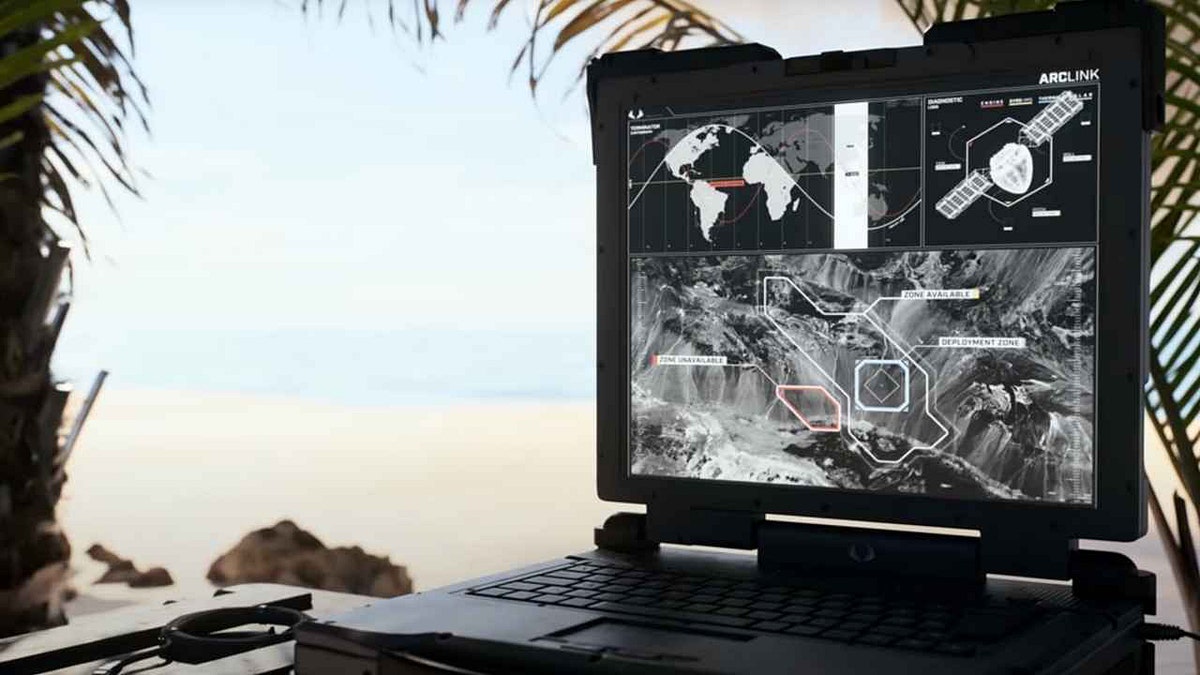
A computer shows orbital and navigational diagrams.

Inversion’s Ray mission tested key systems in orbit, paving the way for Arc’s full development. (Inversion Space)

Why Arc’s hypersonic speed could change aerospace testing

Beyond rapid delivery, Arc doubles as a hypersonic testing platform. It can reach speeds over Mach 20, endure extreme heat and survive massive g-forces. Those capabilities have caught the attention of U.S. defense agencies, which are eager to improve hypersonic flight testing. Inversion’s participation in the Kratos-led MACH-TB 2.0 program highlights the growing military interest in Arc’s reusable design. “Fully reusable and capable of precise landings for rapid recovery, Arc makes hypersonic testing faster, repeatable, and more affordable,” the company said.

A spacecraft floats above the Earth.

Arc could deliver mission-critical cargo anywhere on Earth in under an hour. (Inversion Space)

What Inversion learned from its first spacecraft, Ray

Before Arc, Inversion launched a smaller demo craft called Ray on SpaceX’s Transporter-12 mission. Ray weighed about 200 pounds and successfully tested propulsion, avionics and solar power systems in orbit. Though a short circuit prevented reentry, it provided valuable data that led to Arc’s development. Ray’s success convinced the company to push forward with full-scale testing. Inversion has already completed dozens of drop tests and built a full-scale Arc prototype. The startup also partnered with NASA to refine the vehicle’s thermal protection system for reentry.

UFO MANIA GRIPS SMALL TOWN AFTER MYSTERIOUS GLOWING OBJECT SIGHTING GOES VIRAL

How Arc strengthens defense and emergency logistics

Inversion sees Arc as a bridge between space logistics and national defense. The spacecraft could deliver mission-critical cargo to remote, damaged or denied environments where traditional transport would take days. As Fiaschetti put it, the goal is simple: make a difference the moment it lands. By combining maneuverability, reusability and speed, Arc could reshape both emergency response and battlefield supply chains. It’s not just about moving packages, it’s about delivering readiness.

Inversion Space's Arc reentry vehicle

Engineers at Inversion Space test Arc’s reentry systems as the spacecraft moves closer to flight readiness. (Inversion Space)

What this means for you

If Arc succeeds, it could redefine emergency logistics on Earth. Imagine doctors receiving vital medical kits from orbit after a natural disaster, or soldiers getting urgent supplies in minutes instead of hours. Arc could also accelerate scientific research, enabling faster delivery of experimental payloads or orbital materials. For everyday people, this technology represents the next step toward on-demand space infrastructure, where the line between space and Earth logistics begins to blur.

Inversion Space's Arc reentry vehicle

The reusable Arc spacecraft maneuvers through Earth’s atmosphere using parachutes for safe landing. (Inversion Space)

Take my quiz: How safe is your online security?

Think your devices and data are truly protected? Take this quick quiz to see where your digital habits stand. From passwords to Wi-Fi settings, you’ll get a personalized breakdown of what you’re doing right and what needs improvement. Take my Quiz here: CyberGuy.com.

CLICK HERE TO GET THE FOX NEWS APP

Kurt’s key takeaways

Inversion Space’s Arc is more than a spacecraft; it’s a bold attempt to turn orbit into a delivery zone. With reusable systems, hypersonic capability and a focus on safety, it might just reshape how we think about time, distance and access.

Would you trust a spacecraft to deliver emergency supplies to your neighborhood in under an hour? Let us know by writing to us at CyberGuy.com.

Sign up for my FREE CyberGuy Report
Get my best tech tips, urgent security alerts and exclusive deals delivered straight to your inbox. Plus, you’ll get instant access to my Ultimate Scam Survival Guide — free when you join my CyberGuy.com newsletter.   

Copyright 2025 CyberGuy.com.  All rights reserved.



Source link

Army launches nuclear program to power bases across globe

0

NEWYou can now listen to Fox News articles!

The Army is launching a sweeping new nuclear program to generate power for bases across the globe, particularly in remote or contested locations where fuel might be difficult to obtain, Fox News Digital has learned.

“Hundreds of millions” of dollars will be funneled into the program known as the Janus Project over the next five years, according to Dr. Jeff Waksman, the Army official leading the effort, to install next-generation commercial microreactors at military sites.

“Great power conflict is defined by who can move their resources around,” Waksman said. Energy demands are only set to increase as modern warfare trends toward drones, directed-energy weapons and artificial intelligence. And as war planners prepare for a potential battlefront in the Indo-Pacific with China, “our ability to move energy around the oceans has never been more challenged,” he said.

“It is an immense challenge in terms of providing 24/7 power. Military bases right now are powered entirely by fossil fuels. It is not possible with current technology to provide 24/7 power with solar, wind, and batteries,” Waksman said. “So the only solution to the tyranny of fuel that exists now is nuclear power.”

TRUMP MUST TRIPLE SEVERELY OUTDATED NUKE ARSENAL TO OUTPACE CHINA AND RUSSIA, REPORT WARNS

Nuclear microreactors are smaller, factory-built power systems that use the same basic principles as traditional nuclear plants but at a fraction of the size. (Pallava Bagla/Corbis via Getty Images)

The new plan follows an executive order President Donald Trump signed earlier this year directing the Department of War to begin operating an Army-regulated nuclear reactor at a U.S. military installation by September 2028.

The initiative — known as the Janus Program — will be led by the Department of the Army, designated as the executive agent for the mission. Waksman described Janus as a “real hardware program” aimed at delivering tangible energy capacity rather than a policy concept. “There have been a lot of nuclear projects in the past that peaked at the press release,” he said. “That is not what this is.”

Under Janus, the Army will partner with the Defense Innovation Unit and the Department of Energy’s national laboratories to oversee the design and testing of commercial microreactors. The reactors will be commercially built and operated, rather than owned by the military. To encourage private investment, the Army will use a milestone-based contracting model inspired by NASA’s Commercial Orbital Transportation Services (COTS) program — the same framework that helped launch the commercial space industry by funding companies like SpaceX and Boeing to reach key technical milestones instead of paying for traditional government procurement.

The Army hopes this flexible model will accelerate development, lower costs, and spur a self-sustaining market for small reactors that could eventually power both military and civilian infrastructure.

Construction of the first hardware is not expected before 2027, which Waksman called “light speed” for a nuclear program. Early work will focus heavily on materials science and supply chains, which he said remain major bottlenecks.

“In order to provide components that are viable under the conditions of a nuclear reactor, you need certified suppliers — and there just aren’t enough,” he said. “One of our goals is to help consolidate and strengthen the industrial base so multiple companies can use the same qualified suppliers.”

US COULD LOSE NEXT MAJOR WAR DUE TO PENTAGON’S ‘BROKEN’ ACQUISITION SYSTEM

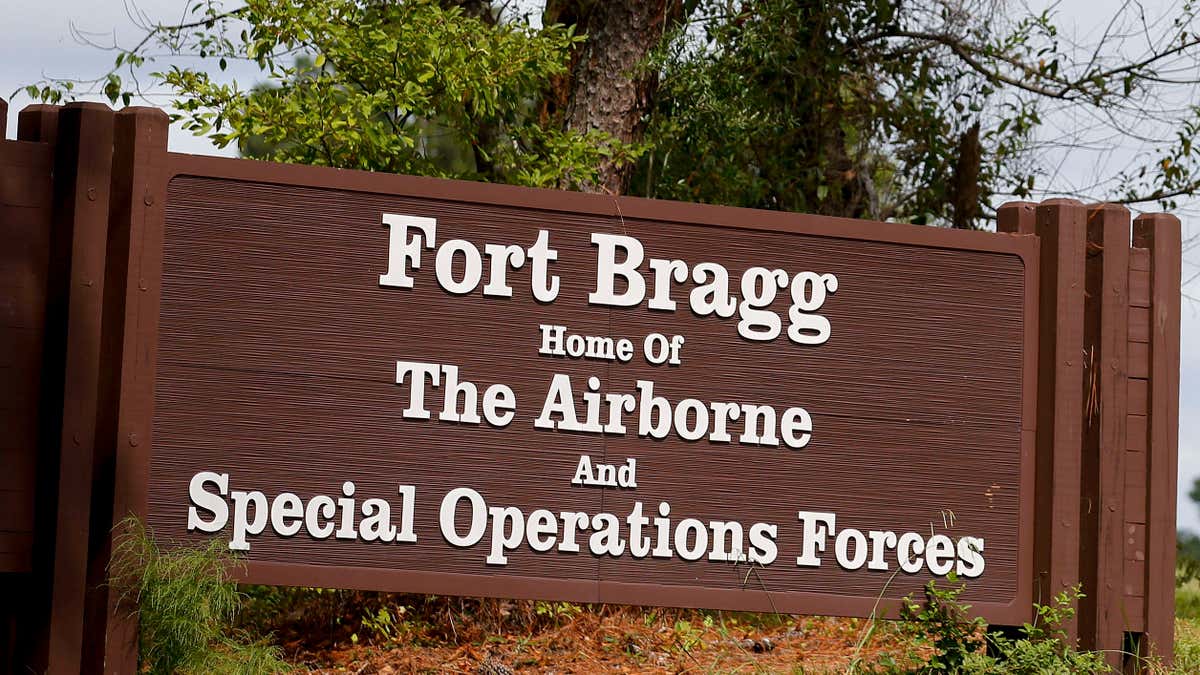
Sept. 26, 2014: A sign for Fort Bragg is seen in Fayetteville, North Carolina.

Nuclear microreactors will begin powering domestic military bases in 2028.  (Reuters)

The Army plans to work with multiple vendors, each expected to build at least two reactors — the first serving as a prototype and the second refined through lessons learned.

Beyond powering domestic installations, officials say Janus will also help solve one of the most pressing logistical challenges in a potential conflict with China: moving energy across vast ocean distances. Waksman cited Guam as an example — an island where more than 90 percent of electricity comes from imported oil delivered by foreign-flagged tankers traveling thousands of miles across contested sea lanes.

“Having something that can provide power for years at a time without any resupply would be an absolute game-changer,” he said.

For now, the reactors will remain stateside, but Waksman said the technology is being developed with future expeditionary use and commercial spin-offs in mind.

“The Army doesn’t want to be the only buyer of these reactors,” he said. “If we can get industry to the sixth or seventh unit, where they can sell to commercial partners, then we’ve succeeded.”

U.S. Soldier holds a drone

The Army’s power needs are only expected to increase in the era of drones, AI and directed energy warfare.  (Samuel Corum/Getty Images)

CLICK HERE TO DOWNLOAD THE FOX NEWS APP

Nuclear microreactors are smaller, factory-built power systems that use the same basic principles as traditional nuclear plants but at a fraction of the size. Most produce between one and 20 megawatts of electricity — enough to power a small town or a military installation — and can operate for years without refueling.

Unlike large commercial reactors, which can take a decade to construct, microreactors are designed for rapid deployment. They can be shipped by truck or aircraft and installed on-site within weeks, providing steady, carbon-free power in places where fuel delivery is difficult or dangerous.

Donald Trump declines to commit on two-state solution after hostages freed

0

NEWYou can now listen to Fox News articles!

President Donald Trump, when asked about the prospect of a two-state solution for Israel and the Palestinians, declined to commit, telling reporters, “We’ll have to see.” 

The comments came during a press gaggle aboard Air Force One as Trump returned home after signing a historic peace agreement that ended two years of fighting in Gaza. 

When the topic came up, Trump said he was focused on rebuilding Gaza after two years of Israeli bombardment, following the Oct. 7, 2023, massacre by Hamas. 

“I’m not talking about a single state or double state or two state,” Trump said, adding: “A lot of people like the one-state solution, some people like the two-state solution. We’ll have to see.” 

TRUMP’S WEEK IN REVIEW: PRESIDENT SECURES HISTORIC PEACE DEAL TO BRING HOSTAGES HOME AS SHUTDOWN CONTINUES

President Donald Trump speaks to the media aboard Air Force One before departure from Royal Air Force Mildenhall on October 14, 2025 in Mildenhall, England. (Chip Somodevilla/Getty Images)

Trump said any decision on the matter would be made in coordination with regional and international partners. 

The president concluded a whirlwind trip Monday that included a global peace summit in Egypt and a speech before the Knesset in Jerusalem earlier in the day, where he celebrated a U.S.-brokered ceasefire with Hamas.

Speaking to leaders gathered in Egypt, Trump called for a new era of harmony in the Middle East, seeking to advance broader peace in the region.

TRUMP SAYS ‘WHOLE WORLD CAME TOGETHER’ TO SECURE ISRAEL-HAMAS PEACE DEAL AFTER MONTHS OF DEADLOCK

“We have a once-in-a-lifetime chance to put the old feuds and bitter hatreds behind us,” Trump said, urging leaders “to declare that our future will not be ruled by the fights of generations past.”

trump's speech at peace summit

President Donald Trump delivers a speech at the Gaza International Peace Summit, in Sharm el-Sheikh, Egypt, Monday, Oct.13 2025.  (Yoan Valat, Pool photo via AP)

Leaders from dozens of countries, including from Europe and the Middle East, attended the summit. 

Trump, Egyptian President Abdel Fattah el-Sissi, Turkish President Recep Tayyip Erdogan and Qatari Emir Tamim bin Hamad Al Thani signed a document outlining a broad vision for Gaza’s future.

TREY YINGST: HAMAS MUST ACCEPT TRUMP PEACE PLAN TO END WAR ONCE AND FOR ALL

Twenty hostages were released Monday as part of an agreement intended to end the war in Gaza. Trump met with some of their families during his visit to the Knesset.

The moment remains fragile, however, as Israel and Hamas are still in the early stages of implementing the first phase of Trump’s peace plan.

U.S. President Donald Trump addresses the Knesset

JERUSALEM – OCTOBER 13: U.S. President Donald Trump addresses the Knesset, Israel’s parliament, on October 13, 2025, in Jerusalem.  (Evelyn Hocksteinl/Getty Images)

The sides have not agreed on Gaza’s postwar governance, its reconstruction, or Israel’s demand that Hamas disarm. Negotiations over those issues could break down, and Israel has hinted it may resume military operations if its demands are not met.

Much of Gaza has been reduced to rubble, and the territory’s roughly 2 million residents continue to struggle in dire conditions. Under the deal, Israel agreed to reopen five border crossings to ease the flow of food and supplies into Gaza, parts of which are experiencing famine.

CLICK HERE TO GET THE FOX NEWS APP

Roughly 200 U.S. troops will also help monitor and support the ceasefire deal as part of a team that includes partner nations, nongovernmental organizations and private-sector groups.

The Associated Press contributed to this report.

Settlement scammers target Facebook and AT&T payouts to steal data

0


NEWYou can now listen to Fox News articles!

Sometimes, data breaches result in more than just free credit monitoring. Recently, Facebook began paying out its $725 million settlement, and AT&T is preparing to distribute $177 million. Those payouts caught scammers’ attention.

Now, fake settlement claim emails and websites are flooding inboxes. They look convincing, but behind the plain design and official-sounding language is a trap for your Social Security number, banking info and more. So how can you make sure you get your money without losing even more in the process?

Sign up for my FREE CyberGuy Report
Get my best tech tips, urgent security alerts and exclusive deals delivered straight to your inbox. Plus, you’ll get instant access to my Ultimate Scam Survival Guide – free when you join my CyberGuy.com newsletter.

TOP 5 OVERPAYMENT SCAMS TO AVOID

Why fake settlement sites are so convincing

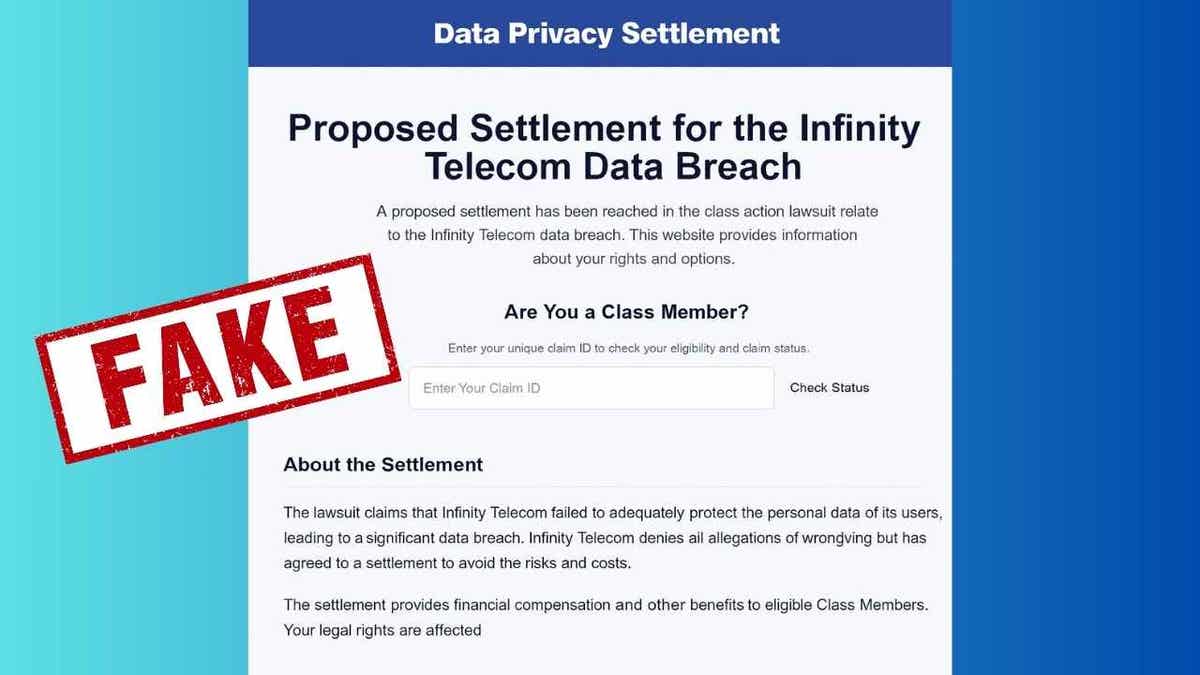
Settlement claim websites rarely look polished. Most have generic layouts, long URLs and simple forms asking for a claim ID from your email or postcard. That makes it easy for scammers to mimic them. To test how simple it is, we created a fake settlement site (below) in minutes using AI tools like ChatGPT.

Scammers build fake settlement sites that mimic the real thing to steal your data (Kurt "CyberGuy" Knutsson)

To steal your data, scammers build fake settlement sites that mimic real sites (Kurt “CyberGuy” Knutsson)

If we can do it, you can bet criminals are already exploiting the same shortcuts. Facebook has been the target. A fake site once popped up around the Equifax settlement, tricking thousands before it was shut down. The lesson? If the site appears unusual, it doesn’t necessarily mean it’s fake, but it should prompt you to double-check before entering your details or clicking on any links.

Red flags that expose fake settlement sites

Spotting a scam often comes down to noticing the little details. Watch for these common warning signs before you hand over your information.

Requests for too much personal data

If a site asks for your full Social Security number or the names of your children, stop. For example, the official Equifax settlement only requested the last six digits of SSNs. Genuine claim sites may ask for limited info (like the last four digits of your SSN), but they rarely demand complete Social Security or bank details.

Promises of payout estimates upfront

Real administrators calculate payments only after the claim period closes.

Texts or social media messages

Settlements are announced by mail or email, not through random DMs or SMS.

Red flags like odd URLs, urgent countdowns, or fee requests often expose the fraud (Kurt "CyberGuy" Knutsson) 

Fraud can be found with red flags like odd URLs, urgent countdowns, or fee requests (Kurt “CyberGuy” Knutsson)

Odd or misspelled URLs

Even one extra letter in the web address is a sign of a spoof site. Legitimate settlements use official or clearly named administrator domains. Be wary of addresses with unusual add-ons, such as “secure-pay” or “claims-pay.”

Urgent language or countdowns

Scammers rely on urgency to pressure you into acting fast. Real settlement sites don’t demand 24-hour turnarounds.

Processing fee checkboxes

A sure giveaway of a fake. Real settlement administrators never require money to file or to receive your payout.

Cheap trust badges

Scam sites often throw in fake “secure” seals. Look for recognized security seals and make sure they’re clickable and verifiable.

Generic contact info tied to the suspicious domain

Official sites list multiple, verifiable contacts. If the email or phone number matches the weird domain, that’s a red flag.

Grammar or spelling mistakes in the fine print

Sloppy errors in legal-sounding text are a classic sign you’re looking at a scam.

Always start at official FTC links or mailed notices to file claims safely (Kurt "CyberGuy" Knutsson) 

Start with official FTC links or mailed notices to file claims safely (Kurt “CyberGuy” Knutsson)

How to safely handle settlement claim notices

Before filing any claim, follow these steps to ensure you’re dealing with a legitimate settlement site and protecting your information.

1) Start at the FTC

The Federal Trade Commission keeps updated lists of approved class action settlements at ftc.gov/enforcement/refunds. The legitimate links always point to a .gov website. If your email sends you elsewhere, treat it with caution. 

2) Cross-check with other resources

Trusted outlets often cover large settlements and include safe links. ClassAction.org is another resource for checking legitimate URLs.

3) Skip the links, use the mail

Your claim notice may include a mailing address. Sending a paper form avoids the digital phishing minefield altogether.

4) Use strong antivirus software

Strong antivirus software can block malicious links, warn you about dangerous websites and prevent malware from taking over your device.

The best way to safeguard yourself from malicious links that install malware and potentially access your private information is to have strong antivirus software installed on all your devices. This protection can also alert you to phishing emails and ransomware scams, keeping your personal information and digital assets safe.

Get my picks for the best 2025 antivirus protection winners for your Windows, Mac, Android and iOS devices at CyberGuy.com.

HOW RETIREES CAN STOP FAKE DEBT COLLECTOR SCAMS

5) Try a data removal service

Data removal services work to scrub your personal information from broker lists, making it more difficult for criminals to target you.

While no service can guarantee the complete removal of your data from the internet, a data removal service is really a smart choice. They aren’t cheap, and neither is your privacy. These services do all the work for you by actively monitoring and systematically erasing your personal information from hundreds of websites. It’s what gives me peace of mind and has proven to be the most effective way to erase your personal data from the internet. By limiting the information available, you reduce the risk of scammers cross-referencing data from breaches with information they might find on the dark web, making it harder for them to target you.

Check out my top picks for data removal services and get a free scan to find out if your personal information is already out on the web by visiting CyberGuy.com.

Get a free scan to find out if your personal information is already out on the web: Cyberguy.com.

6) Never pay to file

If a site asks for “administrative fees” or a “processing charge,” close it immediately. Real settlement administrators will never ask for money.

7) Report suspicious sites

Spot a fake? Protect others by reporting it to:

  • The FTC Complaint Assistant at reportfraud.ftc.gov/
  • The Internet Crime Complaint Center (IC3) at ic3.gov/
  • The Consumer Financial Protection Bureau (CFPB) at consumerfinance.gov/about-us/the-bureau/

Quick reporting helps authorities shut down scams before more people fall victim.

Can you tell a real email from a fake?

Take our quick quiz at Cyberguy.com/ScamCheck to learn how to spot phishing scams, protect your inbox, and stay a step ahead of hackers. 

Kurt’s key takeaways

Class action settlements can feel like rare wins for consumers after data breaches. But scammers see them as easy hunting grounds. The best defense is skepticism. Check URLs, avoid clicking direct links and never give away details that don’t match the claim’s purpose. Your payout should help you recover, not put you at greater risk.

Have you ever received a settlement notice that felt suspicious, and how did you handle it? Let us know by writing to us at CyberGuy.com.

Sign up for my FREE CyberGuy Report
Get my best tech tips, urgent security alerts and exclusive deals delivered straight to your inbox. Plus, you’ll get instant access to my Ultimate Scam Survival Guide – free when you join my CyberGuy.com newsletter.

CLICK HERE TO GET THE FOX NEWS APP

Copyright 2025 CyberGuy.com.  All rights reserved.  


Source link

Google Maps vs Waze vs Apple Maps detailed comparison guide for 2025

0


NEWYou can now listen to Fox News articles!

Navigation apps have become an essential part of modern life. Whether you are commuting to work, running errands or exploring a new city, relying on accurate directions and real-time traffic updates can make all the difference. Over the past decade, Google Maps, Waze and Apple Maps have emerged as the dominant players in this space, each offering a distinct approach to navigation.

While millions of people rely on these apps daily, choosing the right one can depend on a variety of factors, from interface design to privacy policies. In this article, we compare these three apps across usability, accuracy, features and data handling to help you determine which one best fits your needs.

Sign up for my FREE CyberGuy Report
Get my best tech tips, urgent security alerts and exclusive deals delivered straight to your inbox. Plus, you’ll get instant access to my Ultimate Scam Survival Guide – free when you join my CyberGuy.com newsletter.

What each app does best

Google Maps is widely regarded as the all-rounder. It combines extensive mapping data with points of interest, public transit information, Street View, Live View AR and detailed business listings. Its versatility makes it a top choice for both daily commuters and travelers.

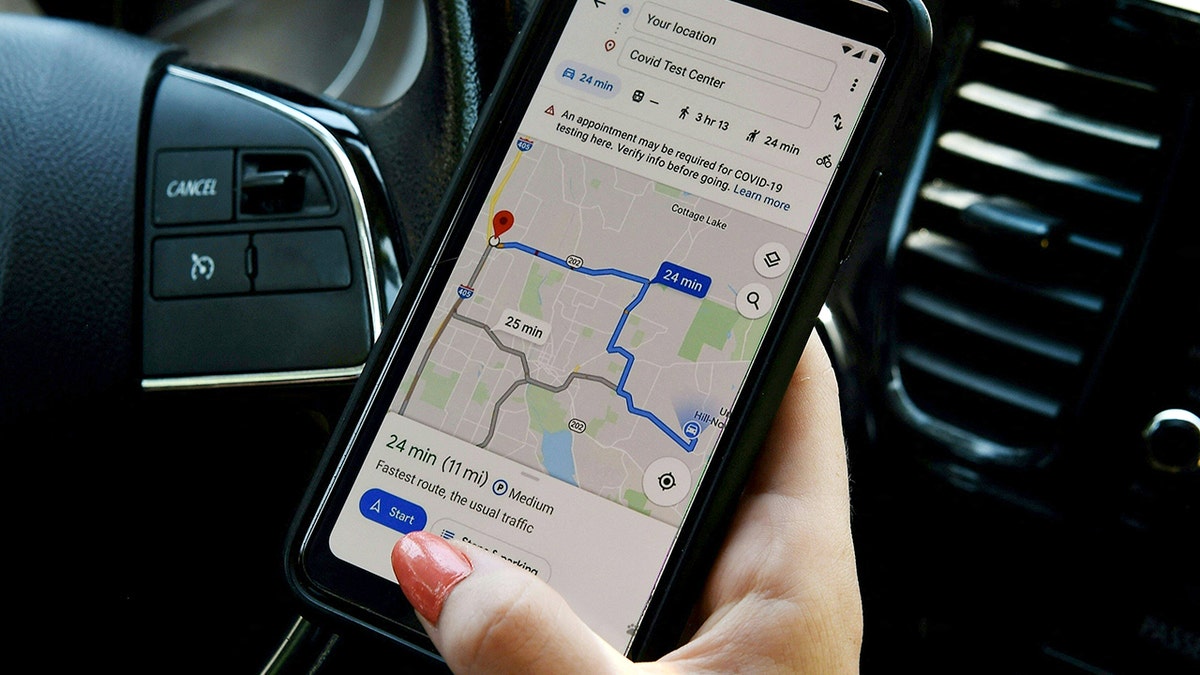
Google Maps application on smartphone

Google Maps is a great way to explore the world with detailed routes, Street View, and real-time traffic insights. (OLIVIER DOULIERY/AFP via Getty Images)

Waze, on the other hand, is designed primarily for drivers. It thrives on community input, offering live updates about traffic jams, road hazards, accidents and even police presence. Since Google owns Waze, many Waze-style real-time alerts have now begun appearing directly inside Google Maps. While Waze still focuses on driving, this integration blurs the lines between the two apps.

Apple Maps has made major strides in recent years. Once considered the underdog, it’s now a solid choice for iOS users. Its clean interface, privacy-focused design and seamless integration with Siri, CarPlay and Apple Watch make it a convenient pick for those fully in the Apple ecosystem.

INSTAGRAM FRIEND MAP FEATURE SPARKS PRIVACY QUESTIONS

Usability and interface

When it comes to interface, each app approaches design differently.

Google Maps provides a dense but intuitive layout, giving users access to multiple layers of information, including traffic, satellite imagery and public transit routes. Switching between driving, walking, biking and transit is straightforward, and the search functionality is robust, often displaying detailed business profiles, ratings, and hours of operation.

Waze prioritizes active driving support. Its interface is visually bold, with clear alerts for traffic jams, accidents and road hazards submitted by other users. While some may find the screen slightly cluttered, the focus is entirely on driving efficiency, which makes sense given its target audience.

Waze maps app on a phone

Waze helps to put you on a faster route with live, community-driven alerts that help you dodge traffic jams and road hazards.  (Kurt “CyberGuy” Knutsson)

Apple Maps offers a minimalist, streamlined interface that emphasizes simplicity. Searching for locations, initiating navigation, and following turn-by-turn instructions is straightforward. The app works seamlessly with iOS features like Siri and CarPlay, providing a smooth and cohesive experience for Apple users.

Navigation accuracy and performance

Accurate routing and timely traffic updates are critical.

Google Maps remains the most reliable for precise routing and travel time estimates. It combines AI-enhanced predictive routing with historical and live traffic data to suggest the best route. Its consistency holds strong across urban and rural areas alike.

Waze is unmatched for real-time rerouting. Relying heavily on crowd-sourced reports, it often detects slowdowns or hazards before Google Maps does. However, it still struggles when offline or in areas with poor data coverage.

Apple Maps has significantly improved its routing accuracy, especially in cities. Its traffic data is now crowd-sourced from millions of iPhones, processed on-device to protect privacy. In some rural or international regions, though, it can still lag behind Google Maps and Waze.

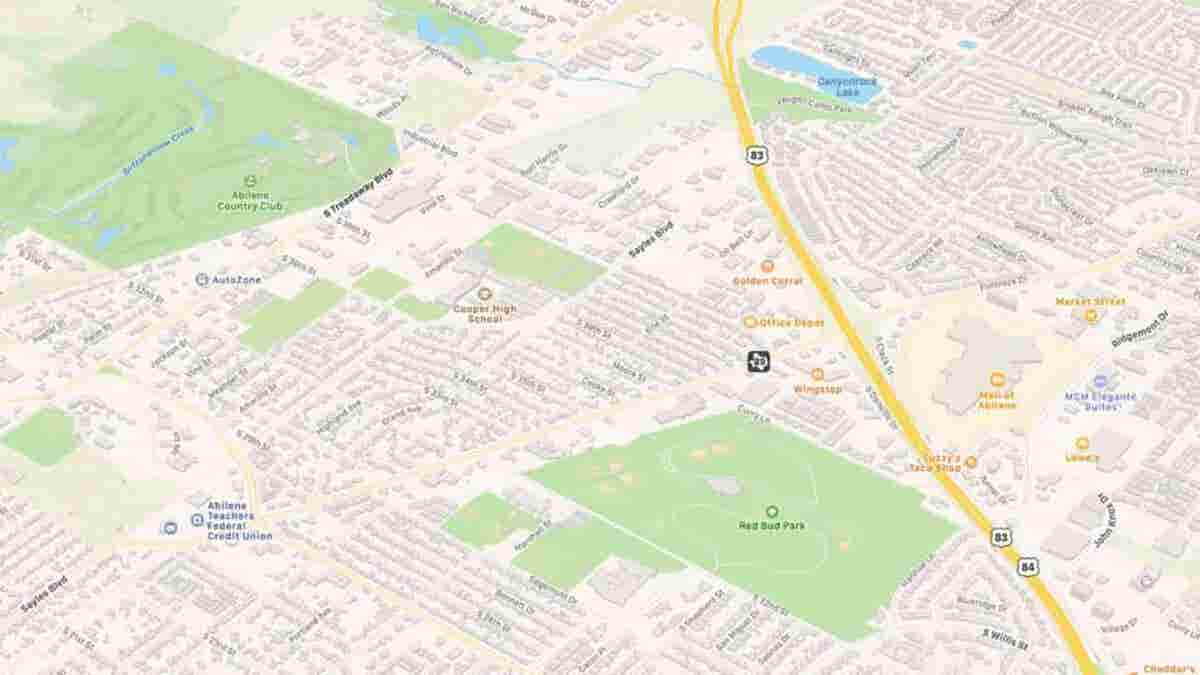
Apple Maps offers smooth, privacy-focused navigation designed for seamless use with your iPhone and CarPlay. 

Apple Maps offers seamless use with your iPhone and CarPlay for smooth and privacy-focused navigation.  (Kurt “CyberGuy” Knutsson)

Features and ecosystem integration

Beyond basic navigation, each app offers additional tools and integrations.

Google Maps offers offline maps, Live View AR navigation, multi-stop routing, EV charger locations and indoor maps for airports and malls. Integration with Gmail, Calendar and Google Assistant creates a seamless travel experience.

Waze remains focused on social and driving-specific features. You can report hazards or police sightings and even control Spotify, Audible or podcasts directly from the app without switching screens.

Apple Maps leans into privacy and ecosystem benefits. Its “Look Around” feature rivals Street View, while EV routing, cycling paths and Siri integration make it ideal for Apple fans. Apple also uses anonymized “Look Around” imagery to train its AI models, but with strict privacy safeguards like blurring faces and plates.

YOUR PHONE IS TRACKING YOU EVEN WHEN YOU THINK IT’S NOT

Privacy and data handling

How these apps handle your personal data matters more than ever.

Google Maps collects detailed location and usage data to power personalization and advertising. That means better recommendations, but less privacy for users who prefer anonymity.

Waze, also owned by Google, gathers anonymized driving data to enhance community reporting. Its functionality depends on sharing your location in real time, which is necessary for crowd-sourced accuracy.

Apple Maps takes a different approach. It processes most data on-device, uses random identifiers instead of personal accounts and does not associate searches with your Apple ID. That makes it the most privacy-conscious option, though even Apple collects anonymized data for traffic and route improvements.

Take my quiz: How safe is your online security?

Think your devices and data are truly protected? Take this quick quiz to see where your digital habits stand. From passwords to Wi-Fi settings, you’ll get a personalized breakdown of what you’re doing right and what needs improvement. Take my Quiz here: CyberGuy.com.

Kurt’s key takeaway

There is no single “best” navigation app, and the right choice depends on your priorities. Google Maps is ideal if you want a feature-packed, versatile app that works well for a variety of transportation modes and travel scenarios. Its global coverage and rich data make it reliable for everyday use and exploration. Waze is best if your main concern is real-time driving efficiency. Its community-driven traffic alerts and dynamic rerouting help you avoid congestion and save time during daily commutes. Apple Maps suits users deeply embedded in the Apple ecosystem who value simplicity, clean design and privacy protections. It may not have as many features as Google Maps or the same real-time edge as Waze, but its seamless integration with iOS makes it convenient.

Which navigation app do you rely on most for daily commuting, and why?  Let us know by writing to us at CyberGuy.com.

Sign up for my FREE CyberGuy Report
Get my best tech tips, urgent security alerts and exclusive deals delivered straight to your inbox. Plus, you’ll get instant access to my Ultimate Scam Survival Guide – free when you join my CyberGuy.com newsletter.
CLICK HERE TO GET THE FOX NEWS APP

Copyright 2025 CyberGuy.com.  All rights reserved.  


Source link

Vegas travelers say $1,000 dinners and resort fees are crushing tourism

0

NEWYou can now listen to Fox News articles!

The city of Las Vegas has experienced a widely reported dip in tourism — with travelers pointing to extremely high prices in many parts of the city. 

Fox News Digital spoke with visitors to Sin City to hear about their experiences and get their thoughts. 

A woman named Sarah from Staten Island, New York, said she’d been to Vegas quite a few times over the years. 

LAS VEGAS BECOMING ‘PLAYGROUND FOR THE AFFLUENT’ AS ‘EVERYDAY TRAVELER’ LEFT BEHIND

“[Vegas] has changed immensely price-wise,” she said. “It’s a little crazy, but dinners are like $1,000, it’s nuts. They need to go back a little bit, and I think they’ll get more tourism if they do that.”

A man named Craig, also from Staten Island, agreed that the Strip has changed. 

Night view of the exterior of the Flamingo hotel in Vegas on Saturday, Sept. 20, 2025. “[Vegas] has changed immensely price-wise. It’s a little crazy, but dinners are like $1,000, it’s nuts,” one traveler told Fox News Digital.  (Michael Anthony for Fox News Digital)

“If you’re looking for a bottle of wine, you’ve got to pay at least $2,000 a night for a good bottle of wine,” he said. 

Amanda from Valencia, Spain, shared a personal tip for saving money while in Vegas.

She said that since the “hotels [are] more expensive,” it is better to purchase food on the street.

VEGAS TIPPING DROPS DRASTICALLY AS VISITORS SAY SERVICE DOESN’T MATCH HIGHER COSTS

“You can find one coffee for maybe $5-$6 on the street, and in a hotel [it’s about] $20,” she said. 

Irene from Los Angeles, California, told Fox News Digital she had to pay a $135 resort fee.

las vegas casino empty

“I’d probably say one of the cons of being here is probably the price of things,” said one Vegas visitor this fall.  (Ashley J. DiMella/Fox News Digital)

“The price is going up and up, and the resort fee is very high,” she said. 

A man from Houston, Texas, told Fox News Digital, “I’d probably say one of the cons of being here is the price of things. You know, it’s Vegas, so I mean, everything’s pretty expensive.”

Travelmation supervisor and adviser Mallory Dumond told Fox News Digital that for clients of her firm, which is based in Fort Lauderdale, Florida, Vegas pricing is becoming more of a concern.

CLICK HERE TO SIGN UP FOR OUR LIFESTYLE NEWSLETTER

Dumond suggested staying off the Strip or staying nearby during a Vegas trip. 

“I have saved clients 30-50% on room rates while keeping them near the action,” she said. “Many hotels also offer bus or even monorail access to the Strip as well.” 

las vegas cvs tousits

Stop by a convenience or grocery store near the Strip for snacks and essentials, suggested a travel expert — rather than buy food at hotels and resorts.  (Ashley J. DiMella/Fox News Digital)

“Eating like a Vegas local can also save travelers big money,” Dumond added.

She said that eateries inside Ellis Island Casino or the Miracle Mile Shops have meal offerings for $5 to $10. It’s “Vegas flavor without the inflated pricing,” she said.

CLICK HERE FOR MORE LIFESTYLE STORIES

Dumond added that visitors should consider planning their travels around cheap attractions that are fun. 

“There are a ton of free shows, art attractions and other experiences in Las Vegas,” she said. 

“Catch the Bellagio fountains, explore the Fremont Street Experience or check out hotel attractions like the Flamingo’s wildlife habitat. Save your money for one paid splurge experience that’s truly worth it.”

People eating outside at Mon Ami Gabi in Las Vegas.

The exterior of Mon Ami Gabi on the Vegas Strip is shown on Sept. 20, 2025. The city recently made an appeal to locals amid declining tourist numbers. (Michael Anthony for Fox News Digital)

Dumond also suggested stopping by a convenience or grocery store near the Strip for snacks and essentials as opposed to buying them at hotels and resorts. 

“Save your money for one paid splurge experience that’s truly worth it.”

“This small move can save you as much as $50 over a few days — giving you more cash for a show, cocktail or slot pull,” she said. 

CLICK HERE TO GET THE FOX NEWS APP

The city of Las Vegas, meanwhile, recently made an appeal to locals amid the declining tourist numbers.

Travelers walking through the streets of Las Vegas.

Tourists walk outside the Paris hotel in Las Vegas, on Sept. 20, 2025. (Michael Anthony for Fox News Digital)

“This city is yours, Las Vegas locals! It’s time to rediscover your city with offers and events crafted just for you,” the website of the Las Vegas Convention and Visitors Authority (LVCVA) noted, as Fox News Digital previously reported. 

Many hotels, restaurants and attractions offered deep discounts to woo Nevadans into their establishments. 

JD Vance slams NBC for biased Israel rally coverage omitting Trump cheers

0

NEWYou can now listen to Fox News articles!

Vice President JD Vance criticized NBC News on Sunday morning, accusing the network of ignoring Israelis celebrating President Donald Trump’s role in securing a peace deal between Israel and Hamas.

During NBC’s “Meet the Press,” Vance said he watched NBC’s coverage showing demonstrators in Israel booing when Prime Minister Benjamin Netanyahu’s name was mentioned at a rally — while failing to note that the crowd cheered when Trump’s name came up.

Vance said, “But I also have to give your network a little bit of grief, Kristen, because last night I was watching NBC, they were covering this and they mentioned during a rally last night in Israel, when Steve Witkoff our special envoy mentioned Bibi Netanyahu the crowd booed, but the broadcast didn’t mention when Steve Witkoff mentioned President Trump –– the crowd actually cheered.”

TRUMP UNVEILS 20-POINT PLAN TO SECURE PEACE IN GAZA, INCLUDING GRANTING SOME HAMAS MEMBERS ‘AMNESTY’

Vice President JD Vance accused NBC of ignoring Israeli praise for President Donald Trump securing a peace deal between Hamas and Israel. (Alex Wong / Getty)

U.S. Middle East envoy Steve Witkoff, Ivanka Trump and Jared Kushner spoke at a Tel Aviv rally Saturday night, held in support of the remaining hostages still held by Hamas ahead of their planned release on Monday.

Trump and his team announced last week that they had negotiated a peace deal between Israel and Hamas that they said would end the war and lead to the release of all remaining hostages — two years after Hamas attacked Israel on Oct. 7, 2023.

TRUMP PEACE DEAL TRIGGERS 72-HOUR COUNTDOWN FOR HAMAS TO RELEASE 48 HOSTAGES FROM GAZA

thousands protest in Hostage Square

An aerial view of the area as protesters gather in “Hostages Square” in Tel Aviv, Israel, calling for an end to the attacks on Gaza and the release of Israeli hostages, on Aug. 24, 2025 in Tel Aviv, Israel.   (Yair Palti/Anadolu via Getty Images)

According to Israeli officials, the living hostages are expected to be released in a single phase within 72 hours. The return of the bodies of deceased hostages will take longer, but Israel insists on their inclusion in the deal.

During the Tel Aviv rally, speakers and attendees celebrated the agreement. However, the crowd booed Netanyahu when Witkoff mentioned his role in the negotiations.

As the booing continued, Witkoff said, “OK, let me just finish my thought. I was in the trenches with the prime minister. Believe me, he was a very important part here.”

CLICK HERE FOR MORE COVERAGE OF MEDIA AND CULTURE

Trump and Netanyahu shake hands

U.S. President Donald Trump shakes hands with Israeli Prime Minister Benjamin Netanyahu at the White House in Washington, D.C., U.S., Sept.29, 2025. (Kevin Lamarque/Reuters)

When Witkoff mentioned Trump’s name later in the address, the crowd cheered. 

Vance told Welker he noticed that NBC’s coverage omitted the cheers for Trump and explained why he believed the former president deserved praise from the crowd in Tel Aviv.

“And why is that, Kristen?  Why did the crowd cheer? Because this moment came from very, very deliberate and consequential diplomacy from the president and the entire administration.”

CLICK HERE TO GET THE FOX NEWS APP

Kyoto tackles overtourism with new $65 per night hotel tax starting 2026

0

NEWYou can now listen to Fox News articles!

Japan’s ancient capital is taking drastic steps to rein in overtourism. 

Starting in March 2026, Kyoto will introduce the highest accommodation tax in Japan, charging visitors more to stay in the city’s hotels, inns and guesthouses.

Under the new system, tourists at high-end hotels could pay up to ¥10,000 (about $65) per person, per night, in tourism taxes: a tenfold increase from current rates. 

Budget travelers will also see jumps from about ¥200 to ¥400 (about $1.30 to $2.60), while mid-range rooms will jump from ¥500 to ¥1,000 (about $3.30 to $6.50) per person.

COASTAL CITY GREENLIGHTS NEW VISITOR TAX AMID WIDESPREAD OVERTOURISM TREND

Hotel rates across Kyoto are expected to climb as the city doubles down on funding for infrastructure and crowd control. (iStock)

City officials say the extra funds are expected to more than double Kyoto’s tourism tax revenue and will go toward managing crowds, preserving cultural sites, and easing strain on local infrastructure.

LOCALS RANT THEIR NEIGHBORHOOD NOW ‘LIKE DISNEYLAND’ AS POST-OLYMPICS TOURISM SURGES

When applying to hike the fee, Kyoto travel authorities insisted that tourists should bear the cost of maintaining the very attractions that draw them into the city.

People enjoying a beautiful day in Kyoto, Japan.

Locals in Kyoto neighborhoods have complained of overcrowding and disrespectful tourist behavior. (Philip Fong/AFP via Getty Images)

While tourism drives Kyoto’s economy, many residents say the city has become nearly unlivable in peak seasons. Narrow streets clogged with selfie-snapping visitors, and popular districts like Gion, known for its traditional tea houses and geisha, have attempted to crack down on tourists after incidents of trespassing and aggressive photography. Japanese media reports these efforts have been unsuccessful.

‘CARBON PASSPORTS’ WOULD TRACK TRAVEL AND EVEN RESTRICT HOW SOME PEOPLE TAKE VACATION

The new tax aims to fund enforcement and reduce friction between visitors and locals, but critics warn it may not go far enough. Japan welcomed more than 35 million foreign tourists in 2024, and officials hope to reach 60 million by 2030.

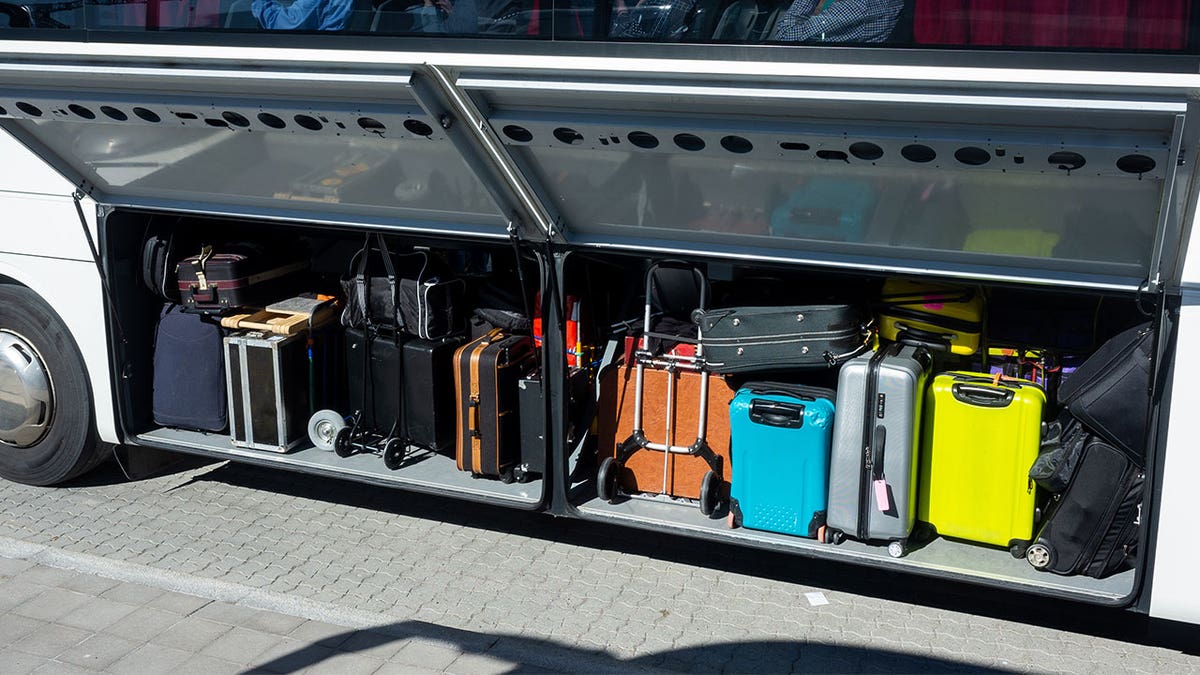
Suitcases loaded onto a bus.

The city hopes higher hotel fees will fund crowd control and protect Kyoto’s cultural heritage from mass tourism. (iStock)

Kyoto isn’t alone in feeling the squeeze. Fox News Digital previously reported that Mount Fuji, another of Japan’s iconic destinations, is dealing with its own side effects of booming tourism. 

CLICK HERE TO SIGN UP FOR OUR LIFESTYLE NEWSLETTER

Trash, overcrowding and safety concerns have grown so severe that officials have begun calling the landmark a “trash mountain.”

MORE IN LIFESTYLE NEWS

Visitors are being asked to pack out their garbage and respect new crowd limits, as local authorities scramble to protect the mountain’s natural beauty.

CLICK HERE TO GET THE FOX NEWS APP

Kyoto’s move may be a sign of what’s ahead for other tourist-heavy regions. As Japan’s popularity surges, cities are being forced to choose between economic opportunity and preserving the peace that makes them so popular in the first place.