Legendary American tennis pro Pete Sampras revealed that his wife Bridgette Wilson Sampras has been battling ovarian cancer after being diagnosed nearly a year ago and asked for “good thoughts and prayers” as the actress continues on in her “healing journey.”
Sampras, a 14-time Grand Slam champion before his official retirement in 2003, made the revelation in a lengthy statement shared by the ATP Tour on social media Sunday.
Pete Sampras and Bridgette Wilson during 2001 ESPY Awards at MGM Grand Arena in Las Vegas.(KMazur/WireImage)
“As most have come to know, I’m a pretty quiet and private person. However, this past year has been an exceptionally challenging time for me and my family and I have decided to share what’s been going on,” his statement read.
“Last December, my wife, Bridgette, was diagnosed with ovarian cancer. Since then, she has had major surgery, pushed through chemotherapy and continues with target maintenance therapy.”
He continued, “It is hard to watch someone you love go through a challenge like this. However, seeing our boys step up and be such strong supporters of Bridgette, myself and each other has been amazing.”
Sampras said his wife inspires him as she continues to be an “incredible mom and wife.” He added that while he has struggled asking for support throughout this process, he hopes to change that with sharing their family’s story.
Pete Sampras, center right, celebrates his win over Andre Agassi with his wife Bridgette Wilson, center left, at the end of their men’s singles final match at the US Open Tennis Tournament Sept. 8, 2002 at Flushing Meadows, New York. Sampras won his 14th grand slam title over Agassi 6-3, 6-4, 5-7, 6-4.(TIMOTHY A. CLARY/AFP via Getty Images)
“With that said, I will end this by humbly asking for good thoughts and prayers for our family as Bridgette continues to thrive on her healing journey.”
Sampras and his wife were married in 2000 and share two children together.
A decorated tennis star, Sampras won his first Grand Slam at just 19 years old when he defeated what would become his career-rival Andre Agassi in the 1990 US Open.
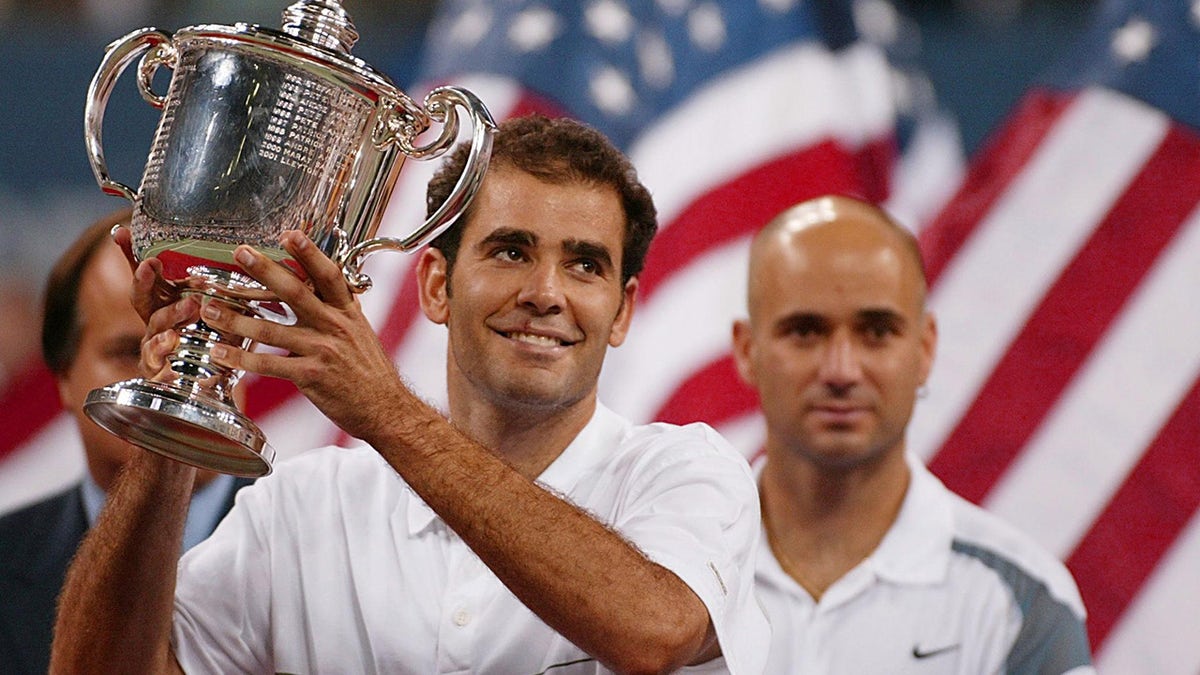
Pete Sampras holds up the trophy as Andre Agassi looks on after their men’s singles final match at the US Open Tennis Tournament Sept. 8, 2002 at Flushing Meadows, New York. Sampras won his 14th grand slam title over Agassi 6-3, 6-4, 5-7, 6-4.(TIMOTHY A. CLARY/AFP via Getty Images)
Decentralized crypto exchange PancakeSwap now has portfolio manager functionality, according to an Oct. 30 announcement. The feature has been added in partnership with decentralized finance (DeFi) protocol Bril Finance.
The new feature allows PancakeSwap users to deposit tokens into single-asset vaults via the exchange’s user interface. Once the tokens are deposited, they go into a liquidity provision algorithm with automatic rebalancing. The development teams for PancakeSwap and Bril claim that this system will allow users to get higher risk-adjusted returns compared to other methods.
PancakeSwap user interface. Source: PancakeSwap
According to the announcement, users will be able to deposit crypto, such as Tether (USDT), Bitcoin (BTC), BNB (BNB) and Ether (ETH). The teams claim the protocol has already produced over 24% internal rate of return (IRR) in tests. IRR is a metric that measures the compound annual growth rate for a project.
For the first four weeks of the feature’s release, additional rewards in PancakeSwap’s (CAKE), the exchange’s governance token, will also be provided to users. At launch, PancakeSwap will be the only interface that provides users access to Bril’s portfolio management system, the announcement stated.
PancakeSwap’s “Head Chef,” or CEO, Mochi, claimed that the new integration would help make the exchange a major hub for DeFi, stating:
“We aim to become a hub for all of DeFi and integrations such as this, allowing us to become a one-stop shop for portfolio management. Bril’s automated technology and its integration with PancakeSwap will allow PancakeSwap users to enjoy the core features and functionalities they are already accustomed to and seamlessly earn on their assets in a hands-off manner.”
PancakeSwap is the second-largest fully decentralized crypto exchange in terms of daily volume, according to data from DefiLlama. In May, it launched a pancake-themed game called Pancake Protectors. In September, it integrated Transak as a vendor for making fiat to crypto payments.
Speaker Mike Johnson, R-La., praised the “Judeo-Christian tradition” and “classical liberal” values that he said shaped the West in his first international speech on Monday.
Johnson virtually addressed the inaugural conference of the Alliance For Responsible Citizenship (ARC) in London. In his remarks, Johnson outlined four questions he is using to shape an “optimistic vision” for the country and the world.
He called on the audience to consider, “How do we restore good governance and restore faith in our institutions,” how to “re-focus on the family and strengthen the social fabric that ties us all together,” along with “the best way to deliver reliable and affordable energy” and finally: “how do we sell the idea that the best answers to these questions are the keys to greater human flourishing across the globe?”
“The answers to these and other key questions will form our optimistic vision, and what we’re calling our better story,” he said.
Speaker Mike Johnson’s first international speech will be a virtual address to the Alliance For Responsible Citizenship in London
Johnson cited the “unprecedented times” both at home and abroad – including “political divides” in the U.S. and a “crisis of identity” in the western world as a whole.
He referenced international instablity in Hamas’s attacks on Israel, China’s growing aggression to Taiwan and its neighbors and the “war in Eastern Europe.”
Johnson called on the people gathered to seek a “better story” in terms of expanding opportunity and “the return of responsibility” from government to individuals.
“And finally, and most importantly, our better story says that we, in the West, draw on an extraordinary heritage, built on the best of the classical liberal and the Judaeo-Christian tradition. These are not just political ideas; these are foundational principles which have governed our public debate for centuries and which we would do well to remember,” he said.
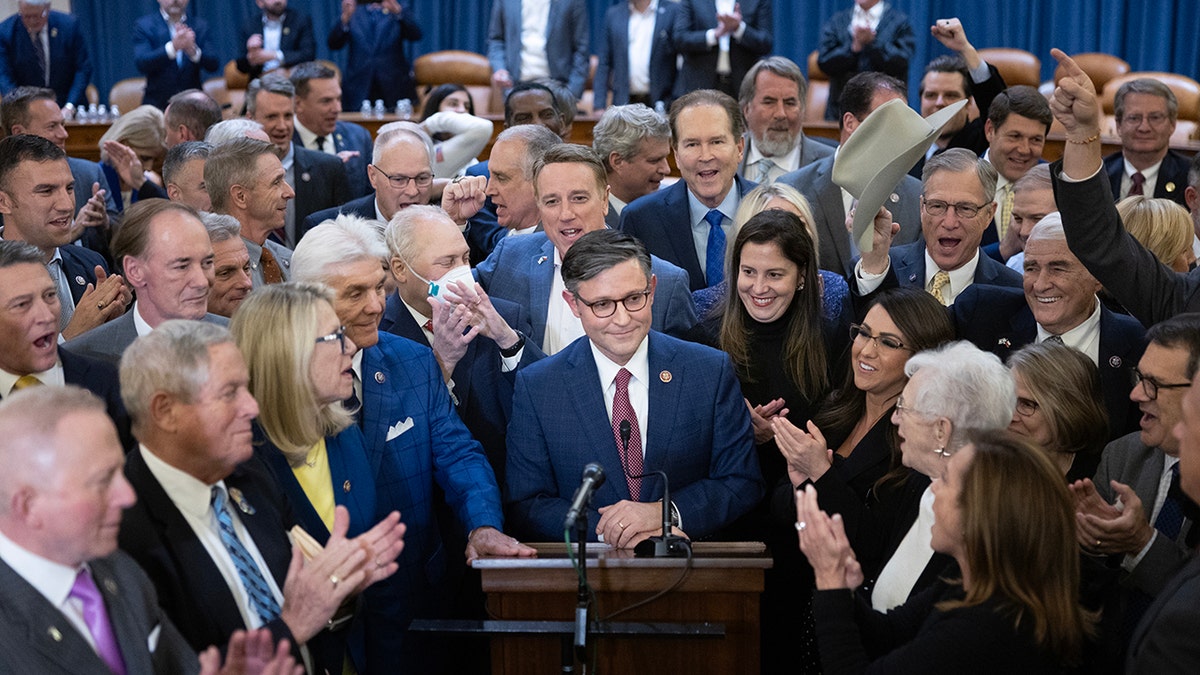
House Republicans unanimously selected Johnson to be their nominee for speaker(Tom Brenner for The Washington Post via Getty Images)
Toward the end of his remarks the speaker called for a “radical shift in thinking about the role of government and the proper delegation of responsibility.”
His speech comes after House Republicans unanimously elected Johnson as speaker, ending three weeks of paralysis in Congress without an elected leader in its lower chamber.
“[D]emocracy can be messy, and thankfully, I believe the United States Congress and our entire nation has re-emerged now as a beacon of liberty for the world as a result of all this,” Johnson said toward the beginning of his speech.
“The House is back in session as we say here. Now look, I believe God brings leaders together to address certain challenges, just as I believe the Alliance for Responsible Citizenship has been called together this week to begin the challenging work of pushing back on the failed visions that currently plague the West.”
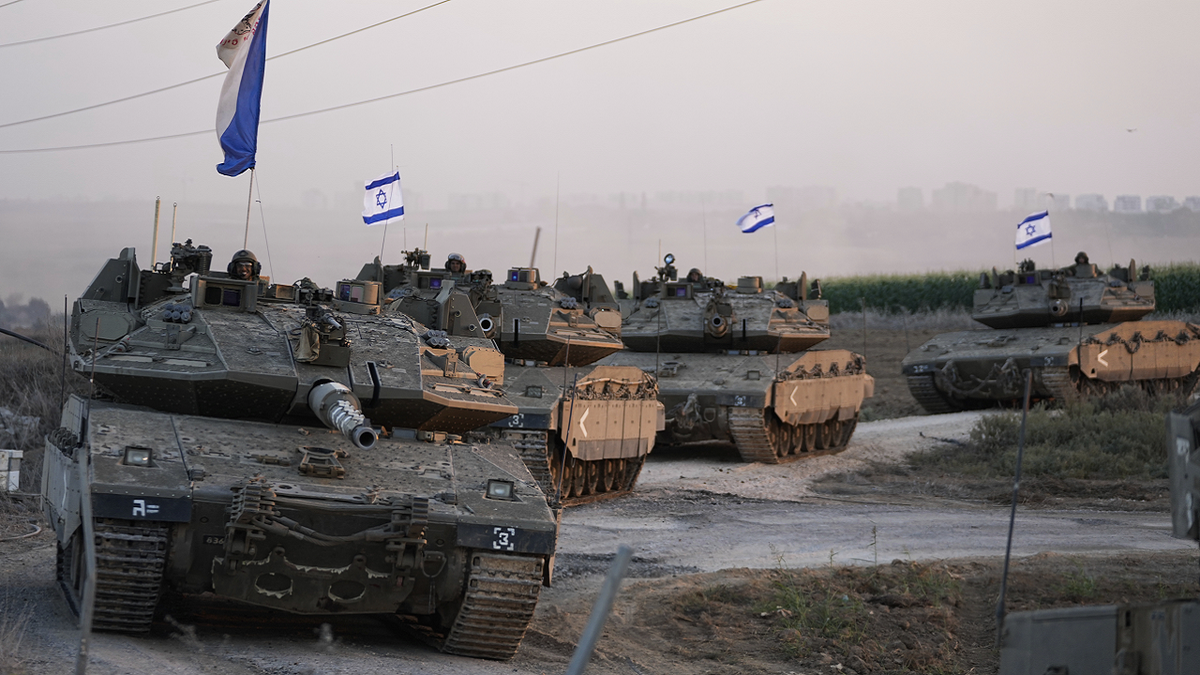
Israeli tanks head towards the Gaza Strip border in southern Israel on Thursday, Oct. 12, ahead of an anticipated ground incursion.(AP/Ohad Zwigenberg)
ARC CEO, Baroness Phillipa Stroud, praised Johnson and his leadership in her own statement.
“It’s been lovely to work with Speaker Johnson this year as we planned and developed the ARC mission. We are so excited for him as he takes on this incredible role and know his servant leadership approach, which is a fundamental principle here at ARC, will serve the American people well,” Stroud said.
Elizabeth Elkind is a reporter for Fox News Digital focused on Congress as well as the intersection of Artificial Intelligence and politics. Previous digital bylines seen at Daily Mail and CBS News.
Follow on Twitter at @liz_elkind and send tips to elizabeth.elkind@fox.com
Zero knowledge-proof (ZK-proof) scalability solutions have grown in prominence in the crypto ecosystem in recent years, making way for several ZK-focused conferences and events. A marquee ZK conference dedicated to the growing community will take place on Nov. 13 in Istanbul, Turkey. ZkDay is hosted by zero knowledge layer-1 platform, the Manta Network, Polychain Capital, nil; Foundation and Cointelegraph.
ZkDay is dedicated to facilitating top-notch community gatherings, fostering learning and networking, and driving the progress and application of ZK technology across the blockchain space. ZkDay Istanbul comes just three months after the success of ZkDay Paris in July, which hosted 3,000 attendees, with several participants in its “Pitch” competition securing financing rounds from tier-one investors.
The conference will showcase 10+ curated early-stage ZK projects, with venture capital and ZK panels as well. There will be several sponsor booths for attendees to interact with, as well as food and drinks provided throughout the gathering, allowing for plenty of networking among participants.
Taking place alongside Devconnect, zkDay Istanbul is also hosting a zkDay Pitch competition sponsored by ETHGlobal, which will take place at the beginning of the event for two to three hours. The competition will allow ZK-focused projects from various stages to showcase themselves to the community.
We’re excited to announce our partnership with @ETHGlobal, bringing you zkDay Pitch Competition at the beginning of zkDay Istanbul, featuring ZK startups at all stages.
— zkDay ️ Istanbul (Devconnect) (@zkdayofficial) October 17, 2023
Eligibility criteria for projects to participate in the Pitch competition include a solid idea and projects in search of funds or that have completed their seed round. Each participating project will have five minutes to pitch, followed by two minutes of questions and answers.
The winner of the zkDay Pitch competition will receive a tailored advertisement program from Cointelegraph, with an estimated budget of $20,000–$30,000. The winner also has a chance to secure a share of the sponsor-backed prize pool to be announced on Oct. 30.
Source: ZkDay Istanbul
The Pitch competition will be followed by keynote speeches and industry panel talks from some distinguished guests, with a lineup of over 20 speakers. The community conference will be a hotspot for networking opportunities with a broad range of industry representatives, allowing the participants to connect with important players.
Follow zkDay Istanbul’s official website and X account for the latest updates and announcements.
Sponsored: Cointelegraph does not endorse the content of this article nor any product mentioned herein. Readers should do their own research before taking any action related to any product or company mentioned and carry full responsibility for their decisions.
Former Pittsburgh Penguin forward Adam Johnson tragically died after he suffered a catastrophic neck injury on the ice over the weekend in what his team has called a “freak accident.”
In the days following his death, tributes for the American ice hockey player have poured in, including a heartbreaking social media post from his girlfriend, who was reportedly in attendance when Johnson was fatally wounded.
Adam Johnson, #47 of the Pittsburgh Penguins, skates against the Nashville Predators at PPG Paints Arena on March 29, 2019 in Pittsburgh.(Joe Sargent/NHLI via Getty Images)
Ryan Wolf shared a tribute post from one of Johnson’s previous teams, the Augsburger Panther, to her Instagram Stories on Monday.
“My sweet angel,” she wrote in the post, “I’ll miss you forever and love you always.”
Johnson, 29, was playing in a Challenge Cup game between the Nottingham Panthers and the Sheffield Steelers at Sheffield’s Utilita Arena on Saturday when another player from the opposing team appeared to collide with him.
The blade of the opposing player’s skate cut Johnson in the neck.
Adam Johnson, #47 of the Pittsburgh Penguins, skates against the Carolina Hurricanes at PPG Paints Arena on March 31, 2019 in Pittsburgh.(Joe Sargent/NHLI via Getty Images)
“The Nottingham Panthers are truly devastated to announce that Adam Johnson has tragically passed away following a freak accident at the game in Sheffield last night,” the Panthers said in a statement Sunday morning.
“The Panthers would like to send our thoughts and condolences to Adam’s family, his partner, and all his friends at this extremely difficult time. Everyone at the club, including players, staff, management and ownership, are heartbroken at the news of Adam’s passing.”
According to a report from The Sun, Wolfe was in attendance at the game and reportedly ran onto the ice after Johnson was injured.
The South Yorkshire Police announced Monday that they are investigating the incident after being called to the arena on Saturday night.
Pittsburgh Penguins Left Wing Adam Johnson, #47, looks on during the second period in the NHL game between the Pittsburgh Penguins and the Colorado Avalanche on Oct. 16, 2019, at PPG Paints Arena in Pittsburgh.(Jeanine Leech/Icon Sportswire via Getty Images)
“Our officers remain at the scene carrying out inquiries and our investigation into the circumstances surrounding the incident remain ongoing,” the statement read.
“We would encourage the public to avoid speculation regarding the incident while we continue our inquiries.”
Johnson’s memory was honored across different leagues in the days following his death.
A moment of silence was held for him before the start of the Heritage Classic between the Calgary Flames and Edmonton Oilers on Sunday night.
The ghastly events of this past month raise again some troubling questions: Does crypto have a terrorist fundraising problem? Are its networks really being exploited by terrorists to wreak global havoc? If so, what must it do better?
On the other hand, maybe the problem is one of perception — more appearance than reality — because public blockchains, after all, are transparent and traceable. In that event, how does the industry turn around a less-than-sterling reputation?
Cryptocurrencies like Bitcoin (BTC) have been associated with illicit activities almost from their inception. This image has been difficult to shake, even as analytical groups like Chainalysis assert that “terrorism financing is a very small portion of the already very small portion of cryptocurrency transaction volume that is illicit.”
But in early October, the world awoke to Hamas’ incursion into southern Israel, and shortly after, Israeli police announced it had frozen cryptocurrency accounts used by Hamas as part of its ongoing efforts to locate the “financial infrastructure in cryptocurrencies used by terror entities to fund their activities.”
A week later, a group of 28 United States senators and 76 Congressional representatives — led by Senator Elizabeth Warren — sent a letter to high-level Biden administration officials asking what steps are being taken “to address the use of cryptocurrency by terrorist organizations.”
The Congressional letter to President Biden’s administration. Source: U.S. Senate
So once again, the industry finds itself on the defensive as governments, legislators and even asset managers are asking: Are crypto’s networks again being exploited by the worst of the worst?
“Out of proportion to the facts”
“If any terrorist organization is using crypto for fundraising, then I’d argue it’s a problem,” Cody Carbone, vice president, policy at the Chamber of Digital Commerce, told Cointelegraph. But recent reports, including those appearing in The Wall Street Journal and later cited in the Warren coalition’s letter, were inaccurate. Carbone said:
“I believe the numbers being used by WSJ and Senator Warren’s coalition are skewed or downright incorrect. According to Chainalysis, of the roughly $82 million in cryptocurrency received by the WSJ posted address, about $450,000 worth of funds were transferred from the known terror-affiliated wallet.”
Kristin Smith, CEO of the Blockchain Association, told Cointelegraph: “We view the hysteria around the links between crypto and Hamas as out of proportion to the facts.” Like Carbone, Smith said any funding of terrorist organizations “is too much,” but she also asked why the focus of some legislators and policymakers was so narrow.
“Why not ask the [Biden] administration for details on ALL sources of Hamas funding? We want the entire picture, which would put the role of digital assets into proper perspective.”
One often hears this argument from industry supporters. Crypto’s contribution to terrorist coffers — whether those groups are based in North Korea, Iran, Lebanon or Gaza — is trivial compared to the volumes raised via fiat currencies that use more traditional means of transfer.
“Terrorist organizations have historically used and will likely continue to use traditional, fiat-based methods such as financial institutions, hawalas, and shell companies as their primary financing vehicles,” said Chainalysis in an Oct. 18 blog.
“The reality is that this [crypto] is just a tiny piece of the larger terror financing puzzle,” Ari Redbord, global head of policy and government affairs at TRM Labs, told Cointelegraph. What about nation-states like Iran? Or global mega-donors? Or Hamas raising millions through taxing Gaza residents? “Crypto plays a tiny part in all this.”
There’s an irony at play here, too. Raising illicit funds via public blockchains like Bitcoin or Ethereum is actually a boon for law enforcement agencies. Modern analytic techniques employed by specialty firms like Chainalysis, Elliptic and others often make it easier to identify and seize funds bound for designated terrorist groups.
“What’s missing from the conversation is that our ability to track and trace on open blockchain has far better than anything we are able to do with fiat,” said Redbord. Tracing illicit funds through shell companies or stolen art is much more problematic. By comparison, “blockchain allows for tracking.”
“Previous efforts of law enforcement and private industry […] have been successful in detecting Hamas’s terrorist financing activity on the blockchain — leveraging the transparency of crypto assets to freeze and confiscate related funds,” Elliptic’s David Carlisle wrote in an October 11 blog.
In fact, Hamas said in April that it was giving up crypto-related fundraising and would no longer receive funds via Bitcoin, “citing an increase in ‘hostile’ activity against donors,” reported Reuters.
“The industry needs to be more vigilant”
But even a relatively small amount of crypto usage by Hamas, Palestinian Islamic Jihad (PIJ), et al. appears to be enough to stir the waters.
“There is an opportunity to address this issue constructively,” Carbone told Cointelegraph, “but I fear that some anti-crypto policymakers in Washington are using the crisis to push their agenda and significantly restrict crypto use in the U.S. or eradicate it completely.”
Chainalysis’ analysis of a wallet suspected of terrorism financing found 20 suspected service providers. Source: Chainalysis
How does one set the record right then? More education and more data answered Carbone. “More education on how blockchain technology is a terrible tool for terrorists because of its public nature, but also identify the pain points.”
Some steps need to be taken. The industry still has to deal better with the dangerous use of mixers and tumblers that can hide wallet addresses from law enforcement agencies by developing better cybersecurity controls and operational risk procedures, said Carbone. “Everyone in the industry needs to be more vigilant. We also need more data to identify how serious the problem really is.”
There are signs that some of these things are already happening, added Redbord. Binance has recently been working with Israeli authorities to freeze the crypto accounts of a number of terror-designated groups, including PIJ and Hamas, for instance.
It wouldn’t hurt to be more assertive in the court of public opinion, too.
“We believe crypto is here for good,” said Smith. “The technology is neutral, the protocols are open and can be used by anyone, just like the internet itself. As time goes on, given its ability to lower financial barriers, protect Constitutional rights to privacy, and finally provide an opportunity for users to claw back power from Big Tech and its monopoly over our digital lives, the value of crypto to humanity will become self-evident.”
Is reform crypto legislation in the U.S. dead for now?
But the conflagration in the Middle East may have already torpedoed prospects for comprehensive crypto reform legislation in the U.S. — at least for now.
Analyst Mark Palmer from Berenberg Capital Markets was one of the first to warn of the potential impact of political headwinds from the Israel–Hamas conflict on the crypto reform efforts in the U.S. More recently, Palmer told Cointelegraph:
“Coinbase is likely facing an uphill battle in its effort to lobby Congress in the hope that it would draft legislation that would bring regulatory clarity around the question of whether crypto tokens are securities or not, especially now that recent media reports have put a spotlight on how Hamas used crypto as a means of fundraising in recent years ahead of its attack on Israel.”
Palmer wasn’t really surprised to find crypto opponents redoubling their efforts now to crack down on it in Washington, DC. What’s more alarming, though, is that “the reports appear to have encouraged more lawmakers to join in that effort.”
In other words, momentum could be building against the industry. “None of this is helpful to Coinbase’s cause as it seeks to better position itself in the U.S., and now the potential for new legislation that could undermine the company’s prospects appears to be growing,” Palmer said.
Is it too soon to say that reform legislation in the U.S. is dead on arrival?
“Not dead,” said Carbone. “But we’re running out of time. Forget the chaos of the speakership; we’re nearing the end of the year, the government needs to be funded again next month, and there are other priorities. And then it’s an election year.”
Carbone says there’s still a chance for stablecoin legislation, but even that will likely need “to be traded for either a non-crypto bill — safer banking, credit card legislation — or paired with an illicit finance bill.[…] The issue is becoming more partisan.”
Ultimately, it is voters who will decide, Smith concluded. “Industry builders should continue to build applications that are of mainstream, tangible value to society. Policymakers ultimately serve their voters. The more voters want to use this technology, the better chance we have of protecting it.”
Warning: This article contains graphic details that may be disturbing to some readers.
SHURA ARMY BASE, Israel – Three weeks after Hamas’ deadly massacre on multiple Israeli army bases, civilian communities and a music festival, Israel is still struggling to identify its dead, not only because of the size and scope of the surprise, multi-pronged terrorist attack, but also due to the sheer brutality carried out by thousands of Palestinian terrorists, say those working to identify the dead.
At the Shura Army Base, on the outskirts of the central Israeli city of Ramle, dead bodies and hacked-up body parts continued to pile up this week, still arriving from the country’s south in refrigerated trucks.
At the base, army personnel and volunteers, as well as religious authorities officiating the delicate process, described seeing atrocities reminiscent of the Holocaust – imagery not often invoked in a country whose foundations grew out of the Nazi genocide against the Jews in World War II.
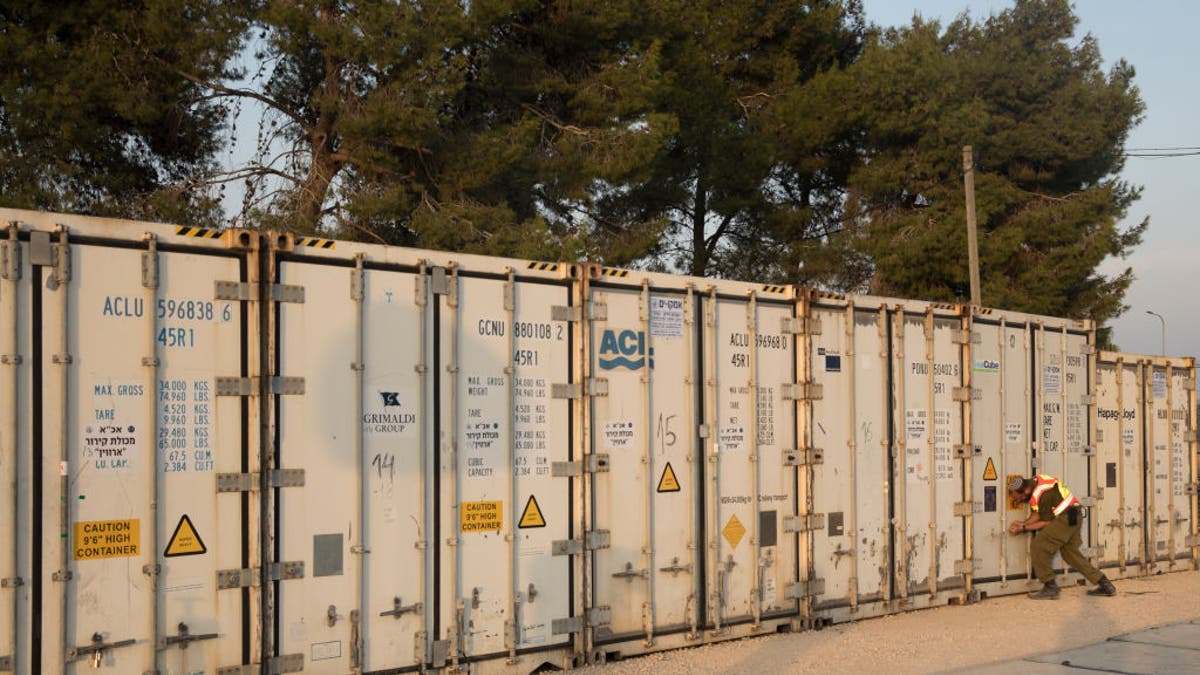
A soldier of the Military Rabbinate unit opens a container filled with bodies killed during at the Hamas attack on the Israeli southern border as the process of identifying deceased individuals continues in the Shura Army Base on Oct. 24, 2023 in Ramle, Israel.(Photo by Amir Levy/Getty Images)
“During a war, each side tries to make a convincing argument that they are right but these kinds of atrocities we have not seen since the days of the Nazis,” Col. Rabbi Haim Weisberg, head of the army’s rabbinic division, said in an interview.
“They went from house to house burning family after family,” he said. “We are seeing trucks still arriving filled with body bags that contain whole families – grandparents, mothers, fathers, and even little children are being brought down from the trucks.”
“In normal times, the rabbis on this base deal with dead soldiers, but this time it is abnormal,” said Weisberg of the base that is just one among several involved in the identification process.
“Here we have identified hundreds of bodies and there are still many more waiting to be examined,” he said.
Weisberg described how some of the bodies were so badly burned that regular DNA testing was useless. In many cases, dental forensic teams were called in and forced to track down the personal dental records of the victims. In some extreme cases, even those methods have not been effective.
Along with the more than 1,400 people murdered in the attack and an additional 239 now confirmed by the Israeli army as being held captive in the Palestinian enclave, a further 100 people still remain missing.
Soldiers of the Military Rabbinate unit open a container filled with bodies killed during at the Hamas attack on the Israeli southern border as the process of identifying deceased individuals continues in the Shura Army Base on Oct. 24, 2023 in Ramle, Israel.(Photo by Amir Levy/Getty Images)
Since the Oct. 7 attack, the IDF’s special forces have been engaged in localized raids inside the Gaza Strip in order to retrieve dead bodies and body parts. Inside the devastated communities that sit along the border with Gaza, forensic archeologists have been called in to search for human remains. Earlier this week, a human jaw was found in a burnt-safe room.
Families, including those who had hoped their loved ones might be still alive even if they were being held hostage by Hamas, are being informed all the time that their relatives are, in fact, among the dead.
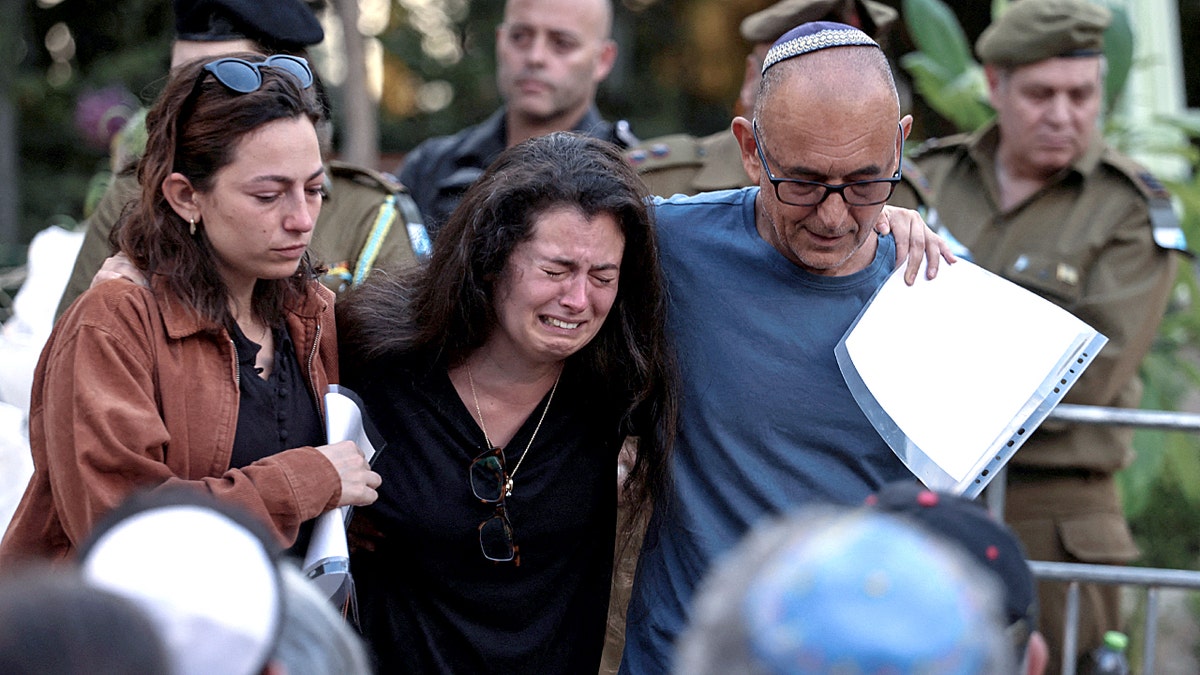
Friends and family members attend the funeral of Shiraz Tamam, who was killed by Hamas during its terrorist attack on revelers at the Nova music festival, at Holon cemetery on Oct. 17, 2023 in Holon, Israel.(Leon Neal/Getty Images)
Speaking at Shura, Weisberg described in graphic detail how one badly charred body turned out to be two victims – a mother and a baby bound together in a deep embrace. Another victim, he said, was a pregnant woman, her stomach cut open, her fetus pulled out and beheaded. The umbilical cord was still attached.
“When you think about evil, you realize it is beyond comprehension when you see what this terror organization did,” the rabbi said.
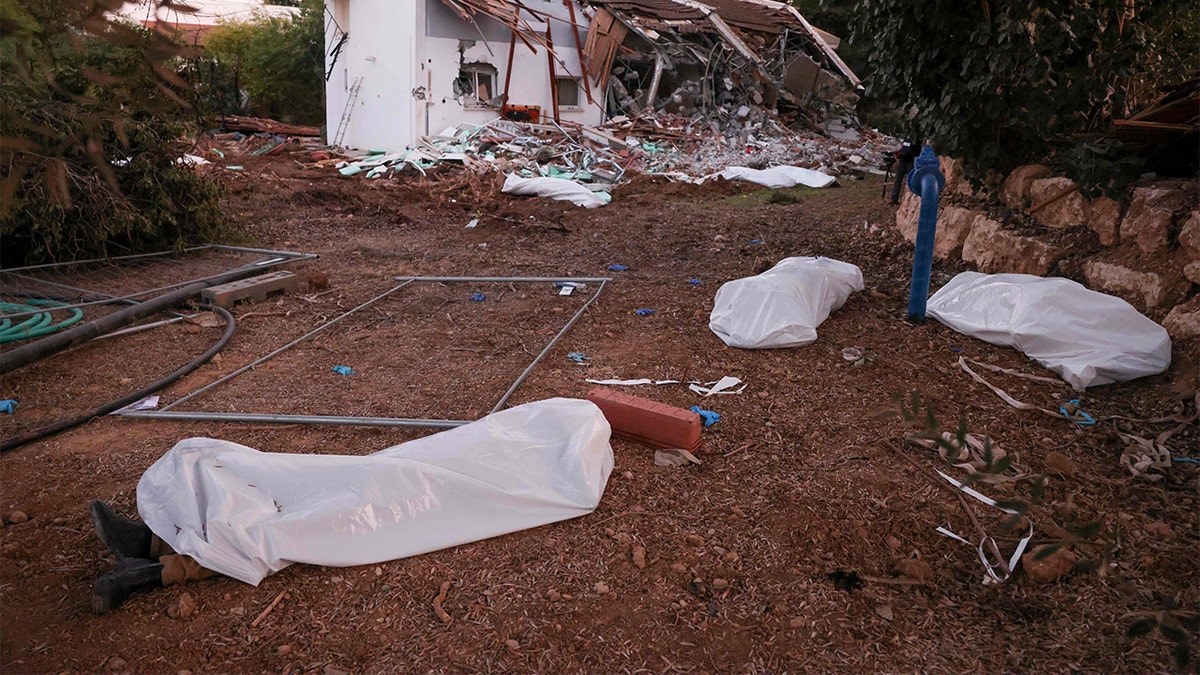
A picture taken on Oct. 11, 2023, shows covered bodies at kibbutz Beeri near the border with Gaza, the site of an infiltration by Hamas terrorists on the weekend.(MENAHEM KAHANA/AFP via Getty Images)
The grisly work at Shura takes place in a large white tent surrounded by rows of refrigerated containers. Inside each dusty box are dozens of carefully wrapped bodies and smaller bags containing either babies and small children or body parts. The smell is overwhelming.
In addition to the army personnel and the religious figures on site, there is also a team of female volunteers tasked with cleaning the bodies of murdered women. The group is part of a unique military reserve set up over a decade ago to deal with female combat soldiers who might be killed in action.
“They wanted to have women who could deal with the burial and the identification procedure so that it wouldn’t fall on young male soldiers and in order to protect the privacy of young women,” said Shari, one of the volunteers who could not be named due to military guidelines.
Shari said the group was specially trained by the army for a mass casualty event, but it was not until Oct. 7 that they were called up for service. Since then, she said, the unit has been working around the clock.
Israelis mourn Ili Bar Sade, a soldier who was killed in an attack by Hamas terrorists, at his funeral in Tel Aviv, Israel, Oct. 9, 2023.(REUTERS/Hadas Parush)
“I’ve seen things that no one should ever see,” said Shari, describing how many of the dead women arrived still wearing their pajamas, their heads blown off and some booby-trapped with grenades.
“We saw evidence of rape,” Shari stated. “Pelvises were broken, and it probably takes a lot to break a pelvis… and this was also among grandmothers down to small children. These are things we saw with our own eyes.”
Ruth Marks Eglash is a veteran journalist based in Jerusalem, Israel. She reports and covers the Middle East and Europe. Originally from the U.K, she has also freelanced for numerous news outlets. Ruth can be followed on Twitter @reglash
The Denver Broncos have not beaten the Kansas City Chiefs since 2015, but after ending the 16-game slide on Sunday with a 22-9 victory, the Broncos took the opportunity to troll one of the Chiefs’ biggest stars.
Fans at Empower Field at Mile High shared videos from inside the stadium on social media that showed the Broncos’ interesting decision to blast Taylor Swift’s 2014 hit “Shake It Off,” a subtle dig at star tight end Travis Kelce.
Kansas City Chiefs tight end Travis Kelce, #87, looks off during the first half at Empower Field at Mile High on Oct. 29, 2023 in Denver. The Denver Broncos taking on the Kansas City Chiefs during week 8 of the NFL regular season.(RJ Sangosti/MediaNews Group/The Denver Post via Getty Images)
Kelce, 34, was limited to just nine targets and hauled in six catches for 58 yards and no touchdowns.
The rest of the offense was not much better. The Chiefs managed just three field goals, went 0-for-3 in the red zone and turned it over four times on offense. Kansas City also struggled on third downs, going 3-10.
“It’s the worst I felt walking out of the stadium,” said quarterback Patrick Mahomes, who was suffering from an illness leading up to the game.
Tight end Travis Kelce, #87 of the Kansas City Chiefs, walks off the field after a 24-9 loss to the Denver Broncos at Empower Field at Mile High on Oct. 29, 2023 in Denver.(Justin Edmonds/Getty Images)
“It’s a great environment and I actually have a lot of fun playing here. They love the game, they know the game. But it is what it is. They beat us. They were the better football team today and I give them their props.”
The Broncos snapped the Chiefs’ six-game win streak, but Swift was not around to witness the debacle.
According to multiple reports, the pop sensation was expected to be absent in Denver as she prepares to return to “The Eras Tour.”
Donna Kelce wore friendship bracelets while chatting with Taylor Swift during a Kansas City game.(David Eulitt)
The second leg of her tour kicks off on Nov. 9 in Argentina.
The Chiefs are also preparing to head overseas next week for an international game against the Miami Dolphins. The two AFC powerhouses will play in Frankfurt, Germany on Sunday.
A Bitcoin (BTC) educator based in Tanzania has scaled Africa’s highest peak, Kilimanjaro, sponsoring the entire trip through Bitcoin and Nostr donations.
Kweks poses with a Bitcoin and NOSTR Flag at Kilimanjaro summit. Source: X
Kweks, (not his real name) crowdfunded over $1,700 in Bitcoin (0.0018 BTC) to cover the costs of the hike, which doubled up as an announcement for a new Bitcoin education academy in Tanzania.
“Kweks” recently moved with his wife to a new city in Tanzania to open a learning center, the “Proof of Work Academy,” or POWA. Kweks told Cointelegraph that while POWA is a pun on Bitcoin’s consensus protocol, proof-of-work, it also refers to the Zwahili word “Poah,” which means fresh or cool.
To promote the new school and subtly hint at his affinity for decentralized protocols, including Bitcoin and Nostr (Notes and Other Stuff Transmitted by Relay), Kweks funded the ascent to nearly 6,000 meters in Satoshis or “Sats” (a satoshi is a unit of a bitcoin, equal to 100 millionth of a bitcoin).
The moment Kweks reached the fundraising milestone. Source: X
Kweks carried and waved a giant Nostr flag while sharing status updates throughout the multi-day hike on X, Nostr and WhatsApp. Speaking from Tanzania, Kweks explained to Cointelegraph that while the money raised was meaningful to cover the costs of getting into the National Park, the impact was primarily educational:
“I thought it [the ascent] would be a great case study to show what Bitcoin can do and then introduce some people to Bitcoin as well.”
The ascent demonstrated to his local community that a global base of Nostriches (users of Nostr), and generous Bitcoin advocates around the world were happy to support Kweks’ climb and educational work on the ground in Tanzania.
Plus, Kweks received a tip from one of the guides leading the party to the summit of “Kili”, as it’s known locally, showing that there is grassroots Bitcoin adoption in Tanzania.
There is, evidently, some understanding of Bitcoin in Tanzania, Kweks explained—but one of the key challenges is “offramps,” into local currency. The likes of Coinbase, Kraken, and Gemini do not operate in Tanzania, so swapping cash for Bitcoin and vice versa can be challenging.
Over the course of the hike, Kweks received questions and curious comments from Tanzanians about how he funded the adventure as well as the inevitable query, “What is Bitcoin?”.
Ultimately, Bitcoin adoption in Tanzania is very different from the United Kingdom, where Kweks spent 25 years of his life prior to moving to Tanzania.
There is, he explains, more of a barter system in place in East Africa. It can be a challenge to explain money and hyperinflation and the reasons why a currency with a programmed inflation rate, such as Bitcoin could offer an alternative economic system to society.
“When I arrived in Tanzania ten years ago, $1 was 1500 hundred Tanzanian Shillings. As of today, [$1 equals] 2600. That’s ten years later. It’s crazy!”
Ultimately, the key to unlocking Bitcoin education is to use terms relevant to people: “I do speak to them about how much bread is going up and how much fuel is going up, and they understand that,” Kweks explained.
“They see that it’s harder to make ends meet. So with these concepts, they understand that Bitcoin the tool can help them—and that’s the work. That’s the work that needs to be shared and explored.”
Kweks continues to post and share educational resources on Nostr and X, while the educational resource POWA offers free educational classes to Tanzanians based near Kilimanjaro.
The Monetary Authority of Singapore (MAS), the country’s central bank and financial regulator, is planning to start crypto-related cooperation with some European countries and Japan.
The MAS officially announced on Oct. 30 that it is partnering with the Financial Services Agency of Japan (FSA), the Swiss Financial Market Supervisory Authority (FINMA) and the United Kingdom’s Financial Conduct Authority (FCA) to promote joint digital asset pilots. The authority specifically seeks to carry out such pilots in relation to fixed income, foreign exchange and asset management products.
The initiative builds upon Singapore’s ongoing asset tokenization project known as Project Guardian, which was launched in 2022. Under the MAS Project Guardian, Singapore’s central bank collaborated with 15 financial institutions to complete pilots on asset tokenization, which demonstrated a significant potential for transaction efficiency.
“As the pilots grow in scale and sophistication, there is a need for closer cross-border collaboration among policymakers and regulators,” the MAS wrote, adding that the regulator has therefore established a Project Guardian policymaker group comprising the FSA, the FCA and FINMA.
The group aims to initiate policy and accounting discussions and identify potential risks and legal gaps related to digital assets and tokenized solutions. The project also seeks to explore the development of common standards for the design of digital asset networks and find best practices across various jurisdictions. Other work vectors include interoperability, regulatory sandboxes and education related to the digital currency industry.
“MAS’ partnership with the FSA, the FCA and FINMA shows a strong desire among policymakers to deepen our understanding of the opportunities and risks arising from digital asset innovation,” MAS deputy managing director of markets and development, Leong Sing Chiong, said. He added:
“Through this partnership, we hope to promote the development of common standards and regulatory frameworks that can better support cross border interoperability, as well as sustainable growth of the digital asset ecosystem.”
Singapore has been actively collaborating with global financial authorities in the field of digital currency. In September 2023, Singapore MAS completed a joint test of the cross-border trading and settlement of wholesale central bank digital currencies in collaboration with the Bank for International Settlements and the central banks of France and Switzerland.