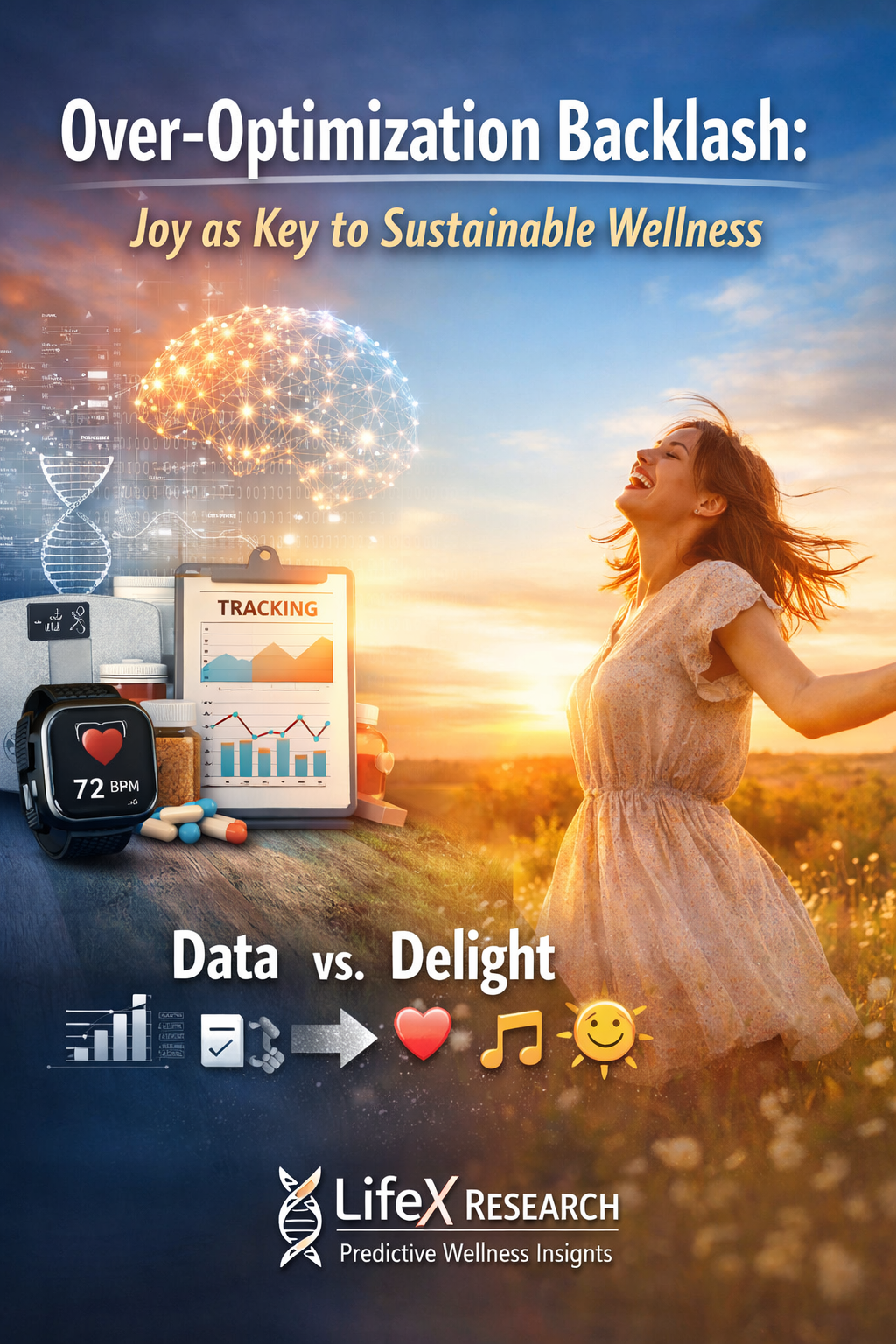
Recent insights from LifeX Research point to an emerging shift: sustainable health outcomes correlate not just with measurable behaviors, but with subjective experience – especially joy, ease, and emotional balance. This “over-optimization backlash” marks a turning point in how both individuals and organizations approach long-term wellness.
Atlanta, GA, February 25, 2026, LifeX Research In the past decade, wellness culture has been dominated by metrics. Steps counted, macros tracked, sleep scored, biomarkers optimized. The promise was simple: more data equals better health. But a growing body of predictive wellness research now suggests a paradox. When optimization becomes obsessive, well-being can actually decline.
For brands, researchers, and communicators, it also signals a new narrative opportunity. As audiences grow wary of biohacking extremes, the future of wellness messaging will center on human experience rather than performance metrics.
The Rise of Optimization Culture in Wellness
Optimization culture emerged from a rational place. Wearables, biometrics, and predictive analytics gave people unprecedented insight into their bodies. Health became quantifiable, trackable, and improvable.
Organizations like LifeX Research helped advance this shift by showing how real-world data can identify health risks early and enable prevention-focused care. Their predictive models analyze lifestyle patterns, stress indicators, sleep data, and behavioral context to anticipate health trends before symptoms appear.
This approach transformed wellness from reactive to predictive. Instead of waiting for disease, individuals could adjust habits early. The benefits were substantial: reduced chronic risk, lower absenteeism, and improved engagement in workplace health programs.
But as optimization tools proliferated, a subtle problem emerged. Health became something to manage constantly rather than live naturally.
When Metrics Replace Meaning
Over-optimization occurs when wellness behaviors shift from supportive to controlling. Data dashboards multiply, routines become rigid, and every activity serves a measurable outcome.
In this environment, people may achieve impressive biomarkers while feeling worse subjectively – more stressed, less present, and disconnected from intrinsic motivation. Emerging wellness commentary describes this as treating the body like a project rather than an experience.
Predictive data from LifeX-style models helps explain why. Human health is not driven solely by physical inputs but by behavioral sustainability. Habits that generate positive emotional feedback – pleasure, satisfaction, enjoyment – are far more likely to persist.
In contrast, highly optimized but joyless routines often degrade adherence over time. The result is oscillation: strict compliance followed by burnout or abandonment. From a predictive standpoint, that instability raises long-term health risk despite short-term gains.
Predictive Wellness Data Reveals the Joy Factor
One of the most important insights from predictive health research is that context matters as much as metrics. LifeX emphasizes metadata – information about when and how behaviors occur – to interpret wellness patterns accurately.
For example, identical exercise intensity can produce different outcomes depending on enjoyment, stress level, or social environment. Likewise, nutrition changes that feel restrictive often fail long term, while those associated with pleasure show durable adherence.
Over time, predictive models detect these behavioral signatures. Patterns associated with positive experience correlate with stable health improvements. Patterns associated with pressure or deprivation correlate with regression.
This is the core of the over-optimization backlash: sustainable wellness depends on lived experience, not just measurable output.
From Biohacking to Human-Centered Health
The wellness industry is already shifting. Instead of peak-performance narratives, audiences increasingly seek balance, emotional safety, and embodied well-being.
Predictive research supports this transition. Data-driven prevention still matters, but the goal is no longer maximizing metrics at any cost. The goal is aligning behaviors with human psychology, so they endure naturally.
LifeX’s predictive framework reinforces this approach. By tracking real-world routines and environmental context, researchers can recommend realistic adjustments rather than extreme protocols.
In practice, this means small, enjoyable interventions – sleep improvements, manageable activity, stress-reducing habits – often outperform aggressive optimization strategies. Health becomes sustainable because it feels good, not because it is enforced.
Why the Backlash Matters for Brands and PR
The over-optimization backlash has implications beyond healthcare. It reshapes how wellness innovation should be communicated to the public.
Audiences are increasingly skeptical of extreme longevity claims, rigid protocols, or “perfect” routines. They respond more positively to messaging that emphasizes quality of life, emotional resilience, and realistic improvement.
For companies and research organizations, this creates a strategic communications opportunity. Positioning predictive wellness as supportive rather than prescriptive aligns with emerging consumer values.
This is where modern press release marketing and PR distribution play a critical role. Communicating nuanced research trends – like the joy factor in health sustainability – requires credible storytelling and targeted media reach. Platforms such as specialize in distributing thought-leadership narratives that connect scientific insight with public interest.
The Future of Sustainable Wellness
The predictive health era is not ending optimization; it is redefining it. Instead of maximizing every variable, sustainable wellness optimizes adherence, satisfaction, and behavioral stability.
In this model, joy is not a soft or subjective metric – it is a predictor. Behaviors associated with positive experience are statistically more likely to persist, making them powerful drivers of long-term health outcomes.
Organizations like LifeX Research illustrate how predictive analytics can incorporate this human dimension. By analyzing lifestyle context alongside biomarkers, they move wellness beyond numbers toward lived experience.
This approach aligns with a broader shift in healthcare: from treating disease to cultivating durable well-being. Preventive systems succeed when people actually want to follow them.
Communicating the New Wellness Narrative
For communicators, marketers, and PR professionals, the over-optimization backlash offers a compelling story framework.
The narrative arc is clear: data once promised perfect health through control, but predictive research now shows that sustainable wellness depends on enjoyment and emotional alignment. The future is not less science – it is smarter science integrated with human psychology.
Effective PR distribution can amplify this message across health, lifestyle, and business media. Thought-leadership press releases positioned around predictive wellness trends resonate strongly with audiences seeking realistic, humane approaches to health.
By combining research credibility with relatable storytelling, organizations can lead the conversation about what wellness truly means in the data era.
Joy as the Ultimate Predictive Metric
The central insight of the over-optimization backlash is deceptively simple: people sustain what they enjoy. Predictive data confirms what intuition has long suggested – health behaviors anchored in pleasure and meaning endure, while those driven by pressure fade.
LifeX Research’s predictive models demonstrate how wellness evolves when data respects human experience. The goal is not perfection but persistence. Not control but coherence.
In the end, sustainable wellness is less about optimizing life and more about living it well. And increasingly, the data agrees.
For those looking to enhance their practice’s effectiveness, exploring LifeX Research’s offerings is a vital step forward. The future of healthcare lies in intelligent data-driven decision-making – make sure you’re part of that evolution by visiting https://lifexresearch.com/ today.
Explore how you can transform your approach to population health analytics and ultimately elevate the standard of care for your patients.
For more information, visit: https://lifexresearch.com/
Media Contact: LifeX Research Corp.
Attn: Media Relations
Atlanta, GA
support@lifexresearch.com